Caudal wedge ostectomy has not been investigated for overriding or impinging spinous processes (SPs).
To establish the feasibility of caudal wedge ostectomy and compare measures of surgical trauma and error between hypothetical caudal and cranial wedge ostectomies on SPs of different inclinations.
Experimental, method comparison study.
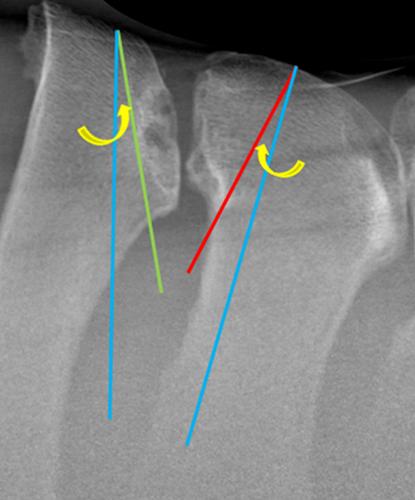
Computed tomography and caudal wedge ostectomy surgery were performed on four cadavers. Observations, technical difficulties, and surgical errors were recorded. Radiographs from 67 horses with overriding/impinging SPs were reviewed. Hypothetical ‘ideal’ caudal and cranial wedge ostectomies, and ‘error’ ostectomies 12° from ideal, were drawn at sites of impingement. Ostectomy area/SP width, ostectomy length/SP width, absolute difference of exit angles (angle ostectomy exits the SP) from 90°, and number of error ostectomies failing to exit the SP (never-ending-cuts [NEC]) were calculated. Continuous variables were compared between techniques in caudally and cranially inclined SP groups using Wilcoxon signed-rank tests. Proportions of NEC were compared using McNemar's tests.
No surgical errors were recorded with caudal wedge ostectomy. Median ostectomy area/SP width was lower for caudal versus cranial wedge ostectomy in caudally (14.32, interquartile-range [IQR] 9.72–20.34 vs. 25.57, IQR 17.74–33.06; p < 0.001) and cranially inclined SP groups (11.78, IQR 7.98–17.19 vs. 19.62, IQR 13.65–28.68; p < 0.001). Median difference in exit angles from 90° was smaller for caudal versus cranial wedge ostectomies in caudally (34.77°, IQR 26.85°–45.91° vs. 67.54°, IQR 58.13°–74.55°; p < 0.001) and cranially inclined SP groups (49.14°, IQR 35.61°–59.33° vs. 62.84°, IQR 55.34°–70.61°; p < 0.001). The proportion of NEC was lower for caudal versus cranial wedge ostectomy in caudally (37.6%, 95% confidence interval [CI] 29.4%–45.8%; n = 50/133 vs. 96.2%, 95% CI 93.0%–99.5%; n = 128/133; p < 0.001), but not in cranially inclined SP groups (76.8%, 95% CI 70.9%–82.7%; n = 152/198 vs. 84.3%, 95% CI 79.3%–89.4%, n = 167/198; p = 0.06).
Potential bias drawing ‘ideal’ ostectomy.
Experimentally, caudal wedge ostectomy was feasible, removed less bone, and resulted in fewer NEC in caudally inclined SPs. Further investigation of the technique is warranted.





 京公网安备 11010802042870号
京ICP备2023020795号-1
京公网安备 11010802042870号
京ICP备2023020795号-1

 分享
分享
 求助内容:
求助内容: 应助结果提醒方式:
 扫码关注我们
