Çisem Yıldız, Batuhan Küçükali, Merve Kutlar, Nuran Belder, Nihal Karaçayır, Büşra Acun, Pelin Esmeray Şenol, Emine Nur Sunar Yayla, Deniz Gezgin Yıldırım, Sevcan A Bakkaloğlu
{"title":"The impact of BMI on disease activity and growth outcomes in juvenile idiopathic arthritis.","authors":"Çisem Yıldız, Batuhan Küçükali, Merve Kutlar, Nuran Belder, Nihal Karaçayır, Büşra Acun, Pelin Esmeray Şenol, Emine Nur Sunar Yayla, Deniz Gezgin Yıldırım, Sevcan A Bakkaloğlu","doi":"10.1007/s00431-025-06084-x","DOIUrl":null,"url":null,"abstract":"<p><p>Juvenile idiopathic arthritis (JIA) presents with diverse phenotypes and can lead to significant morbidity. Obesity, affecting 5 to 23% of JIA patients, may exacerbate disease activity and complicate management. This study evaluates the impact of body mass index (BMI) on disease activity and the influence of joint involvement on BMI in JIA patients. Between January 2012 and June 2024, 225 JIA patients were reviewed, with 173 ultimately included based on specific inclusion and exclusion criteria. Treatments followed the American College of Rheumatology (ACR) recommendations. Data on demographics, BMI, JADAS-27 scores, joint involvement, and laboratory parameters were analyzed, with statistical significance defined as p < 0.05. Among 173 JIA patients, significant increases in weight and height SDS were observed (p < 0.05). Obese patients at baseline had higher JADAS-27 scores at 6 months (p < 0.05). A positive correlation was found between initial JADAS-27 and final BMI SDS (r = 0.170, p < 0.05). Patients with hip involvement had lower BMI at diagnosis and at the first-year follow-up (p < 0.0001, p = 0.049), while knee involvement was linked to lower height SDS at the second year (p = 0.041).</p><p><strong>Conclusion: </strong>Our study revealed that baseline obesity is a significant risk factor for poorer disease control at the 6-month follow-up in JIA patients. We also observed that effective treatment led to improvements in growth, particularly in patients with hip involvement, who initially had lower BMI values. These findings underscore the importance of monitoring BMI in JIA patients to optimize disease management and long-term outcomes.</p><p><strong>What is known: </strong>• Overweight and obesity are prevalent in children with JIA, with reported rates ranging from 5 to 23% in various studies. • The relationship between BMI and disease activity in JIA remains controversial, with previous studies reporting conflicting results on whether BMI impacts disease remission or activity.</p><p><strong>What is new: </strong>• Baseline obesity in juvenile idiopathic arthritis (JIA) patients is associated with worse disease activity during follow-up, particularly evident at the 6-month visit. • Patients with hip involvement had significantly lower BMI values, indicating a potential correlation with more severe disease. • Improved linear growth was observed in JIA patients during follow-up, indicating that effective treatment positively impacts growth despite the chronic nature of the disease.</p>","PeriodicalId":11997,"journal":{"name":"European Journal of Pediatrics","volume":"184 4","pages":"259"},"PeriodicalIF":2.6000,"publicationDate":"2025-03-19","publicationTypes":"Journal Article","fieldsOfStudy":null,"isOpenAccess":false,"openAccessPdf":"https://www.ncbi.nlm.nih.gov/pmc/articles/PMC11923038/pdf/","citationCount":"0","resultStr":null,"platform":"Semanticscholar","paperid":null,"PeriodicalName":"European Journal of Pediatrics","FirstCategoryId":"3","ListUrlMain":"https://doi.org/10.1007/s00431-025-06084-x","RegionNum":3,"RegionCategory":"医学","ArticlePicture":[],"TitleCN":null,"AbstractTextCN":null,"PMCID":null,"EPubDate":"","PubModel":"","JCR":"Q1","JCRName":"PEDIATRICS","Score":null,"Total":0}
引用次数: 0
Abstract
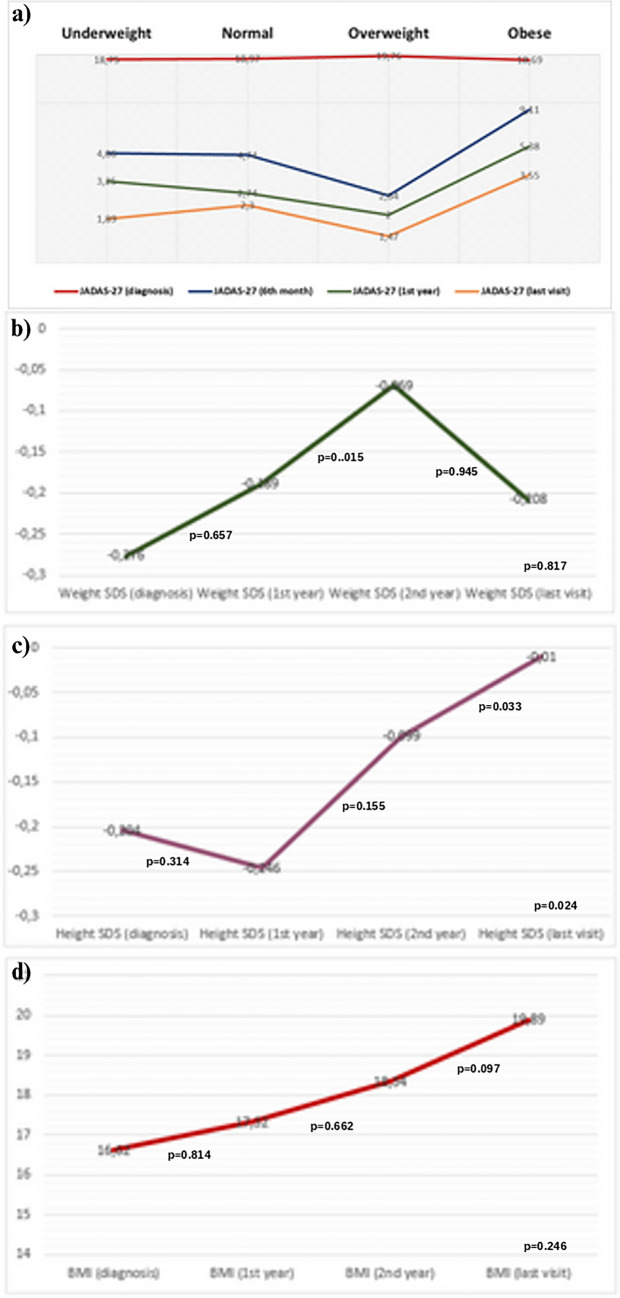
Juvenile idiopathic arthritis (JIA) presents with diverse phenotypes and can lead to significant morbidity. Obesity, affecting 5 to 23% of JIA patients, may exacerbate disease activity and complicate management. This study evaluates the impact of body mass index (BMI) on disease activity and the influence of joint involvement on BMI in JIA patients. Between January 2012 and June 2024, 225 JIA patients were reviewed, with 173 ultimately included based on specific inclusion and exclusion criteria. Treatments followed the American College of Rheumatology (ACR) recommendations. Data on demographics, BMI, JADAS-27 scores, joint involvement, and laboratory parameters were analyzed, with statistical significance defined as p < 0.05. Among 173 JIA patients, significant increases in weight and height SDS were observed (p < 0.05). Obese patients at baseline had higher JADAS-27 scores at 6 months (p < 0.05). A positive correlation was found between initial JADAS-27 and final BMI SDS (r = 0.170, p < 0.05). Patients with hip involvement had lower BMI at diagnosis and at the first-year follow-up (p < 0.0001, p = 0.049), while knee involvement was linked to lower height SDS at the second year (p = 0.041).
Conclusion: Our study revealed that baseline obesity is a significant risk factor for poorer disease control at the 6-month follow-up in JIA patients. We also observed that effective treatment led to improvements in growth, particularly in patients with hip involvement, who initially had lower BMI values. These findings underscore the importance of monitoring BMI in JIA patients to optimize disease management and long-term outcomes.
What is known: • Overweight and obesity are prevalent in children with JIA, with reported rates ranging from 5 to 23% in various studies. • The relationship between BMI and disease activity in JIA remains controversial, with previous studies reporting conflicting results on whether BMI impacts disease remission or activity.
What is new: • Baseline obesity in juvenile idiopathic arthritis (JIA) patients is associated with worse disease activity during follow-up, particularly evident at the 6-month visit. • Patients with hip involvement had significantly lower BMI values, indicating a potential correlation with more severe disease. • Improved linear growth was observed in JIA patients during follow-up, indicating that effective treatment positively impacts growth despite the chronic nature of the disease.
期刊介绍:
The European Journal of Pediatrics (EJPE) is a leading peer-reviewed medical journal which covers the entire field of pediatrics. The editors encourage authors to submit original articles, reviews, short communications, and correspondence on all relevant themes and topics.
EJPE is particularly committed to the publication of articles on important new clinical research that will have an immediate impact on clinical pediatric practice. The editorial office very much welcomes ideas for publications, whether individual articles or article series, that fit this goal and is always willing to address inquiries from authors regarding potential submissions. Invited review articles on clinical pediatrics that provide comprehensive coverage of a subject of importance are also regularly commissioned.
The short publication time reflects both the commitment of the editors and publishers and their passion for new developments in the field of pediatrics.
EJPE is active on social media (@EurJPediatrics) and we invite you to participate.
EJPE is the official journal of the European Academy of Paediatrics (EAP) and publishes guidelines and statements in cooperation with the EAP.





 京公网安备 11010802042870号
京ICP备2023020795号-1
京公网安备 11010802042870号
京ICP备2023020795号-1

 分享
分享
 求助内容:
求助内容: 应助结果提醒方式:
 扫码关注我们
