{"title":"Infusing Multi-Hop Medical Knowledge Into Smaller Language Models for Biomedical Question Answering","authors":"Jing Chen;Zhihua Wei;Wen Shen;Rui Shang","doi":"10.1109/JBHI.2025.3547444","DOIUrl":null,"url":null,"abstract":"MedQA-USMLE is a challenging biomedical question answering (BQA) task, as its questions typically involve multi-hop reasoning. To solve this task, BQA systems should possess not only extensive medical professional knowledge but also strong medical reasoning capabilities. While state-of-the-art larger language models, such as Med-PaLM 2, have overcome this challenge, smaller language models (SLMs) still struggle with it. To bridge this gap, we introduces a multi-hop medical knowledge infusion (MHMKI) procedure to endow SLMs with medical reasoning capabilities. Specifically, we categorize MedQA-USMLE questions into distinct reasoning types, then tailor pre-training instances for each type of questions using the semi-structured information and hyperlinks of Wikipedia articles. To enable SLMs to efficiently capture the multi-hop knowledge contained in these instances, we design a reasoning chain masked language model to further pre-train BERT models. Moreover, we convert the pre-training instances into a composite question answering dataset for intermediate fine-tuning of GPT models. We evaluate MHMKI on six SLMs across five datasets spanning three BQA tasks. The results demonstrate that MHMKI consistently improves SLMs' performance, particularly on tasks requiring substantial medical reasoning. For instance, the accuracy of MedQA-USMLE shows a significant increase of 5.3% on average.","PeriodicalId":13073,"journal":{"name":"IEEE Journal of Biomedical and Health Informatics","volume":"29 7","pages":"5317-5328"},"PeriodicalIF":6.8000,"publicationDate":"2025-03-19","publicationTypes":"Journal Article","fieldsOfStudy":null,"isOpenAccess":false,"openAccessPdf":"","citationCount":"0","resultStr":null,"platform":"Semanticscholar","paperid":null,"PeriodicalName":"IEEE Journal of Biomedical and Health Informatics","FirstCategoryId":"5","ListUrlMain":"https://ieeexplore.ieee.org/document/10932873/","RegionNum":2,"RegionCategory":"医学","ArticlePicture":[],"TitleCN":null,"AbstractTextCN":null,"PMCID":null,"EPubDate":"","PubModel":"","JCR":"Q1","JCRName":"COMPUTER SCIENCE, INFORMATION SYSTEMS","Score":null,"Total":0}
引用次数: 0
Abstract
MedQA-USMLE is a challenging biomedical question answering (BQA) task, as its questions typically involve multi-hop reasoning. To solve this task, BQA systems should possess not only extensive medical professional knowledge but also strong medical reasoning capabilities. While state-of-the-art larger language models, such as Med-PaLM 2, have overcome this challenge, smaller language models (SLMs) still struggle with it. To bridge this gap, we introduces a multi-hop medical knowledge infusion (MHMKI) procedure to endow SLMs with medical reasoning capabilities. Specifically, we categorize MedQA-USMLE questions into distinct reasoning types, then tailor pre-training instances for each type of questions using the semi-structured information and hyperlinks of Wikipedia articles. To enable SLMs to efficiently capture the multi-hop knowledge contained in these instances, we design a reasoning chain masked language model to further pre-train BERT models. Moreover, we convert the pre-training instances into a composite question answering dataset for intermediate fine-tuning of GPT models. We evaluate MHMKI on six SLMs across five datasets spanning three BQA tasks. The results demonstrate that MHMKI consistently improves SLMs' performance, particularly on tasks requiring substantial medical reasoning. For instance, the accuracy of MedQA-USMLE shows a significant increase of 5.3% on average.
期刊介绍:
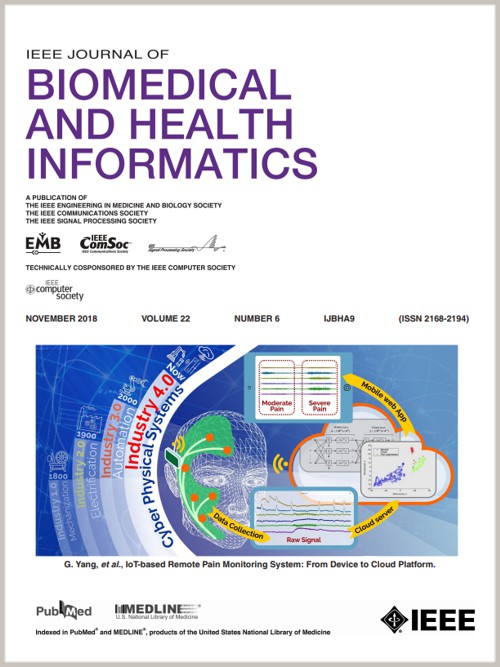
IEEE Journal of Biomedical and Health Informatics publishes original papers presenting recent advances where information and communication technologies intersect with health, healthcare, life sciences, and biomedicine. Topics include acquisition, transmission, storage, retrieval, management, and analysis of biomedical and health information. The journal covers applications of information technologies in healthcare, patient monitoring, preventive care, early disease diagnosis, therapy discovery, and personalized treatment protocols. It explores electronic medical and health records, clinical information systems, decision support systems, medical and biological imaging informatics, wearable systems, body area/sensor networks, and more. Integration-related topics like interoperability, evidence-based medicine, and secure patient data are also addressed.



 京公网安备 11010802042870号
京ICP备2023020795号-1
京公网安备 11010802042870号
京ICP备2023020795号-1

 分享
分享
 求助内容:
求助内容: 应助结果提醒方式:
 扫码关注我们
