Diana Sousa-Guedes , Neftalí Sillero , Mara Abu-Raya , Adolfo Marco , Filipa Bessa
{"title":"Mapping marine debris hotspots on Boa Vista Island, Cabo Verde","authors":"Diana Sousa-Guedes , Neftalí Sillero , Mara Abu-Raya , Adolfo Marco , Filipa Bessa","doi":"10.1016/j.marpolbul.2025.117823","DOIUrl":null,"url":null,"abstract":"<div><div>Coastal ecosystems are under increasing threat, with the accumulation of marine debris—particularly plastics—posing significant ecological risks. Oceanic islands are especially vulnerable due to ocean currents depositing marine debris on their exposed shores. This study presents the first assessment of marine debris accumulation on sandy beaches of Boa Vista Island, Cabo Verde. Using a combination of drone-based aerial imagery and sand sampling, we quantified micro-, meso-, and macro-debris densities across 29 beaches. North- and east-facing beaches of the island showed the highest accumulation of marine debris (>85 % plastics), driven by ocean currents. Mean drone-based densities varied between 5 and 2371 macro-debris items per 100 m of beach length, totalling 23,085 items. As for sand samples, mean densities ranged from 0 to 1639 items/m<sup>2</sup>, totalling 4272 large microplastics, 1221 mesoplastics and 350 macroplastics. The easternmost beach, Ponta de Roque, alone accounted for 31 % of the total debris recorded across all locations, with sand samples averaging 1639 items/m<sup>2</sup> (1453 microplastics larger than 1 mm), and drone-based surveys averaging 68 macro-debris items/100 m<sup>2</sup>. Fishing-related items comprised ∼24 % of drone-surveyed debris, suggesting input from the Northwest African coast. Plastic fragments predominated, with significant correlations between drone-surveyed macro-plastics and sand-sampled large microplastic densities. Drone surveys effectively identified marine debris hotspots, aligning with ground-based data. This study provides important baseline data for long-term monitoring in the archipelago and offers a transferable methodology for assessing plastic pollution in other island systems.</div></div>","PeriodicalId":18215,"journal":{"name":"Marine pollution bulletin","volume":"214 ","pages":"Article 117823"},"PeriodicalIF":4.9000,"publicationDate":"2025-03-18","publicationTypes":"Journal Article","fieldsOfStudy":null,"isOpenAccess":false,"openAccessPdf":"","citationCount":"0","resultStr":null,"platform":"Semanticscholar","paperid":null,"PeriodicalName":"Marine pollution bulletin","FirstCategoryId":"93","ListUrlMain":"https://www.sciencedirect.com/science/article/pii/S0025326X2500298X","RegionNum":3,"RegionCategory":"环境科学与生态学","ArticlePicture":[],"TitleCN":null,"AbstractTextCN":null,"PMCID":null,"EPubDate":"","PubModel":"","JCR":"Q1","JCRName":"ENVIRONMENTAL SCIENCES","Score":null,"Total":0}
引用次数: 0
Abstract
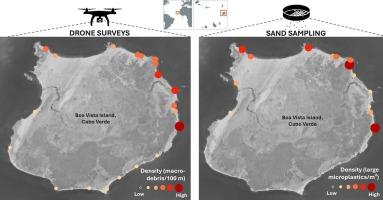
Coastal ecosystems are under increasing threat, with the accumulation of marine debris—particularly plastics—posing significant ecological risks. Oceanic islands are especially vulnerable due to ocean currents depositing marine debris on their exposed shores. This study presents the first assessment of marine debris accumulation on sandy beaches of Boa Vista Island, Cabo Verde. Using a combination of drone-based aerial imagery and sand sampling, we quantified micro-, meso-, and macro-debris densities across 29 beaches. North- and east-facing beaches of the island showed the highest accumulation of marine debris (>85 % plastics), driven by ocean currents. Mean drone-based densities varied between 5 and 2371 macro-debris items per 100 m of beach length, totalling 23,085 items. As for sand samples, mean densities ranged from 0 to 1639 items/m2, totalling 4272 large microplastics, 1221 mesoplastics and 350 macroplastics. The easternmost beach, Ponta de Roque, alone accounted for 31 % of the total debris recorded across all locations, with sand samples averaging 1639 items/m2 (1453 microplastics larger than 1 mm), and drone-based surveys averaging 68 macro-debris items/100 m2. Fishing-related items comprised ∼24 % of drone-surveyed debris, suggesting input from the Northwest African coast. Plastic fragments predominated, with significant correlations between drone-surveyed macro-plastics and sand-sampled large microplastic densities. Drone surveys effectively identified marine debris hotspots, aligning with ground-based data. This study provides important baseline data for long-term monitoring in the archipelago and offers a transferable methodology for assessing plastic pollution in other island systems.
沿海生态系统正面临越来越大的威胁,海洋垃圾——尤其是塑料——的积累构成了重大的生态风险。海洋岛屿由于洋流在其裸露的海岸上沉积海洋垃圾而特别脆弱。本研究首次对佛得角博阿维斯塔岛沙滩上的海洋垃圾堆积进行了评估。通过结合无人机航拍图像和沙子采样,我们量化了29个海滩的微观、中观和宏观碎片密度。在洋流的推动下,岛上朝北和朝东的海滩堆积了最多的海洋垃圾(约85%是塑料)。基于无人机的平均密度在每100米海滩长度5到2371个大型碎片之间变化,总计23,085个。砂样平均密度为0 ~ 1639个/m2,其中大微塑料4272个,中微塑料1221个,宏观塑料350个。仅最东部的Ponta de Roque海滩就占所有地点记录的总碎片的31%,平均每平方米有1639个沙子样本(1453个大于1毫米的微塑料),无人机调查平均每100平方米有68个宏观碎片。与捕鱼有关的物品占无人机调查碎片的24%,表明来自西北非洲海岸。塑料碎片占主导地位,无人机调查的宏观塑料和沙样大微塑料密度之间存在显著相关性。无人机调查有效地识别了海洋垃圾热点,与地面数据保持一致。这项研究为群岛的长期监测提供了重要的基线数据,并为评估其他岛屿系统的塑料污染提供了一种可转移的方法。
期刊介绍:
Marine Pollution Bulletin is concerned with the rational use of maritime and marine resources in estuaries, the seas and oceans, as well as with documenting marine pollution and introducing new forms of measurement and analysis. A wide range of topics are discussed as news, comment, reviews and research reports, not only on effluent disposal and pollution control, but also on the management, economic aspects and protection of the marine environment in general.



 京公网安备 11010802042870号
京ICP备2023020795号-1
京公网安备 11010802042870号
京ICP备2023020795号-1

 分享
分享
 求助内容:
求助内容: 应助结果提醒方式:
 扫码关注我们
