J. Arenas-Alatorre, S. Tehuacanero Cuapa, C. Magaña-Zavala, Cecilia Noguez
{"title":"The Development of an Alternative Methodology to Measure the Particle Size Allowed Passing Through Face Masks Using a Scanning Electron Microscopy","authors":"J. Arenas-Alatorre, S. Tehuacanero Cuapa, C. Magaña-Zavala, Cecilia Noguez","doi":"10.1002/jemt.24857","DOIUrl":null,"url":null,"abstract":"<div>\n \n <p>At the end of 2019, in the city of Wuhan, China, a new highly infectious coronavirus affecting the respiratory tract was announced. It was named SARS-Cov2, causing deaths in the population. In the face of this global health emergency, many medical and protective supplies were quickly depleted, and some others of dubious quality emerged, including face masks for medical and population use. Given this uncertainty, this working group developed a complementary methodology to the wind tunnel, a technique usually used to measure the efficiency of particle passage in certified masks. A gravity-feed airbrush gun operating at a pressure of 60 PSI was used for this purpose. Saline water at a concentration of 20% NaCl was used as the impact liquid on the face mask, and the deposition time was 1 s, emulating the time of sneezing or coughing. The particles that passed through the face masks were deposited in sample holders for scanning electron microscopy (SEM), where a 0.8 × 0.8 cm slide was placed on their surface and the particles covered with an Au film deposited by sputtering. The sizes of the NaCl particles that were allowed to pass through the face masks were evaluated using field-emission SEM (FSEM). It was found that at 0.5 cm between the surface of the face mask and the deposit surface, the distance between the mask and airbrush nozzle was 2.5 cm, and 1 s deposits, the particles allowed to pass through the K95 and KN95 masks were 85% and 88%, respectively, in the range from 0.2 to 1 to 0 μm, in both cases, the number of particles deposited per unit area was low, 0.1 particles/μm<sup>2</sup>. Based on this methodology, some face masks used daily by the population were evaluated, finding that commercial two-layer polypropylene masks allow NaCl particles larger than 5 μm to pass through, while in the commercial three-layer face mask the NaCl particle size was 2 μm in order.</p>\n </div>","PeriodicalId":18684,"journal":{"name":"Microscopy Research and Technique","volume":"88 8","pages":"2250-2258"},"PeriodicalIF":2.1000,"publicationDate":"2025-03-19","publicationTypes":"Journal Article","fieldsOfStudy":null,"isOpenAccess":false,"openAccessPdf":"","citationCount":"0","resultStr":null,"platform":"Semanticscholar","paperid":null,"PeriodicalName":"Microscopy Research and Technique","FirstCategoryId":"5","ListUrlMain":"https://analyticalsciencejournals.onlinelibrary.wiley.com/doi/10.1002/jemt.24857","RegionNum":3,"RegionCategory":"工程技术","ArticlePicture":[],"TitleCN":null,"AbstractTextCN":null,"PMCID":null,"EPubDate":"","PubModel":"","JCR":"Q2","JCRName":"ANATOMY & MORPHOLOGY","Score":null,"Total":0}
引用次数: 0
Abstract
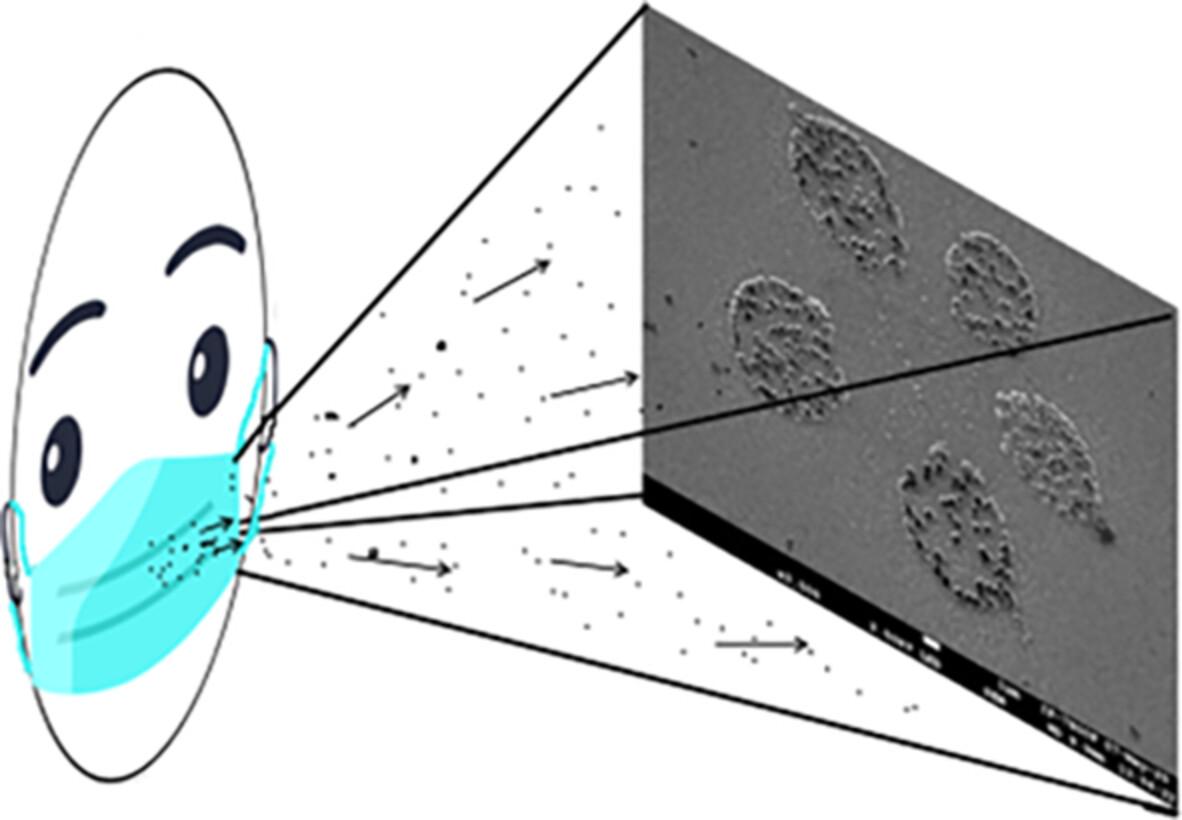
At the end of 2019, in the city of Wuhan, China, a new highly infectious coronavirus affecting the respiratory tract was announced. It was named SARS-Cov2, causing deaths in the population. In the face of this global health emergency, many medical and protective supplies were quickly depleted, and some others of dubious quality emerged, including face masks for medical and population use. Given this uncertainty, this working group developed a complementary methodology to the wind tunnel, a technique usually used to measure the efficiency of particle passage in certified masks. A gravity-feed airbrush gun operating at a pressure of 60 PSI was used for this purpose. Saline water at a concentration of 20% NaCl was used as the impact liquid on the face mask, and the deposition time was 1 s, emulating the time of sneezing or coughing. The particles that passed through the face masks were deposited in sample holders for scanning electron microscopy (SEM), where a 0.8 × 0.8 cm slide was placed on their surface and the particles covered with an Au film deposited by sputtering. The sizes of the NaCl particles that were allowed to pass through the face masks were evaluated using field-emission SEM (FSEM). It was found that at 0.5 cm between the surface of the face mask and the deposit surface, the distance between the mask and airbrush nozzle was 2.5 cm, and 1 s deposits, the particles allowed to pass through the K95 and KN95 masks were 85% and 88%, respectively, in the range from 0.2 to 1 to 0 μm, in both cases, the number of particles deposited per unit area was low, 0.1 particles/μm2. Based on this methodology, some face masks used daily by the population were evaluated, finding that commercial two-layer polypropylene masks allow NaCl particles larger than 5 μm to pass through, while in the commercial three-layer face mask the NaCl particle size was 2 μm in order.
期刊介绍:
Microscopy Research and Technique (MRT) publishes articles on all aspects of advanced microscopy original architecture and methodologies with applications in the biological, clinical, chemical, and materials sciences. Original basic and applied research as well as technical papers dealing with the various subsets of microscopy are encouraged. MRT is the right form for those developing new microscopy methods or using the microscope to answer key questions in basic and applied research.





 京公网安备 11010802042870号
京ICP备2023020795号-1
京公网安备 11010802042870号
京ICP备2023020795号-1

 分享
分享
 求助内容:
求助内容: 应助结果提醒方式:
 扫码关注我们
