{"title":"Changes in Trunk, but Not Limb, Lean Body Mass Contribute to Variability in Metabolic Adaptation Following Weight Loss.","authors":"C Martins, B A Gower, G R Hunter","doi":"10.1002/osp4.70054","DOIUrl":null,"url":null,"abstract":"<p><strong>Background: </strong>Metabolic adaptation (MA) in response to weight loss is highly variable. Several methodological issues are likely to contribute to the large inter-individual variability in MA, namely the lack of adjustment for changes in the composition of fat-free mass.</p><p><strong>Objective: </strong>The aim of this analysis was to investigate the contribution of changes in trunk versus limb lean body mass (LBM) to the variability in MA, at the level of resting metabolic rate (RMR).</p><p><strong>Methods: </strong>116 premenopausal women with overweight (body mass index (BMI): 28.2 ± 1.2 kg/m<sup>2</sup>; age: 34.4 ± 6.4 years) enrolled in a weight loss program. Body weight/composition (dual energy x-ray absorptiometry), RMR (indirect calorimetry) and insulin sensitivity (S<sub>I</sub>) (intravenous glucose tolerance test) were measured after 4 weeks of weight stability at baseline and after weight loss. Multiple linear regression was used to determine the contribution of changes in trunk versus limb LBM to MA variability, after adjusting for relevant confounders.</p><p><strong>Results: </strong>A large variation in MA (-206 to +233 kcal/day) was found after an average of 12.1 ± 2.4 kg weight loss. After adjusting for RMR at baseline and changes in S<sub>I</sub>, changes in trunk (but not limb) LBM were a significant contributor to MA variability.</p><p><strong>Conclusion: </strong>In premenopausal women with overweight and loss of trunk, but not limbs, LBM contributes to MA variability, suggesting that loss of organ mass might be more important than loss of skeletal mass in modulating the magnitude of MA. <b>Trial Registration:</b> ClinicalTrial.gov Identifier (JULIET study): NCT00067873, URL: https://clinicaltrials.gov/ct2/show/NCT0006787.</p>","PeriodicalId":19448,"journal":{"name":"Obesity Science & Practice","volume":"11 2","pages":"e70054"},"PeriodicalIF":1.9000,"publicationDate":"2025-03-19","publicationTypes":"Journal Article","fieldsOfStudy":null,"isOpenAccess":false,"openAccessPdf":"https://www.ncbi.nlm.nih.gov/pmc/articles/PMC11920807/pdf/","citationCount":"0","resultStr":null,"platform":"Semanticscholar","paperid":null,"PeriodicalName":"Obesity Science & Practice","FirstCategoryId":"1085","ListUrlMain":"https://doi.org/10.1002/osp4.70054","RegionNum":0,"RegionCategory":null,"ArticlePicture":[],"TitleCN":null,"AbstractTextCN":null,"PMCID":null,"EPubDate":"2025/4/1 0:00:00","PubModel":"eCollection","JCR":"Q3","JCRName":"ENDOCRINOLOGY & METABOLISM","Score":null,"Total":0}
引用次数: 0
Abstract
Background: Metabolic adaptation (MA) in response to weight loss is highly variable. Several methodological issues are likely to contribute to the large inter-individual variability in MA, namely the lack of adjustment for changes in the composition of fat-free mass.
Objective: The aim of this analysis was to investigate the contribution of changes in trunk versus limb lean body mass (LBM) to the variability in MA, at the level of resting metabolic rate (RMR).
Methods: 116 premenopausal women with overweight (body mass index (BMI): 28.2 ± 1.2 kg/m2; age: 34.4 ± 6.4 years) enrolled in a weight loss program. Body weight/composition (dual energy x-ray absorptiometry), RMR (indirect calorimetry) and insulin sensitivity (SI) (intravenous glucose tolerance test) were measured after 4 weeks of weight stability at baseline and after weight loss. Multiple linear regression was used to determine the contribution of changes in trunk versus limb LBM to MA variability, after adjusting for relevant confounders.
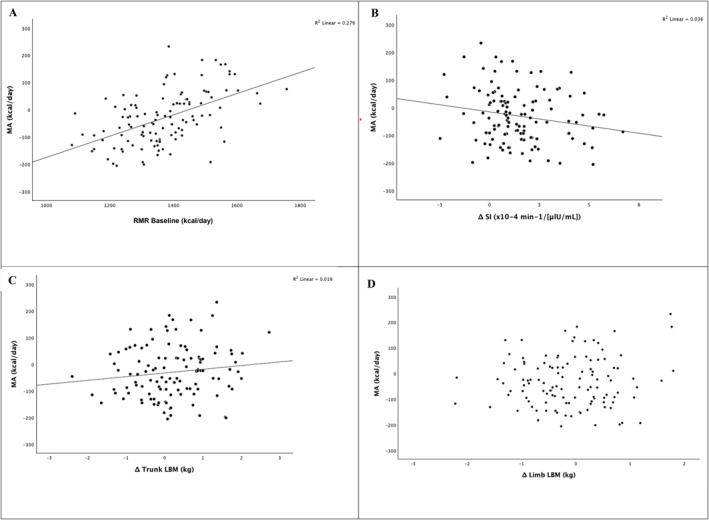
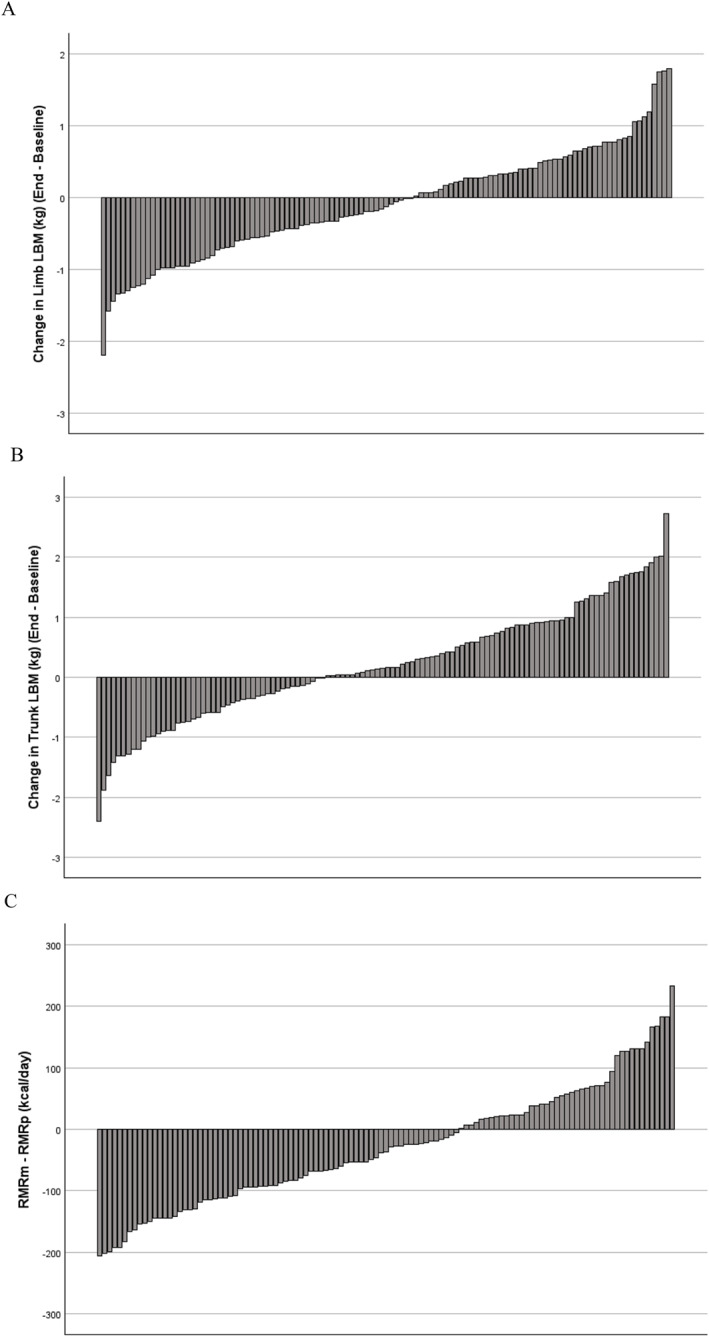
Results: A large variation in MA (-206 to +233 kcal/day) was found after an average of 12.1 ± 2.4 kg weight loss. After adjusting for RMR at baseline and changes in SI, changes in trunk (but not limb) LBM were a significant contributor to MA variability.
Conclusion: In premenopausal women with overweight and loss of trunk, but not limbs, LBM contributes to MA variability, suggesting that loss of organ mass might be more important than loss of skeletal mass in modulating the magnitude of MA. Trial Registration: ClinicalTrial.gov Identifier (JULIET study): NCT00067873, URL: https://clinicaltrials.gov/ct2/show/NCT0006787.





 京公网安备 11010802042870号
京ICP备2023020795号-1
京公网安备 11010802042870号
京ICP备2023020795号-1

 分享
分享
 求助内容:
求助内容: 应助结果提醒方式:
 扫码关注我们
