Thomas Gavin Carmichael, Alexander Rauscher, Ruth E. Grunau, Alexander Mark Weber
{"title":"The application of magnetic susceptibility separation for measuring cerebral oxygenation in preterm neonates","authors":"Thomas Gavin Carmichael, Alexander Rauscher, Ruth E. Grunau, Alexander Mark Weber","doi":"10.1038/s41390-025-03966-6","DOIUrl":null,"url":null,"abstract":"Quantitative susceptibility mapping (QSM), a magnetic resonance imaging (MRI) modality sensitive to deoxyhemoglobin, is a promising method for measuring cerebral oxygenation in human neonates. Paramagnetic sources, like deoxyhemoglobin, however, can be obscured by diamagnetic sources such as water and myelin. This study evaluated whether QSM images, or isolated paramagnetic components, are more accurate for measuring oxygenation of cerebral veins of preterm neonates, and explored oxygenation differences between the major cerebral veins. 19 preterm neonates were scanned on at term equivalent age on a 3T MRI using a multi-echo susceptibility-weighted imaging sequence. Susceptibility values were calculated from QSM images to determine oxygen saturation (SvO2) in the superior sagittal sinus (SSS) and central cerebral veins (CCV). The paramagnetic components of QSM images were isolated, and SvO2 values were recalculated. The mean SvO2 values from QSM were 72.4% (SD, 3.4%) for the SSS and 68.7% (SD, 3.5%) for the CCV. SvO2 values for paramagnetic components were 58.1% (SD, 7.3%) for the SSS and 57.7% (SD, 7.0%) for the CCV. While paramagnetic component decomposition yielded SSS values closer to those found in the literature, it increased variability. No significant oxygenation differences were found between the SSS and CCV, contrasting with prior studies.","PeriodicalId":19829,"journal":{"name":"Pediatric Research","volume":"98 2","pages":"715-722"},"PeriodicalIF":3.1000,"publicationDate":"2025-03-19","publicationTypes":"Journal Article","fieldsOfStudy":null,"isOpenAccess":false,"openAccessPdf":"https://www.nature.comhttps://www.nature.com/articles/s41390-025-03966-6.pdf","citationCount":"0","resultStr":null,"platform":"Semanticscholar","paperid":null,"PeriodicalName":"Pediatric Research","FirstCategoryId":"3","ListUrlMain":"https://www.nature.com/articles/s41390-025-03966-6","RegionNum":3,"RegionCategory":"医学","ArticlePicture":[],"TitleCN":null,"AbstractTextCN":null,"PMCID":null,"EPubDate":"","PubModel":"","JCR":"Q1","JCRName":"PEDIATRICS","Score":null,"Total":0}
引用次数: 0
Abstract
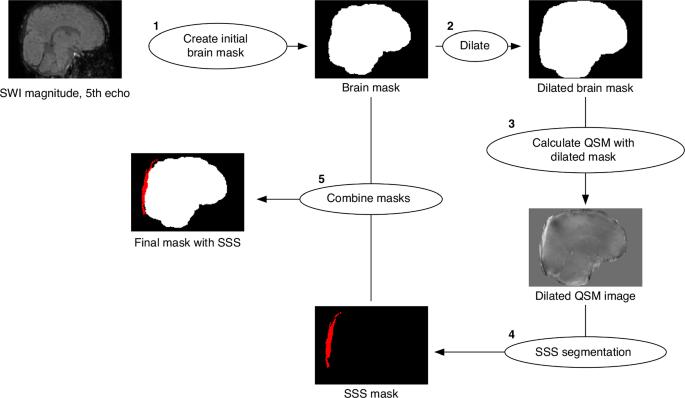
Quantitative susceptibility mapping (QSM), a magnetic resonance imaging (MRI) modality sensitive to deoxyhemoglobin, is a promising method for measuring cerebral oxygenation in human neonates. Paramagnetic sources, like deoxyhemoglobin, however, can be obscured by diamagnetic sources such as water and myelin. This study evaluated whether QSM images, or isolated paramagnetic components, are more accurate for measuring oxygenation of cerebral veins of preterm neonates, and explored oxygenation differences between the major cerebral veins. 19 preterm neonates were scanned on at term equivalent age on a 3T MRI using a multi-echo susceptibility-weighted imaging sequence. Susceptibility values were calculated from QSM images to determine oxygen saturation (SvO2) in the superior sagittal sinus (SSS) and central cerebral veins (CCV). The paramagnetic components of QSM images were isolated, and SvO2 values were recalculated. The mean SvO2 values from QSM were 72.4% (SD, 3.4%) for the SSS and 68.7% (SD, 3.5%) for the CCV. SvO2 values for paramagnetic components were 58.1% (SD, 7.3%) for the SSS and 57.7% (SD, 7.0%) for the CCV. While paramagnetic component decomposition yielded SSS values closer to those found in the literature, it increased variability. No significant oxygenation differences were found between the SSS and CCV, contrasting with prior studies.
期刊介绍:
Pediatric Research publishes original papers, invited reviews, and commentaries on the etiologies of children''s diseases and
disorders of development, extending from molecular biology to epidemiology. Use of model organisms and in vitro techniques
relevant to developmental biology and medicine are acceptable, as are translational human studies



 京公网安备 11010802042870号
京ICP备2023020795号-1
京公网安备 11010802042870号
京ICP备2023020795号-1

 分享
分享
 求助内容:
求助内容: 应助结果提醒方式:
 扫码关注我们
