{"title":"Selective serotonin reuptake inhibitors in the treatment of major depressive disorder after brain trauma: Systematic review and meta-analysis.","authors":"Ren-Xian Gao, Xiao-Na Zhang, Peng Zhu","doi":"10.5498/wjp.v15.i3.100103","DOIUrl":null,"url":null,"abstract":"<p><strong>Background: </strong>Traumatic brain injury (TBI) poses a considerable risk to human health. After TBI, individuals are susceptible to a range of psychiatric disorders, with depression being a primary complication. Selective serotonin reuptake inhibitors (SSRIs) are frequently used in the treatment of depression; however, their efficacy in addressing major depressive disorder (MDD) in adults following TBI remains uncertain.</p><p><strong>Aim: </strong>To investigate the efficacy of SSRIs in the treatment of MDD after TBI.</p><p><strong>Methods: </strong>A comprehensive search across multiple databases was conducted following the guidelines outlined in the Preferred Reporting Items for Systematic Reviews and Meta-Analyses statement, encompassing studies published until May 2024. This review focused on studies that examined the efficacy of SSRIs in the treatment of MDD following TBI. Studies were assessed based sample size, treatment duration, treatment methodologies, severity of brain injury, assessment techniques, and drug response. A random-effects model was used to derive the summary effect size.</p><p><strong>Results: </strong>Eight studies compared the reduction in depression scores in patients with MDD after TBI and SSRI treatment. The eight studies did not exhibit heterogeneity (<i>I</i> <sup>2</sup> = 38%). The depression score for MDD after TBI in the SSRI group decreased more than that in the control group [odds ratio (OR) 1.68, 95%CI: 1.09-2.58, <i>P</i> = 0.02]. The adverse reactions after treatment included diarrhea, dizziness, dry mouth, nausea, or vomiting. There was no difference in the incidence of adverse reactions after treatment between the two groups (OR 1.16, 95%CI: 0.78-1.73, <i>P</i> = 0.46]. These studies did not show significant heterogeneity (<i>I</i> <sup>2</sup> = 44%).</p><p><strong>Conclusion: </strong>SSRIs may be effective in treating patients with MDD after TBI. Adequately powered, randomized, controlled trials are required to confirm these findings.</p>","PeriodicalId":23896,"journal":{"name":"World Journal of Psychiatry","volume":"15 3","pages":"100103"},"PeriodicalIF":3.4000,"publicationDate":"2025-03-19","publicationTypes":"Journal Article","fieldsOfStudy":null,"isOpenAccess":false,"openAccessPdf":"https://www.ncbi.nlm.nih.gov/pmc/articles/PMC11886310/pdf/","citationCount":"0","resultStr":null,"platform":"Semanticscholar","paperid":null,"PeriodicalName":"World Journal of Psychiatry","FirstCategoryId":"3","ListUrlMain":"https://doi.org/10.5498/wjp.v15.i3.100103","RegionNum":4,"RegionCategory":"医学","ArticlePicture":[],"TitleCN":null,"AbstractTextCN":null,"PMCID":null,"EPubDate":"","PubModel":"","JCR":"Q1","JCRName":"PSYCHIATRY","Score":null,"Total":0}
引用次数: 0
Abstract
Background: Traumatic brain injury (TBI) poses a considerable risk to human health. After TBI, individuals are susceptible to a range of psychiatric disorders, with depression being a primary complication. Selective serotonin reuptake inhibitors (SSRIs) are frequently used in the treatment of depression; however, their efficacy in addressing major depressive disorder (MDD) in adults following TBI remains uncertain.
Aim: To investigate the efficacy of SSRIs in the treatment of MDD after TBI.
Methods: A comprehensive search across multiple databases was conducted following the guidelines outlined in the Preferred Reporting Items for Systematic Reviews and Meta-Analyses statement, encompassing studies published until May 2024. This review focused on studies that examined the efficacy of SSRIs in the treatment of MDD following TBI. Studies were assessed based sample size, treatment duration, treatment methodologies, severity of brain injury, assessment techniques, and drug response. A random-effects model was used to derive the summary effect size.
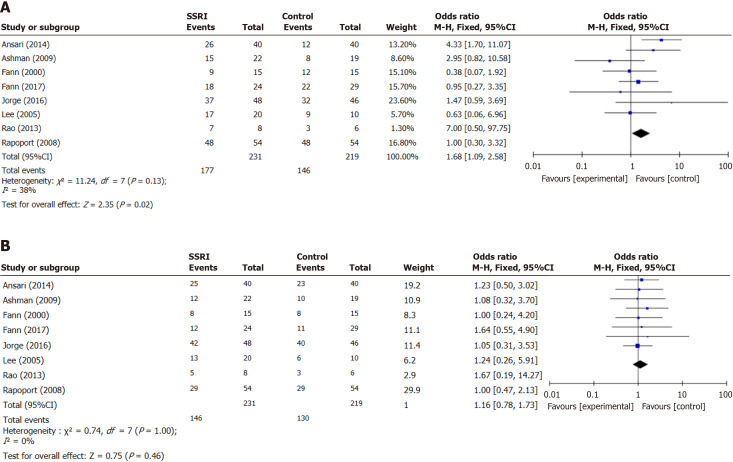
Results: Eight studies compared the reduction in depression scores in patients with MDD after TBI and SSRI treatment. The eight studies did not exhibit heterogeneity (I2 = 38%). The depression score for MDD after TBI in the SSRI group decreased more than that in the control group [odds ratio (OR) 1.68, 95%CI: 1.09-2.58, P = 0.02]. The adverse reactions after treatment included diarrhea, dizziness, dry mouth, nausea, or vomiting. There was no difference in the incidence of adverse reactions after treatment between the two groups (OR 1.16, 95%CI: 0.78-1.73, P = 0.46]. These studies did not show significant heterogeneity (I2 = 44%).
Conclusion: SSRIs may be effective in treating patients with MDD after TBI. Adequately powered, randomized, controlled trials are required to confirm these findings.
期刊介绍:
The World Journal of Psychiatry (WJP) is a high-quality, peer reviewed, open-access journal. The primary task of WJP is to rapidly publish high-quality original articles, reviews, editorials, and case reports in the field of psychiatry. In order to promote productive academic communication, the peer review process for the WJP is transparent; to this end, all published manuscripts are accompanied by the anonymized reviewers’ comments as well as the authors’ responses. The primary aims of the WJP are to improve diagnostic, therapeutic and preventive modalities and the skills of clinicians and to guide clinical practice in psychiatry.



 京公网安备 11010802042870号
京ICP备2023020795号-1
京公网安备 11010802042870号
京ICP备2023020795号-1

 分享
分享
 求助内容:
求助内容: 应助结果提醒方式:
 扫码关注我们
