Jukka Mäenpää, Isobel Anderson, Caroline A Owen, Ulrika Emerath, Rod Hughes, Stefan R Sultana, Marita Olsson
{"title":"Hyperkalemia Is an Underestimated Risk Factor in COPD.","authors":"Jukka Mäenpää, Isobel Anderson, Caroline A Owen, Ulrika Emerath, Rod Hughes, Stefan R Sultana, Marita Olsson","doi":"10.2147/COPD.S490620","DOIUrl":null,"url":null,"abstract":"<p><strong>Background: </strong>Hyperkalemia increases mortality in various patient populations. The risk of hyperkalemia in COPD patients is poorly recognized. Hyperkalemia may increase cardiovascular mortality during and soon after COPD exacerbations.</p><p><strong>Patients and methods: </strong>A cohort based on two clinical trials comprising 7968 patients with moderate-to-very severe COPD was analysed retrospectively for associations between hyperkalemia and common comorbidities such as chronic kidney disease, diabetes mellitus (DM), or renin-angiotensin-aldosterone system inhibitor use.</p><p><strong>Results: </strong>Overall, 6.4% of 7968 patients had hyperkalemia (5.3% Global Initiative for Chronic Obstructive Lung Disease (GOLD) stage 2, 6.8% GOLD 3, and 8.0% GOLD 4). COPD severity was associated with significantly higher hyperkalemia risk in GOLD 3 (odds ratio [OR]=1.28, 95% CI 1.04-1.58) and GOLD 4 (OR=1.64, 95% CI 1.19-2.22) versus GOLD 2 patients. Hyperkalemia cases increased with decreasing renal function. Patients with moderate-to-severe renal impairment had >2-fold increased hyperkalemia risk versus those with normal renal function (OR=2.29, 95% CI 1.71-3.04). DM was associated with increased hyperkalemia risk (OR=1.28, 95% CI 1.02-1.59). Angiotensin-converting-enzyme inhibitor (ACEi) use increased hyperkalemia risk (OR=1.25, 95% CI 1.02-1.53). Unexpectedly, the association between hyperkalemia and renin-angiotensin-aldosterone system inhibitor use was statistically significant only in the normal renal function group (OR=1.63, 95% CI 1.13-2.34).</p><p><strong>Conclusion: </strong>Hyperkalemia risk is higher in severe and very severe COPD patients than patients with moderate COPD. Hyperkalemia was also associated with decreasing kidney function, DM, and ACEi use. Serum potassium levels should be monitored regularly in patients with COPD, particularly those with GOLD-3 and 4.</p>","PeriodicalId":48818,"journal":{"name":"International Journal of Chronic Obstructive Pulmonary Disease","volume":"20 ","pages":"723-734"},"PeriodicalIF":3.1000,"publicationDate":"2025-03-15","publicationTypes":"Journal Article","fieldsOfStudy":null,"isOpenAccess":false,"openAccessPdf":"https://www.ncbi.nlm.nih.gov/pmc/articles/PMC11921801/pdf/","citationCount":"0","resultStr":null,"platform":"Semanticscholar","paperid":null,"PeriodicalName":"International Journal of Chronic Obstructive Pulmonary Disease","FirstCategoryId":"3","ListUrlMain":"https://doi.org/10.2147/COPD.S490620","RegionNum":3,"RegionCategory":"医学","ArticlePicture":[],"TitleCN":null,"AbstractTextCN":null,"PMCID":null,"EPubDate":"2025/1/1 0:00:00","PubModel":"eCollection","JCR":"Q2","JCRName":"RESPIRATORY SYSTEM","Score":null,"Total":0}
引用次数: 0
Abstract
Background: Hyperkalemia increases mortality in various patient populations. The risk of hyperkalemia in COPD patients is poorly recognized. Hyperkalemia may increase cardiovascular mortality during and soon after COPD exacerbations.
Patients and methods: A cohort based on two clinical trials comprising 7968 patients with moderate-to-very severe COPD was analysed retrospectively for associations between hyperkalemia and common comorbidities such as chronic kidney disease, diabetes mellitus (DM), or renin-angiotensin-aldosterone system inhibitor use.
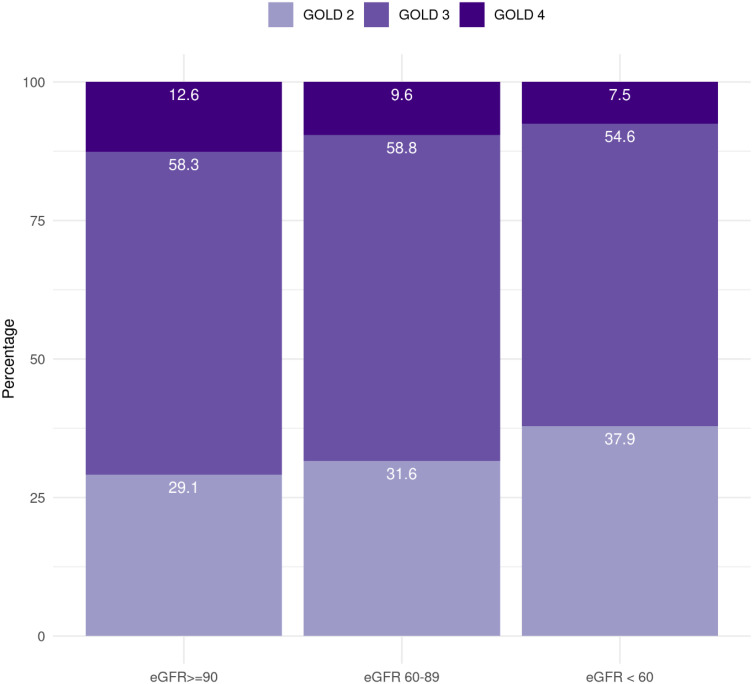
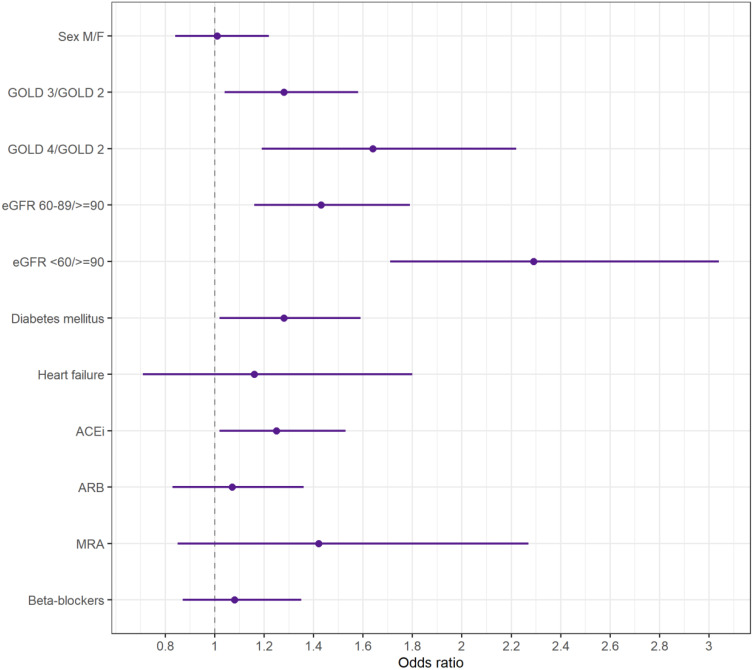
Results: Overall, 6.4% of 7968 patients had hyperkalemia (5.3% Global Initiative for Chronic Obstructive Lung Disease (GOLD) stage 2, 6.8% GOLD 3, and 8.0% GOLD 4). COPD severity was associated with significantly higher hyperkalemia risk in GOLD 3 (odds ratio [OR]=1.28, 95% CI 1.04-1.58) and GOLD 4 (OR=1.64, 95% CI 1.19-2.22) versus GOLD 2 patients. Hyperkalemia cases increased with decreasing renal function. Patients with moderate-to-severe renal impairment had >2-fold increased hyperkalemia risk versus those with normal renal function (OR=2.29, 95% CI 1.71-3.04). DM was associated with increased hyperkalemia risk (OR=1.28, 95% CI 1.02-1.59). Angiotensin-converting-enzyme inhibitor (ACEi) use increased hyperkalemia risk (OR=1.25, 95% CI 1.02-1.53). Unexpectedly, the association between hyperkalemia and renin-angiotensin-aldosterone system inhibitor use was statistically significant only in the normal renal function group (OR=1.63, 95% CI 1.13-2.34).
Conclusion: Hyperkalemia risk is higher in severe and very severe COPD patients than patients with moderate COPD. Hyperkalemia was also associated with decreasing kidney function, DM, and ACEi use. Serum potassium levels should be monitored regularly in patients with COPD, particularly those with GOLD-3 and 4.
背景:高钾血症增加了各种患者群体的死亡率。慢性阻塞性肺病患者高钾血症的风险尚未得到充分认识。高钾血症可能增加慢性阻塞性肺病加重期间和加重后不久的心血管死亡率。患者和方法:回顾性分析了一项基于两项临床试验的队列,包括7968例中度至极重度COPD患者,以研究高钾血症与常见合并症(如慢性肾病、糖尿病(DM)或肾素-血管紧张素-醛固酮系统抑制剂的使用)之间的关系。结果:总体而言,7968名患者中有6.4%患有高钾血症(全球慢性阻塞性肺疾病计划(GOLD) 2期5.3%,GOLD 3期6.8%,GOLD 4期8.0%)。与GOLD 2患者相比,GOLD 3患者和GOLD 4患者COPD严重程度与高钾血症风险显著升高相关(优势比[OR]=1.28, 95% CI 1.04-1.58)和GOLD 4患者(OR=1.64, 95% CI 1.19-2.22)。高钾血症病例随肾功能下降而增加。中度至重度肾功能损害患者的高钾血症风险是肾功能正常患者的2倍(OR=2.29, 95% CI 1.71-3.04)。糖尿病与高钾血症风险增加相关(OR=1.28, 95% CI 1.02-1.59)。使用血管紧张素转换酶抑制剂(ACEi)会增加高钾血症的风险(OR=1.25, 95% CI 1.02-1.53)。出乎意料的是,高钾血症与肾素-血管紧张素-醛固酮系统抑制剂使用之间的关联仅在肾功能正常组有统计学意义(OR=1.63, 95% CI 1.13-2.34)。结论:重度和极重度COPD患者高钾血症风险高于中度COPD患者。高钾血症还与肾功能、糖尿病和ACEi的使用降低有关。COPD患者应定期监测血清钾水平,特别是GOLD-3和4患者。
期刊介绍:
An international, peer-reviewed journal of therapeutics and pharmacology focusing on concise rapid reporting of clinical studies and reviews in COPD. Special focus will be given to the pathophysiological processes underlying the disease, intervention programs, patient focused education, and self management protocols. This journal is directed at specialists and healthcare professionals




 京公网安备 11010802042870号
京ICP备2023020795号-1
京公网安备 11010802042870号
京ICP备2023020795号-1

 分享
分享
 求助内容:
求助内容: 应助结果提醒方式:
 扫码关注我们
