Consensus furin cleavage sites in the cuticular collagens DPY-17 and SQT-3 are required for Q neuroblast left-right asymmetric migration in Caenorhabditis elegans.
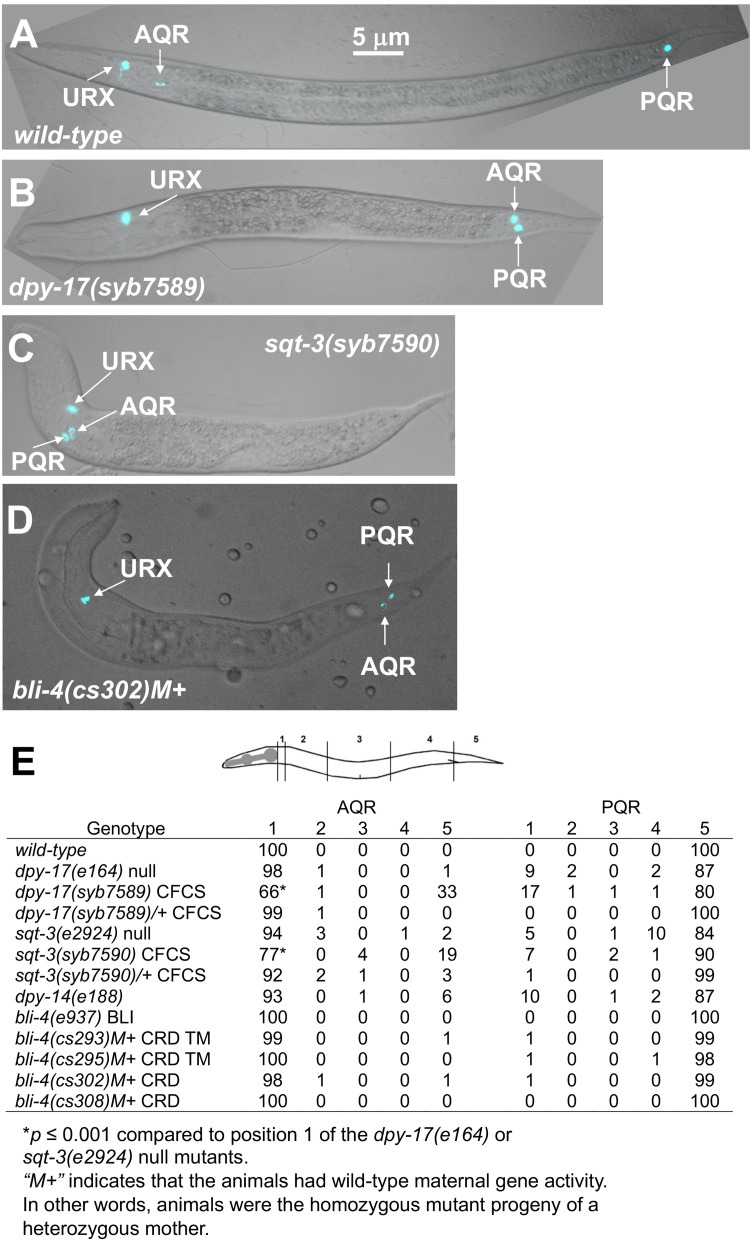
{"title":"Consensus furin cleavage sites in the cuticular collagens DPY-17 and SQT-3 are required for Q neuroblast left-right asymmetric migration in <i>Caenorhabditis elegans</i>.","authors":"Vedant D Jain, Celeste J Gormly, Erik A Lundquist","doi":"10.17912/micropub.biology.001526","DOIUrl":null,"url":null,"abstract":"<p><p>Previous studies showed that the apically secreted cuticular collagens DPY-17 , SQT-3 , and DPY-14 control the left-right asymmetric migration of the Q neuroblasts in <i>Caenorhabditis. elegans</i> . Furthermore, apical secretion of DPY-17 and SQT-3 require the BLI-4 proprotein convertase of the subtilisin/kexin family and the consensus furin cleavage site (CFCS) in the N-terminus of DPY-17 and SQT-3 . Work here shows that the CFCS sites of DPY-17 and SQT-3 are required for their roles in Q neuroblast migration. <i>bli-4</i> mutants had only weak effects on Q neuroblast migration, possibly due to redundancy among isoforms. These results suggest that apical secretion of cuticular collagens is required for Q neuroblast migration. These collagens might themselves provide left-right asymmetric guidance information, or might regulate another aspect of Q cell interaction with the cuticle, such as adhesion.</p>","PeriodicalId":74192,"journal":{"name":"microPublication biology","volume":"2025 ","pages":""},"PeriodicalIF":0.0000,"publicationDate":"2025-03-04","publicationTypes":"Journal Article","fieldsOfStudy":null,"isOpenAccess":false,"openAccessPdf":"https://www.ncbi.nlm.nih.gov/pmc/articles/PMC11920829/pdf/","citationCount":"0","resultStr":null,"platform":"Semanticscholar","paperid":null,"PeriodicalName":"microPublication biology","FirstCategoryId":"1085","ListUrlMain":"https://doi.org/10.17912/micropub.biology.001526","RegionNum":0,"RegionCategory":null,"ArticlePicture":[],"TitleCN":null,"AbstractTextCN":null,"PMCID":null,"EPubDate":"2025/1/1 0:00:00","PubModel":"eCollection","JCR":"","JCRName":"","Score":null,"Total":0}
引用次数: 0
Abstract
Previous studies showed that the apically secreted cuticular collagens DPY-17 , SQT-3 , and DPY-14 control the left-right asymmetric migration of the Q neuroblasts in Caenorhabditis. elegans . Furthermore, apical secretion of DPY-17 and SQT-3 require the BLI-4 proprotein convertase of the subtilisin/kexin family and the consensus furin cleavage site (CFCS) in the N-terminus of DPY-17 and SQT-3 . Work here shows that the CFCS sites of DPY-17 and SQT-3 are required for their roles in Q neuroblast migration. bli-4 mutants had only weak effects on Q neuroblast migration, possibly due to redundancy among isoforms. These results suggest that apical secretion of cuticular collagens is required for Q neuroblast migration. These collagens might themselves provide left-right asymmetric guidance information, or might regulate another aspect of Q cell interaction with the cuticle, such as adhesion.



 京公网安备 11010802042870号
京ICP备2023020795号-1
京公网安备 11010802042870号
京ICP备2023020795号-1

 分享
分享

 求助内容:
求助内容: 应助结果提醒方式:
 扫码关注我们
