Suwen Wang , Junkai Xia , Xiaohui Yang , Qian Xie , Zechao Zhuang , Huajun Feng , Hai Xiang , Zuliang Chen , Hui Li , Lei Zhang , Yongfu Li , Bing Yu , Tianyi Ma
{"title":"Two-dimensional materials for NOx reduction to ammonia: From electrocatalyst to system","authors":"Suwen Wang , Junkai Xia , Xiaohui Yang , Qian Xie , Zechao Zhuang , Huajun Feng , Hai Xiang , Zuliang Chen , Hui Li , Lei Zhang , Yongfu Li , Bing Yu , Tianyi Ma","doi":"10.1016/j.ccr.2025.216610","DOIUrl":null,"url":null,"abstract":"<div><div>Ammonia is a globally produced commodity chemical that is essential in supporting the needs of an expanding population. The traditional Haber-Bosch process for the production of ammonia, although effective, encounters obstacles stemming from its reliance on fossil fuels and substantial energy expenditure. The electrocatalytic NO<sub>x</sub> reduction reaction (NO<sub>x</sub>RR) for ammonia synthesis has recently captured interest as a compelling alternative due to its high efficiency and environmentally friendly characteristics. Two-dimensional (2D) materials, with their numerous exposed active sites, substantial specific surface area, excellent conductivity, and readily adjustable electronic properties, offer significant potential for activating NO<sub>x</sub> species in sustainable NO<sub>x</sub>RR applications. This review highlights the latest research advancements in the use of 2D materials for electrochemical NO<sub>x</sub> reduction. We began by providing an overview of the fundamental principles of electrochemical NO<sub>x</sub> reduction. Next, we introduced recent progress in this field using 2D materials such as graphene, MXene, metal alloys/sulfides, layered double hydroxides, and carbon nitride. We then summarized the state-of-the-art electrochemical systems employed in NO<sub>x</sub>RR processes. Finally, we discussed the challenges and prospects of NO<sub>x</sub>RR based on 2D materials, aiming for large-scale industrial implementation in the near future.</div></div>","PeriodicalId":289,"journal":{"name":"Coordination Chemistry Reviews","volume":"535 ","pages":"Article 216610"},"PeriodicalIF":23.5000,"publicationDate":"2025-07-15","publicationTypes":"Journal Article","fieldsOfStudy":null,"isOpenAccess":false,"openAccessPdf":"","citationCount":"0","resultStr":null,"platform":"Semanticscholar","paperid":null,"PeriodicalName":"Coordination Chemistry Reviews","FirstCategoryId":"92","ListUrlMain":"https://www.sciencedirect.com/science/article/pii/S0010854525001808","RegionNum":1,"RegionCategory":"化学","ArticlePicture":[],"TitleCN":null,"AbstractTextCN":null,"PMCID":null,"EPubDate":"2025/3/20 0:00:00","PubModel":"Epub","JCR":"Q1","JCRName":"CHEMISTRY, INORGANIC & NUCLEAR","Score":null,"Total":0}
引用次数: 0
Abstract
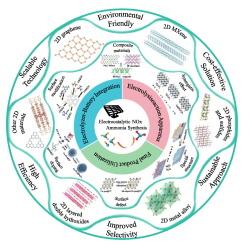
Ammonia is a globally produced commodity chemical that is essential in supporting the needs of an expanding population. The traditional Haber-Bosch process for the production of ammonia, although effective, encounters obstacles stemming from its reliance on fossil fuels and substantial energy expenditure. The electrocatalytic NOx reduction reaction (NOxRR) for ammonia synthesis has recently captured interest as a compelling alternative due to its high efficiency and environmentally friendly characteristics. Two-dimensional (2D) materials, with their numerous exposed active sites, substantial specific surface area, excellent conductivity, and readily adjustable electronic properties, offer significant potential for activating NOx species in sustainable NOxRR applications. This review highlights the latest research advancements in the use of 2D materials for electrochemical NOx reduction. We began by providing an overview of the fundamental principles of electrochemical NOx reduction. Next, we introduced recent progress in this field using 2D materials such as graphene, MXene, metal alloys/sulfides, layered double hydroxides, and carbon nitride. We then summarized the state-of-the-art electrochemical systems employed in NOxRR processes. Finally, we discussed the challenges and prospects of NOxRR based on 2D materials, aiming for large-scale industrial implementation in the near future.
期刊介绍:
Coordination Chemistry Reviews offers rapid publication of review articles on current and significant topics in coordination chemistry, encompassing organometallic, supramolecular, theoretical, and bioinorganic chemistry. It also covers catalysis, materials chemistry, and metal-organic frameworks from a coordination chemistry perspective. Reviews summarize recent developments or discuss specific techniques, welcoming contributions from both established and emerging researchers.
The journal releases special issues on timely subjects, including those featuring contributions from specific regions or conferences. Occasional full-length book articles are also featured. Additionally, special volumes cover annual reviews of main group chemistry, transition metal group chemistry, and organometallic chemistry. These comprehensive reviews are vital resources for those engaged in coordination chemistry, further establishing Coordination Chemistry Reviews as a hub for insightful surveys in inorganic and physical inorganic chemistry.





 京公网安备 11010802042870号
京ICP备2023020795号-1
京公网安备 11010802042870号
京ICP备2023020795号-1

 分享
分享
 求助内容:
求助内容: 应助结果提醒方式:
 扫码关注我们
