{"title":"Feasibility and application of membrane aerated biofilm reactors for industrial wastewater treatment","authors":"Gennaro Dicataldo , Peter Desmond , Mashael Al-Maas , Samer Adham","doi":"10.1016/j.watres.2025.123523","DOIUrl":null,"url":null,"abstract":"<div><div>Membrane aerated biofilm reactors (MABRs) have emerged as a promising technology for wastewater treatment, offering significant advantages over conventional activated sludge (CAS) systems. Over the past decades, membrane processes have revolutionized municipal water treatment with membrane bioreactors (MBRs) becoming a widely accepted process for municipal and then industrial wastewater (IW) treatment. By the same token, MABR technologies were initially applied to municipal wastewater; however, their application in industrial settings is still emerging. Despite the promise of MABRs due to the biofilm's tolerance to IW toxins, there is a lack of information on their industrial applications. Therefore, this paper critically reviews the feasibility and application of MABRs for IW treatment, including pharmaceutical, chemical, refinery, petrochemical, oilfield, landfill leachate and other complex industrial waters. Three existing technology vendors with full-scale experience were compared; however, additional providers with innovative designs may provide step-changes in performance. Key outcomes highlight the effectiveness of MABRs in reducing carbon, nitrogen, and xenobiotics from high-strength IWs at bench and pilot scales. Critical factors influencing MABR performance, such as biofilm thickness (BT) were correlated to organics and nitrogen removal efficiency in industrial applications. Review of advances in MABR modeling techniques showed that current models lack the needed resolution for large and dynamic industrial systems. Additionally, the review compares municipal and industrial applications of MABRs, emphasizing the unique challenges and innovations required for their adoption in IW treatment. Overall, the MABR process was found to be feasible for industrial applications with pilot and/or demonstration-scale testing being necessary to further optimize process performance.</div></div>","PeriodicalId":443,"journal":{"name":"Water Research","volume":"280 ","pages":"Article 123523"},"PeriodicalIF":12.4000,"publicationDate":"2025-03-20","publicationTypes":"Journal Article","fieldsOfStudy":null,"isOpenAccess":false,"openAccessPdf":"","citationCount":"0","resultStr":null,"platform":"Semanticscholar","paperid":null,"PeriodicalName":"Water Research","FirstCategoryId":"93","ListUrlMain":"https://www.sciencedirect.com/science/article/pii/S0043135425004361","RegionNum":1,"RegionCategory":"环境科学与生态学","ArticlePicture":[],"TitleCN":null,"AbstractTextCN":null,"PMCID":null,"EPubDate":"","PubModel":"","JCR":"Q1","JCRName":"ENGINEERING, ENVIRONMENTAL","Score":null,"Total":0}
引用次数: 0
Abstract
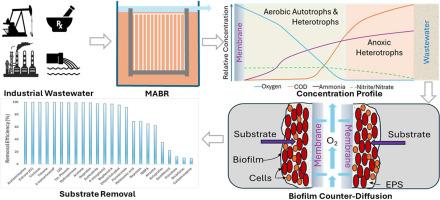
Membrane aerated biofilm reactors (MABRs) have emerged as a promising technology for wastewater treatment, offering significant advantages over conventional activated sludge (CAS) systems. Over the past decades, membrane processes have revolutionized municipal water treatment with membrane bioreactors (MBRs) becoming a widely accepted process for municipal and then industrial wastewater (IW) treatment. By the same token, MABR technologies were initially applied to municipal wastewater; however, their application in industrial settings is still emerging. Despite the promise of MABRs due to the biofilm's tolerance to IW toxins, there is a lack of information on their industrial applications. Therefore, this paper critically reviews the feasibility and application of MABRs for IW treatment, including pharmaceutical, chemical, refinery, petrochemical, oilfield, landfill leachate and other complex industrial waters. Three existing technology vendors with full-scale experience were compared; however, additional providers with innovative designs may provide step-changes in performance. Key outcomes highlight the effectiveness of MABRs in reducing carbon, nitrogen, and xenobiotics from high-strength IWs at bench and pilot scales. Critical factors influencing MABR performance, such as biofilm thickness (BT) were correlated to organics and nitrogen removal efficiency in industrial applications. Review of advances in MABR modeling techniques showed that current models lack the needed resolution for large and dynamic industrial systems. Additionally, the review compares municipal and industrial applications of MABRs, emphasizing the unique challenges and innovations required for their adoption in IW treatment. Overall, the MABR process was found to be feasible for industrial applications with pilot and/or demonstration-scale testing being necessary to further optimize process performance.
期刊介绍:
Water Research, along with its open access companion journal Water Research X, serves as a platform for publishing original research papers covering various aspects of the science and technology related to the anthropogenic water cycle, water quality, and its management worldwide. The audience targeted by the journal comprises biologists, chemical engineers, chemists, civil engineers, environmental engineers, limnologists, and microbiologists. The scope of the journal include:
•Treatment processes for water and wastewaters (municipal, agricultural, industrial, and on-site treatment), including resource recovery and residuals management;
•Urban hydrology including sewer systems, stormwater management, and green infrastructure;
•Drinking water treatment and distribution;
•Potable and non-potable water reuse;
•Sanitation, public health, and risk assessment;
•Anaerobic digestion, solid and hazardous waste management, including source characterization and the effects and control of leachates and gaseous emissions;
•Contaminants (chemical, microbial, anthropogenic particles such as nanoparticles or microplastics) and related water quality sensing, monitoring, fate, and assessment;
•Anthropogenic impacts on inland, tidal, coastal and urban waters, focusing on surface and ground waters, and point and non-point sources of pollution;
•Environmental restoration, linked to surface water, groundwater and groundwater remediation;
•Analysis of the interfaces between sediments and water, and between water and atmosphere, focusing specifically on anthropogenic impacts;
•Mathematical modelling, systems analysis, machine learning, and beneficial use of big data related to the anthropogenic water cycle;
•Socio-economic, policy, and regulations studies.




 京公网安备 11010802042870号
京ICP备2023020795号-1
京公网安备 11010802042870号
京ICP备2023020795号-1

 分享
分享
 求助内容:
求助内容: 应助结果提醒方式:
 扫码关注我们
