Bingqian Yang , Peng Zhou , Long Tian , Nigel Graham , Guibai Li , Zhaoyang Su , Wenzheng Yu
{"title":"The nanoscale explanation of metal cations differences in enhancing the Fe(III) coagulation performance","authors":"Bingqian Yang , Peng Zhou , Long Tian , Nigel Graham , Guibai Li , Zhaoyang Su , Wenzheng Yu","doi":"10.1016/j.watres.2025.123524","DOIUrl":null,"url":null,"abstract":"<div><div>Coagulation is a widely applied and important process for water treatment, and the development of improved coagulation reagents continues to be a practical objective. However, mechanisms guiding the development of composite coagulants remain insufficiently understood. In addressing this deficiency, this study has investigated the enhancement of conventional Fe(III) coagulation by composite coagulants that incorporate an additional metal salt (Me: Ca²⁺, Al³⁺, Ti⁴⁺, Zr⁴⁺), focusing on the mechanistic roles that Me constituents play in Fe-based coagulation. The effectiveness of composite coagulants was assessed through floc size and the removal of organics and phosphates. Results demonstrated that Me constituents enhance coagulation performances to varying extents, with Al³⁺ and Zr⁴⁺ showing the most significant improvements. FT-ICR MS analysis at the molecular scale reveals that additional Me facilitates the removal of humic acid, hydrophobic macromolecules, and highly aromatic organics containing polycarboxyl and secondary carbon structures. EXAFS results indicate that co-hydrolysis of Fe³⁺ with Me disrupts the formation of conventional ferrihydrite at the nanoscale of flocs and promotes the development of Fe-phosphate clusters. Me effectively reduces the corner- and edge-sharing coordination between FeO₆ octahedra within clusters, resulting in a more dispersed arrangement of FeO₆ polymers with available binding sites for the PO<sub>4</sub> tetrahedron. The shortened Fe-P bond indicates that Me promotes a more compact link between FeO₆ octahedra and PO₄ tetrahedra. By revealing how cations in composite coagulants change the nanoscale structure of Fe flocs to affect macroscopic coagulation, this study enhances the understanding of metal ion interactions during co-hydrolysis and co-precipitation in natural systems.</div></div>","PeriodicalId":443,"journal":{"name":"Water Research","volume":"280 ","pages":"Article 123524"},"PeriodicalIF":12.4000,"publicationDate":"2025-03-20","publicationTypes":"Journal Article","fieldsOfStudy":null,"isOpenAccess":false,"openAccessPdf":"","citationCount":"0","resultStr":null,"platform":"Semanticscholar","paperid":null,"PeriodicalName":"Water Research","FirstCategoryId":"93","ListUrlMain":"https://www.sciencedirect.com/science/article/pii/S0043135425004373","RegionNum":1,"RegionCategory":"环境科学与生态学","ArticlePicture":[],"TitleCN":null,"AbstractTextCN":null,"PMCID":null,"EPubDate":"","PubModel":"","JCR":"Q1","JCRName":"ENGINEERING, ENVIRONMENTAL","Score":null,"Total":0}
引用次数: 0
Abstract
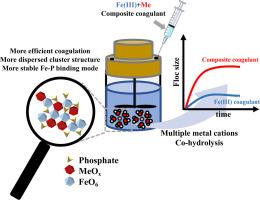
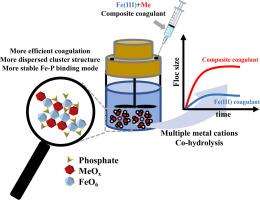
Coagulation is a widely applied and important process for water treatment, and the development of improved coagulation reagents continues to be a practical objective. However, mechanisms guiding the development of composite coagulants remain insufficiently understood. In addressing this deficiency, this study has investigated the enhancement of conventional Fe(III) coagulation by composite coagulants that incorporate an additional metal salt (Me: Ca²⁺, Al³⁺, Ti⁴⁺, Zr⁴⁺), focusing on the mechanistic roles that Me constituents play in Fe-based coagulation. The effectiveness of composite coagulants was assessed through floc size and the removal of organics and phosphates. Results demonstrated that Me constituents enhance coagulation performances to varying extents, with Al³⁺ and Zr⁴⁺ showing the most significant improvements. FT-ICR MS analysis at the molecular scale reveals that additional Me facilitates the removal of humic acid, hydrophobic macromolecules, and highly aromatic organics containing polycarboxyl and secondary carbon structures. EXAFS results indicate that co-hydrolysis of Fe³⁺ with Me disrupts the formation of conventional ferrihydrite at the nanoscale of flocs and promotes the development of Fe-phosphate clusters. Me effectively reduces the corner- and edge-sharing coordination between FeO₆ octahedra within clusters, resulting in a more dispersed arrangement of FeO₆ polymers with available binding sites for the PO4 tetrahedron. The shortened Fe-P bond indicates that Me promotes a more compact link between FeO₆ octahedra and PO₄ tetrahedra. By revealing how cations in composite coagulants change the nanoscale structure of Fe flocs to affect macroscopic coagulation, this study enhances the understanding of metal ion interactions during co-hydrolysis and co-precipitation in natural systems.
期刊介绍:
Water Research, along with its open access companion journal Water Research X, serves as a platform for publishing original research papers covering various aspects of the science and technology related to the anthropogenic water cycle, water quality, and its management worldwide. The audience targeted by the journal comprises biologists, chemical engineers, chemists, civil engineers, environmental engineers, limnologists, and microbiologists. The scope of the journal include:
•Treatment processes for water and wastewaters (municipal, agricultural, industrial, and on-site treatment), including resource recovery and residuals management;
•Urban hydrology including sewer systems, stormwater management, and green infrastructure;
•Drinking water treatment and distribution;
•Potable and non-potable water reuse;
•Sanitation, public health, and risk assessment;
•Anaerobic digestion, solid and hazardous waste management, including source characterization and the effects and control of leachates and gaseous emissions;
•Contaminants (chemical, microbial, anthropogenic particles such as nanoparticles or microplastics) and related water quality sensing, monitoring, fate, and assessment;
•Anthropogenic impacts on inland, tidal, coastal and urban waters, focusing on surface and ground waters, and point and non-point sources of pollution;
•Environmental restoration, linked to surface water, groundwater and groundwater remediation;
•Analysis of the interfaces between sediments and water, and between water and atmosphere, focusing specifically on anthropogenic impacts;
•Mathematical modelling, systems analysis, machine learning, and beneficial use of big data related to the anthropogenic water cycle;
•Socio-economic, policy, and regulations studies.



 京公网安备 11010802042870号
京ICP备2023020795号-1
京公网安备 11010802042870号
京ICP备2023020795号-1

 分享
分享
 求助内容:
求助内容: 应助结果提醒方式:
 扫码关注我们
