Chao Zeng , JiaWei Ren , RongKai Wang , ZhiCheng Qiu , LiYang Wang , ShengMing Zhang , Peng Ji , ChaoSheng Wang , HuaPing Wang
{"title":"A bio-based rigid-flexible polyester-polycarbonate with excellent packaging properties","authors":"Chao Zeng , JiaWei Ren , RongKai Wang , ZhiCheng Qiu , LiYang Wang , ShengMing Zhang , Peng Ji , ChaoSheng Wang , HuaPing Wang","doi":"10.1016/j.polymer.2025.128297","DOIUrl":null,"url":null,"abstract":"<div><div>Using DMC derived from carbon dioxide (CO<sub>2</sub>) to prepare polymers based on transesterification could reduce greenhouse gas emissions associated with polymer manufacturing and achieve sustainable production of polymers. However, the polymers prepared by this method exhibit deficiencies in thermal and mechanical properties, and the structure-property relationship of the resulting polymers needs to be elucidated. This study describes a new type of polyester-polycarbonates (PCCFs) based on biomass 2,5-furan dicarboxylic acid (FDCA). The series of copolyesters have acceptable glass transition temperature (47.13 °C < <em>T</em><sub><em>g</em></sub> < 75.63 °C) and high yield strength (46.13 MPa < <em>σ</em><sub><em>y</em></sub> < 60.67 MPa). Time-temperature superposition (TTS) analysis shows that the characteristic relaxation time decreases with increasing carbonate content, resulting in a decrease in entanglement molecular weight, possessed a lower Kuhn monomer volume, and an increase in the number of entanglements per chain, suggesting a reduction in chain stiffness and entanglement density. Notably, PCCFs exhibit excellent packaging properties, especially gas barrier (<em>P</em><sub>CO2</sub> = 0.0627 barrer and <em>P</em><sub>O2</sub> = 0.0292 barrer) and optical properties (λ<sub>400</sub> = 86.28 % and Haze = 3.15 %) for PCCF<sub>30</sub>. In addition, the PCCF film has considerable shrinkage performance, with a shrinkage rate and shrinkage strain of 71.3 % and 3.10 N mm<sup>−1</sup> respectively. It can also be chemically recycled with a monomer recovery rate of 87.2 %, indicating good recyclability.</div></div>","PeriodicalId":405,"journal":{"name":"Polymer","volume":"325 ","pages":"Article 128297"},"PeriodicalIF":4.5000,"publicationDate":"2025-03-20","publicationTypes":"Journal Article","fieldsOfStudy":null,"isOpenAccess":false,"openAccessPdf":"","citationCount":"0","resultStr":null,"platform":"Semanticscholar","paperid":null,"PeriodicalName":"Polymer","FirstCategoryId":"92","ListUrlMain":"https://www.sciencedirect.com/science/article/pii/S0032386125002836","RegionNum":2,"RegionCategory":"化学","ArticlePicture":[],"TitleCN":null,"AbstractTextCN":null,"PMCID":null,"EPubDate":"","PubModel":"","JCR":"Q2","JCRName":"POLYMER SCIENCE","Score":null,"Total":0}
引用次数: 0
Abstract
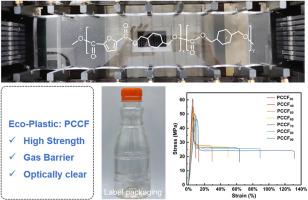
Using DMC derived from carbon dioxide (CO2) to prepare polymers based on transesterification could reduce greenhouse gas emissions associated with polymer manufacturing and achieve sustainable production of polymers. However, the polymers prepared by this method exhibit deficiencies in thermal and mechanical properties, and the structure-property relationship of the resulting polymers needs to be elucidated. This study describes a new type of polyester-polycarbonates (PCCFs) based on biomass 2,5-furan dicarboxylic acid (FDCA). The series of copolyesters have acceptable glass transition temperature (47.13 °C < Tg < 75.63 °C) and high yield strength (46.13 MPa < σy < 60.67 MPa). Time-temperature superposition (TTS) analysis shows that the characteristic relaxation time decreases with increasing carbonate content, resulting in a decrease in entanglement molecular weight, possessed a lower Kuhn monomer volume, and an increase in the number of entanglements per chain, suggesting a reduction in chain stiffness and entanglement density. Notably, PCCFs exhibit excellent packaging properties, especially gas barrier (PCO2 = 0.0627 barrer and PO2 = 0.0292 barrer) and optical properties (λ400 = 86.28 % and Haze = 3.15 %) for PCCF30. In addition, the PCCF film has considerable shrinkage performance, with a shrinkage rate and shrinkage strain of 71.3 % and 3.10 N mm−1 respectively. It can also be chemically recycled with a monomer recovery rate of 87.2 %, indicating good recyclability.
期刊介绍:
Polymer is an interdisciplinary journal dedicated to publishing innovative and significant advances in Polymer Physics, Chemistry and Technology. We welcome submissions on polymer hybrids, nanocomposites, characterisation and self-assembly. Polymer also publishes work on the technological application of polymers in energy and optoelectronics.
The main scope is covered but not limited to the following core areas:
Polymer Materials
Nanocomposites and hybrid nanomaterials
Polymer blends, films, fibres, networks and porous materials
Physical Characterization
Characterisation, modelling and simulation* of molecular and materials properties in bulk, solution, and thin films
Polymer Engineering
Advanced multiscale processing methods
Polymer Synthesis, Modification and Self-assembly
Including designer polymer architectures, mechanisms and kinetics, and supramolecular polymerization
Technological Applications
Polymers for energy generation and storage
Polymer membranes for separation technology
Polymers for opto- and microelectronics.




 京公网安备 11010802042870号
京ICP备2023020795号-1
京公网安备 11010802042870号
京ICP备2023020795号-1

 分享
分享
 求助内容:
求助内容: 应助结果提醒方式:
 扫码关注我们
