Qais M. Al-Bataineh , Ahmad D. Telfah , Ihsan Aljarrah , Ahmad A. Ahmad , Carlos J. Tavares , Johannes Etzkorn , Yves Rosefort
{"title":"Anomalous phenomena in explosive percolation of polymer/metal nanocomposite films","authors":"Qais M. Al-Bataineh , Ahmad D. Telfah , Ihsan Aljarrah , Ahmad A. Ahmad , Carlos J. Tavares , Johannes Etzkorn , Yves Rosefort","doi":"10.1016/j.polymer.2025.128303","DOIUrl":null,"url":null,"abstract":"<div><div>This study examines the electrical conductivity of polyethylene oxide (PEO) nanocomposite films with varying aluminum nanoparticle (AlNP) volume fractions. A sharp increase in the electrical conductivity occurs at the percolation threshold, reaching 219 S cm<sup>−1</sup>, followed by a plateau at higher AlNP concentrations, indicating the formation of stable conductive pathways. Upon UV irradiation, the electrical conductivity increases to 1770 S cm<sup>−1</sup>, suggesting the significant influence of localized surface plasmon resonance (LSPR) effects. The conductivity behavior is quantitatively characterized through mathematical modeling, highlighting the volume fraction dependence of the nanocomposite's electrical properties. Scanning electron microscopy and atomic force microscopy demonstrate the distribution and morphology of AlNPs, showing their dispersion at lower concentrations and agglomeration at higher concentrations. Fourier-transform infrared spectroscopy identifies the chemical interactions between PEO and AlNPs, while X-ray diffraction (XRD) demonstrates the AlNP-induced disruption of PEO crystallinity. These insights provide a comprehensive understanding of the nanocomposite's electrical behavior, offering valuable guidance for the design and optimization of materials for electronics and optoelectronics applications.</div></div>","PeriodicalId":405,"journal":{"name":"Polymer","volume":"325 ","pages":"Article 128303"},"PeriodicalIF":4.5000,"publicationDate":"2025-03-20","publicationTypes":"Journal Article","fieldsOfStudy":null,"isOpenAccess":false,"openAccessPdf":"","citationCount":"0","resultStr":null,"platform":"Semanticscholar","paperid":null,"PeriodicalName":"Polymer","FirstCategoryId":"92","ListUrlMain":"https://www.sciencedirect.com/science/article/pii/S0032386125002897","RegionNum":2,"RegionCategory":"化学","ArticlePicture":[],"TitleCN":null,"AbstractTextCN":null,"PMCID":null,"EPubDate":"","PubModel":"","JCR":"Q2","JCRName":"POLYMER SCIENCE","Score":null,"Total":0}
引用次数: 0
Abstract
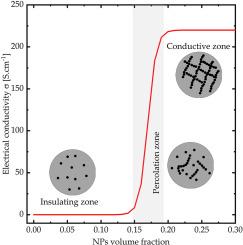
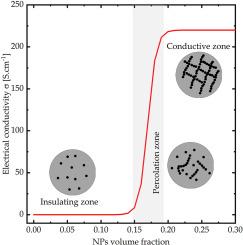
This study examines the electrical conductivity of polyethylene oxide (PEO) nanocomposite films with varying aluminum nanoparticle (AlNP) volume fractions. A sharp increase in the electrical conductivity occurs at the percolation threshold, reaching 219 S cm−1, followed by a plateau at higher AlNP concentrations, indicating the formation of stable conductive pathways. Upon UV irradiation, the electrical conductivity increases to 1770 S cm−1, suggesting the significant influence of localized surface plasmon resonance (LSPR) effects. The conductivity behavior is quantitatively characterized through mathematical modeling, highlighting the volume fraction dependence of the nanocomposite's electrical properties. Scanning electron microscopy and atomic force microscopy demonstrate the distribution and morphology of AlNPs, showing their dispersion at lower concentrations and agglomeration at higher concentrations. Fourier-transform infrared spectroscopy identifies the chemical interactions between PEO and AlNPs, while X-ray diffraction (XRD) demonstrates the AlNP-induced disruption of PEO crystallinity. These insights provide a comprehensive understanding of the nanocomposite's electrical behavior, offering valuable guidance for the design and optimization of materials for electronics and optoelectronics applications.
期刊介绍:
Polymer is an interdisciplinary journal dedicated to publishing innovative and significant advances in Polymer Physics, Chemistry and Technology. We welcome submissions on polymer hybrids, nanocomposites, characterisation and self-assembly. Polymer also publishes work on the technological application of polymers in energy and optoelectronics.
The main scope is covered but not limited to the following core areas:
Polymer Materials
Nanocomposites and hybrid nanomaterials
Polymer blends, films, fibres, networks and porous materials
Physical Characterization
Characterisation, modelling and simulation* of molecular and materials properties in bulk, solution, and thin films
Polymer Engineering
Advanced multiscale processing methods
Polymer Synthesis, Modification and Self-assembly
Including designer polymer architectures, mechanisms and kinetics, and supramolecular polymerization
Technological Applications
Polymers for energy generation and storage
Polymer membranes for separation technology
Polymers for opto- and microelectronics.



 京公网安备 11010802042870号
京ICP备2023020795号-1
京公网安备 11010802042870号
京ICP备2023020795号-1

 分享
分享
 求助内容:
求助内容: 应助结果提醒方式:
 扫码关注我们
