Gianmarco Munaò , Cosimo Brondi , Antonio Baldanza , Antonio De Nicola , Riccardo Chiarcos , Michele Laus , Michele Perego , Giuseppe Scherillo , Giuseppe Mensitieri , Giuseppe Milano
{"title":"Multiscale molecular simulations of grafted materials","authors":"Gianmarco Munaò , Cosimo Brondi , Antonio Baldanza , Antonio De Nicola , Riccardo Chiarcos , Michele Laus , Michele Perego , Giuseppe Scherillo , Giuseppe Mensitieri , Giuseppe Milano","doi":"10.1016/j.polymer.2025.128269","DOIUrl":null,"url":null,"abstract":"<div><div>An overview of recent applications of hybrid particle-field Molecular Dynamics (hPF-MD) to grafted materials is presented. For such an aim, two classes of materials are considered: polymer nanocomposites and polymer brushes. In the first case, the hybrid approach demonstrates its efficiency to properly relax polymer chains even of high molecular weight. Also, results highlight the role played by configurational entropy of polymer chains in determining the effective (two-body and three-body) nanoparticle–nanoparticle interaction in the melt. A similar role emerges also in the investigation of polymer brushes, where hPF-MD simulations clarify the mechanisms underlying the “grafting to” process, pointing towards a partition by molecular weight of polymer chains. This effect, which causes the segregation of the chains with lower molecular weight in proximity of the substrate surface, is purely entropic and it is originated by the stretching of polymer chains during the grafting to reaction. This picture is also confirmed by a very recent combination of self-consistent field theory with the lattice-based reactive Monte Carlo method which allows to predict for the first time the final composition of the chains grafted on the surfaces.</div></div>","PeriodicalId":405,"journal":{"name":"Polymer","volume":"325 ","pages":"Article 128269"},"PeriodicalIF":4.5000,"publicationDate":"2025-03-20","publicationTypes":"Journal Article","fieldsOfStudy":null,"isOpenAccess":false,"openAccessPdf":"","citationCount":"0","resultStr":null,"platform":"Semanticscholar","paperid":null,"PeriodicalName":"Polymer","FirstCategoryId":"92","ListUrlMain":"https://www.sciencedirect.com/science/article/pii/S0032386125002551","RegionNum":2,"RegionCategory":"化学","ArticlePicture":[],"TitleCN":null,"AbstractTextCN":null,"PMCID":null,"EPubDate":"","PubModel":"","JCR":"Q2","JCRName":"POLYMER SCIENCE","Score":null,"Total":0}
引用次数: 0
Abstract
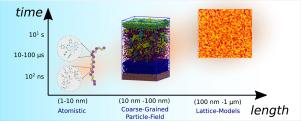
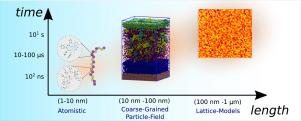
An overview of recent applications of hybrid particle-field Molecular Dynamics (hPF-MD) to grafted materials is presented. For such an aim, two classes of materials are considered: polymer nanocomposites and polymer brushes. In the first case, the hybrid approach demonstrates its efficiency to properly relax polymer chains even of high molecular weight. Also, results highlight the role played by configurational entropy of polymer chains in determining the effective (two-body and three-body) nanoparticle–nanoparticle interaction in the melt. A similar role emerges also in the investigation of polymer brushes, where hPF-MD simulations clarify the mechanisms underlying the “grafting to” process, pointing towards a partition by molecular weight of polymer chains. This effect, which causes the segregation of the chains with lower molecular weight in proximity of the substrate surface, is purely entropic and it is originated by the stretching of polymer chains during the grafting to reaction. This picture is also confirmed by a very recent combination of self-consistent field theory with the lattice-based reactive Monte Carlo method which allows to predict for the first time the final composition of the chains grafted on the surfaces.
期刊介绍:
Polymer is an interdisciplinary journal dedicated to publishing innovative and significant advances in Polymer Physics, Chemistry and Technology. We welcome submissions on polymer hybrids, nanocomposites, characterisation and self-assembly. Polymer also publishes work on the technological application of polymers in energy and optoelectronics.
The main scope is covered but not limited to the following core areas:
Polymer Materials
Nanocomposites and hybrid nanomaterials
Polymer blends, films, fibres, networks and porous materials
Physical Characterization
Characterisation, modelling and simulation* of molecular and materials properties in bulk, solution, and thin films
Polymer Engineering
Advanced multiscale processing methods
Polymer Synthesis, Modification and Self-assembly
Including designer polymer architectures, mechanisms and kinetics, and supramolecular polymerization
Technological Applications
Polymers for energy generation and storage
Polymer membranes for separation technology
Polymers for opto- and microelectronics.



 京公网安备 11010802042870号
京ICP备2023020795号-1
京公网安备 11010802042870号
京ICP备2023020795号-1

 分享
分享
 求助内容:
求助内容: 应助结果提醒方式:
 扫码关注我们
