{"title":"Developing glycosylase-based T-to-G and C-to-K base editors in rice","authors":"Yongjie Kuang, Xuemei Wu, Meijie Liu, Fang Yan, Dongfang Ma, Xueping Zhou, Huanbin Zhou, Bin Ren","doi":"10.1111/pbi.70063","DOIUrl":null,"url":null,"abstract":"<p>The advancement of CRISPR/Cas-mediated base editors holds significant promise for installing nucleotide variations to correct defective alleles or create elite alleles through artificial evolution, thereby accelerating crop genetic improvement. The cytosine and adenine base editors have been widely applied in many plant species by utilizing various DNA deaminases to deaminate cytosine (C) and adenine (A) as a crucial step to produce uridine (U) and inosine (I) intermediates, which are in turn transformed into thymine (T) and guanine (G) (Li <i>et al</i>., <span>2024</span>). In addition, the rice deaminase-free guanine base editor was also developed by integrating the engineered human N-methylpurine DNA glycosylase (MPGv6.3) with SpCas9 (D10A) nickase (SpCas9n). This editor converted G to T via glycosylating G and initiating the base excision repair (BER) pathway to generate an apurinic/apyrimidinic (AP) site (Liu <i>et al</i>., <span>2024</span>). However, no direct thymine base editing in plants has been reported so far. Recently, several engineered thymine DNA glycosylases (TDGs) and cytosine DNA glycosylases (CDGs), artificially evolved from human uracil-N-glycosylases hUNG1 and hUNG2, have exhibited efficient T-to-S (S = G/C) and C-to-G editing activities in human cells (He <i>et al</i>., <span>2024</span>; Tong <i>et al</i>., <span>2024</span>; Ye <i>et al</i>., <span>2024</span>). The applicability of these variants for deaminase-free base editing in plants remains unexplored. Here, we employed the evolved UNG variants to develop glycosylase-mediated thymine and cytosine base editors, which are capable of performing efficient direct T and C editing, respectively, as well as enabling nucleotide insertions and deletions (indels) in rice.</p><p>The N-terminal domain-truncated version with 1–88 amino acids truncation (Δ1–88) of hUNG2 increased the targeted pyrimidine base editing activities in human cells (Tong <i>et al</i>., <span>2024</span>). Therefore, the truncated TDG-EKΔ (Δ1–79/G107E/Y147A/R260K), TDG3Δ (Δ1–79/F85L/G107E/L142V/Y147A/K175E/S238L/A255V/K259E/T266A/V274A/Y275S) and gTBEv3 (Δ1–79/Y156A/A214T/Q259A/Y284D), were selected for their relatively high T-to-G editing activities (He <i>et al</i>., <span>2024</span>; Tong <i>et al</i>., <span>2024</span>; Ye <i>et al</i>., <span>2024</span>) and then fused at the N-terminus of SpCas9n, resulting in three rice thymine base editors, rBE127aΔ (TDG-EKΔ-SpCas9n), rBE127bΔ (TDG3Δ-SpCas9n) and rBE127cΔ (gTBEv3-SpCas9n) (Figure 1a, Figure S1 and Table S1). Five target sites were selected to evaluate their direct T editing capability in rice (Table S2). Sequencing of transgenic lines showed that all thymine base editors successfully achieved direct T editing at five target sites (Figure 1b,c). The average T-to-G editing efficiencies of rBE127aΔ (8.00%-29.41%), rBE127bΔ (5.00%-20.83%) and rBE127cΔ (12.50%-62.50%) were 13.68%, 11.63% and 34.82%, respectively (Figure 1c). T-to-C and T-to-A editing events were also introduced by rBE127bΔ and rBE127cΔ at some of targeted sites with the efficiency of <10.00% (Figure 1c). Overall, rBE127cΔ demonstrated the highest T editing efficiency (Figure 1c–e), and we named those thymine base editors collectively TGBEs as the predominant base editing events being T-to-G conversions (Figure 1c). Besides the base conversions, a significant number of indels were also induced by rBE127aΔ, rBE127bΔ and rBE127cΔ (Figure 1b,c, Figures S2–S6). Meanwhile, the T editing windows of rBE127bΔ (spanning from protospacer positions −1 to 8, counting the NGG as positions 21–23) and rBE127cΔ (positions 4–12) were broader than rBE127aΔ (positions 2–8) (Figure 1e). Moreover, rBE127cΔ generated more bi-allelic mutations with the pure base editing or the base editing/indel than rBE127aΔ and rBE127bΔ (Figure 1f). These data indicate that the glycosylase-mediated TGBEs enable highly efficient T-to-G editing in rice.</p><p>To evaluate CDGs' direct C editing features in rice, TGBEs were updated by replacing the TDGs with CDG4Δ (Δ1–79/G107E/K175E/D183G/N204D/R220Q/Y248H/T266A/V274A/Y275H/K302T) and gCBEv2 (Δ1–88/K184A/N213D/A214V) (Tong <i>et al</i>., <span>2024</span>; Ye <i>et al</i>., <span>2024</span>), resulting in glycosylase-based rice cytosine base editors rBE128aΔ (CDG4Δ-SpCas9n) and rBE128bΔ (gCBEv2-SpCas9n) (Figure 1a). The editing results of the eight targeted sites indicated that both rBE128aΔ and rBE128bΔ achieved efficient and comparable direct C editing activity (Figure 1g, Figure S7). Among the three types of C base editing outcomes, C-to-G editing events were the most dominant with average efficiencies of 29.41% and 29.77% for rBE128aΔ and rBE128bΔ respectively, and C-to-T editing events came second with average efficiencies of 14.43% and 20.16% for rBE128aΔ and rBE128bΔ, respectively. In contrast, C-to-A editing events exhibited the lowest efficiencies of 1.22% and 3.65% for rBE128aΔ and rBE128bΔ, respectively (Figure 1g, Figure S7d,e). Therefore, we named these glycosylase-based rice cytosine base editors as CKBEs (K = G/T). Moreover, bi-allelic plants with base substitutions and indels were also frequently detected (Figures S7c, S8–S15). The CKBEs exhibited comparable base editing efficiency and slightly broader editing windows (positions 2–9) than previously reported plant deaminase-based CGBEs (positions 5–8 or positions 5–9) (Figures S7d,e and S16; Tian <i>et al</i>., <span>2022</span>; Wang <i>et al</i>., <span>2023</span>; Yu <i>et al</i>., <span>2024</span>). These data demonstrate that glycosylase-based CKBE enables efficient C-to-K editing and is a potential screening platform for direct evolution in rice.</p><p>The potential off-target effects of TGBE and CKBEs were evaluated in the transgenic lines by CRISPR-GE (http://skl.scau.edu.cn/). Only one off-target site (LOC_Os04g31960) with one nucleotide (nt) mismatch at site 6 was efficiently mutated by rBE128aΔ and rBE128bΔ (Table S3). However, other predicted off-target sites with 2 or 3 nucleotide mismatches targeted by TGBE and CKBEs revealed significantly lower off-target activity, with mutation frequencies ranging from 0% to 8.51% (Table S3).</p><p>In conclusion, we have successfully developed glycosylase-mediated rice pyrimidine base editing toolkits (TGBEs and CKBEs). Different from the T/C-to-A outcomes in <i>Escherichia coli</i> and T/C-to-S outcomes in mammalian cells (He <i>et al</i>., <span>2024</span>; Tong <i>et al</i>., <span>2024</span>; Ye <i>et al</i>., <span>2024</span>), the glycosylase-mediated pyrimidine base editing predominantly generated the T/C-to-K conversions and indels in rice. Thus, to facilitate this understanding, we constructed a schematic diagram to elucidate the editing model of these pyrimidine base editors in rice (Figure 1h). The glycosylase-based base editors can induce diverse editing events, including base transitions, base transversions and indels (Figures S2–S6 and S8–S15), and are more profitable for the artificial evolution of crop endogenous genes. Overall, the DNA glycosylases can serve as admirable DNA-modifying proteins to greatly facilitate the development of base editors in various crops and accelerate functional genomics research and genetic improvement.</p><p>The authors have declared no conflict of interest.</p><p>B.R. and H.Z. designed the research; Y.K., X.W., M.L. and B.R. conducted the experiments; F.Y., D.M. and X.Z. supervised the research; B.R., H.Z., Y.K. and X.W. wrote the original draft; all authors participated in discussion and revision of the manuscript.</p>","PeriodicalId":221,"journal":{"name":"Plant Biotechnology Journal","volume":"23 6","pages":"2358-2360"},"PeriodicalIF":10.5000,"publicationDate":"2025-03-20","publicationTypes":"Journal Article","fieldsOfStudy":null,"isOpenAccess":false,"openAccessPdf":"https://onlinelibrary.wiley.com/doi/epdf/10.1111/pbi.70063","citationCount":"0","resultStr":null,"platform":"Semanticscholar","paperid":null,"PeriodicalName":"Plant Biotechnology Journal","FirstCategoryId":"5","ListUrlMain":"https://onlinelibrary.wiley.com/doi/10.1111/pbi.70063","RegionNum":1,"RegionCategory":"生物学","ArticlePicture":[],"TitleCN":null,"AbstractTextCN":null,"PMCID":null,"EPubDate":"","PubModel":"","JCR":"Q1","JCRName":"BIOTECHNOLOGY & APPLIED MICROBIOLOGY","Score":null,"Total":0}
引用次数: 0
Abstract
The advancement of CRISPR/Cas-mediated base editors holds significant promise for installing nucleotide variations to correct defective alleles or create elite alleles through artificial evolution, thereby accelerating crop genetic improvement. The cytosine and adenine base editors have been widely applied in many plant species by utilizing various DNA deaminases to deaminate cytosine (C) and adenine (A) as a crucial step to produce uridine (U) and inosine (I) intermediates, which are in turn transformed into thymine (T) and guanine (G) (Li et al., 2024). In addition, the rice deaminase-free guanine base editor was also developed by integrating the engineered human N-methylpurine DNA glycosylase (MPGv6.3) with SpCas9 (D10A) nickase (SpCas9n). This editor converted G to T via glycosylating G and initiating the base excision repair (BER) pathway to generate an apurinic/apyrimidinic (AP) site (Liu et al., 2024). However, no direct thymine base editing in plants has been reported so far. Recently, several engineered thymine DNA glycosylases (TDGs) and cytosine DNA glycosylases (CDGs), artificially evolved from human uracil-N-glycosylases hUNG1 and hUNG2, have exhibited efficient T-to-S (S = G/C) and C-to-G editing activities in human cells (He et al., 2024; Tong et al., 2024; Ye et al., 2024). The applicability of these variants for deaminase-free base editing in plants remains unexplored. Here, we employed the evolved UNG variants to develop glycosylase-mediated thymine and cytosine base editors, which are capable of performing efficient direct T and C editing, respectively, as well as enabling nucleotide insertions and deletions (indels) in rice.
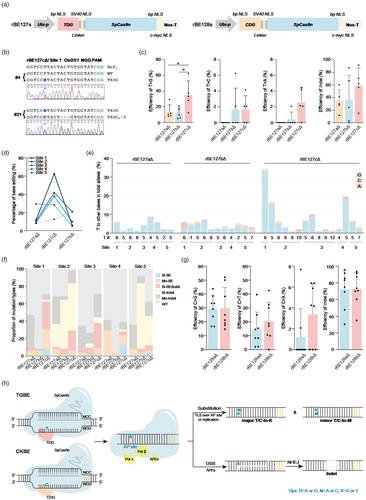
The N-terminal domain-truncated version with 1–88 amino acids truncation (Δ1–88) of hUNG2 increased the targeted pyrimidine base editing activities in human cells (Tong et al., 2024). Therefore, the truncated TDG-EKΔ (Δ1–79/G107E/Y147A/R260K), TDG3Δ (Δ1–79/F85L/G107E/L142V/Y147A/K175E/S238L/A255V/K259E/T266A/V274A/Y275S) and gTBEv3 (Δ1–79/Y156A/A214T/Q259A/Y284D), were selected for their relatively high T-to-G editing activities (He et al., 2024; Tong et al., 2024; Ye et al., 2024) and then fused at the N-terminus of SpCas9n, resulting in three rice thymine base editors, rBE127aΔ (TDG-EKΔ-SpCas9n), rBE127bΔ (TDG3Δ-SpCas9n) and rBE127cΔ (gTBEv3-SpCas9n) (Figure 1a, Figure S1 and Table S1). Five target sites were selected to evaluate their direct T editing capability in rice (Table S2). Sequencing of transgenic lines showed that all thymine base editors successfully achieved direct T editing at five target sites (Figure 1b,c). The average T-to-G editing efficiencies of rBE127aΔ (8.00%-29.41%), rBE127bΔ (5.00%-20.83%) and rBE127cΔ (12.50%-62.50%) were 13.68%, 11.63% and 34.82%, respectively (Figure 1c). T-to-C and T-to-A editing events were also introduced by rBE127bΔ and rBE127cΔ at some of targeted sites with the efficiency of <10.00% (Figure 1c). Overall, rBE127cΔ demonstrated the highest T editing efficiency (Figure 1c–e), and we named those thymine base editors collectively TGBEs as the predominant base editing events being T-to-G conversions (Figure 1c). Besides the base conversions, a significant number of indels were also induced by rBE127aΔ, rBE127bΔ and rBE127cΔ (Figure 1b,c, Figures S2–S6). Meanwhile, the T editing windows of rBE127bΔ (spanning from protospacer positions −1 to 8, counting the NGG as positions 21–23) and rBE127cΔ (positions 4–12) were broader than rBE127aΔ (positions 2–8) (Figure 1e). Moreover, rBE127cΔ generated more bi-allelic mutations with the pure base editing or the base editing/indel than rBE127aΔ and rBE127bΔ (Figure 1f). These data indicate that the glycosylase-mediated TGBEs enable highly efficient T-to-G editing in rice.
To evaluate CDGs' direct C editing features in rice, TGBEs were updated by replacing the TDGs with CDG4Δ (Δ1–79/G107E/K175E/D183G/N204D/R220Q/Y248H/T266A/V274A/Y275H/K302T) and gCBEv2 (Δ1–88/K184A/N213D/A214V) (Tong et al., 2024; Ye et al., 2024), resulting in glycosylase-based rice cytosine base editors rBE128aΔ (CDG4Δ-SpCas9n) and rBE128bΔ (gCBEv2-SpCas9n) (Figure 1a). The editing results of the eight targeted sites indicated that both rBE128aΔ and rBE128bΔ achieved efficient and comparable direct C editing activity (Figure 1g, Figure S7). Among the three types of C base editing outcomes, C-to-G editing events were the most dominant with average efficiencies of 29.41% and 29.77% for rBE128aΔ and rBE128bΔ respectively, and C-to-T editing events came second with average efficiencies of 14.43% and 20.16% for rBE128aΔ and rBE128bΔ, respectively. In contrast, C-to-A editing events exhibited the lowest efficiencies of 1.22% and 3.65% for rBE128aΔ and rBE128bΔ, respectively (Figure 1g, Figure S7d,e). Therefore, we named these glycosylase-based rice cytosine base editors as CKBEs (K = G/T). Moreover, bi-allelic plants with base substitutions and indels were also frequently detected (Figures S7c, S8–S15). The CKBEs exhibited comparable base editing efficiency and slightly broader editing windows (positions 2–9) than previously reported plant deaminase-based CGBEs (positions 5–8 or positions 5–9) (Figures S7d,e and S16; Tian et al., 2022; Wang et al., 2023; Yu et al., 2024). These data demonstrate that glycosylase-based CKBE enables efficient C-to-K editing and is a potential screening platform for direct evolution in rice.
The potential off-target effects of TGBE and CKBEs were evaluated in the transgenic lines by CRISPR-GE (http://skl.scau.edu.cn/). Only one off-target site (LOC_Os04g31960) with one nucleotide (nt) mismatch at site 6 was efficiently mutated by rBE128aΔ and rBE128bΔ (Table S3). However, other predicted off-target sites with 2 or 3 nucleotide mismatches targeted by TGBE and CKBEs revealed significantly lower off-target activity, with mutation frequencies ranging from 0% to 8.51% (Table S3).
In conclusion, we have successfully developed glycosylase-mediated rice pyrimidine base editing toolkits (TGBEs and CKBEs). Different from the T/C-to-A outcomes in Escherichia coli and T/C-to-S outcomes in mammalian cells (He et al., 2024; Tong et al., 2024; Ye et al., 2024), the glycosylase-mediated pyrimidine base editing predominantly generated the T/C-to-K conversions and indels in rice. Thus, to facilitate this understanding, we constructed a schematic diagram to elucidate the editing model of these pyrimidine base editors in rice (Figure 1h). The glycosylase-based base editors can induce diverse editing events, including base transitions, base transversions and indels (Figures S2–S6 and S8–S15), and are more profitable for the artificial evolution of crop endogenous genes. Overall, the DNA glycosylases can serve as admirable DNA-modifying proteins to greatly facilitate the development of base editors in various crops and accelerate functional genomics research and genetic improvement.
The authors have declared no conflict of interest.
B.R. and H.Z. designed the research; Y.K., X.W., M.L. and B.R. conducted the experiments; F.Y., D.M. and X.Z. supervised the research; B.R., H.Z., Y.K. and X.W. wrote the original draft; all authors participated in discussion and revision of the manuscript.
期刊介绍:
Plant Biotechnology Journal aspires to publish original research and insightful reviews of high impact, authored by prominent researchers in applied plant science. The journal places a special emphasis on molecular plant sciences and their practical applications through plant biotechnology. Our goal is to establish a platform for showcasing significant advances in the field, encompassing curiosity-driven studies with potential applications, strategic research in plant biotechnology, scientific analysis of crucial issues for the beneficial utilization of plant sciences, and assessments of the performance of plant biotechnology products in practical applications.



 京公网安备 11010802042870号
京ICP备2023020795号-1
京公网安备 11010802042870号
京ICP备2023020795号-1

 分享
分享
 求助内容:
求助内容: 应助结果提醒方式:
 扫码关注我们
