Fei Liu , Jiurong Liu , Jinbo Zhao , Zhidong Jin , Shiqiang Li , Lin Liu , Zhou Wang , Lili Wu
{"title":"Au atomic clusters engineered on sea urchin-like In6WO12 nanospheres for high-performance ppb-level NO2 sensing at room temperature","authors":"Fei Liu , Jiurong Liu , Jinbo Zhao , Zhidong Jin , Shiqiang Li , Lin Liu , Zhou Wang , Lili Wu","doi":"10.1016/j.snb.2025.137653","DOIUrl":null,"url":null,"abstract":"<div><div>Conventional metal oxide semiconductor sensors frequently face challenges in detecting trace harmful gases at room temperature (RT) due to their limited sensing capabilities. Addressing this challenge, we construct a novel binary metal oxide sensors based on In<sub>6</sub>WO<sub>12</sub> for the detection of NO<sub>2</sub> at RT according to the synergistic effect of effective volume depletion and electron scattering. The sea urchin-like In<sub>6</sub>WO<sub>12</sub> nanospheres with large surface area (124.5 cm<sup>2</sup>g<sup>−1</sup>) and multiple diffusion paths are assembled from 7.5 nm nanoparticles via an ethylenediamine-assisted coprecipitation method. Additionally, the decorating of Au atomic cluster with ∼4.5 nm further optimizes the surface reaction path of NO<sub>2</sub>. The 1 wt%Au-In<sub>6</sub>WO<sub>12</sub> sensor demonstrates a remarkably high response value (203) to 2 ppm NO<sub>2</sub> at RT, which was 54.8 times greater than that of the pristine In<sub>6</sub>WO<sub>12</sub>. Significantly, the sensor also shows exceptional selectivity, with a selectivity coefficient exceeding 98 %, and it can detect NO<sub>2</sub> at concentrations as low as 1.73 ppb, outperforming state-of-the-art conventional MOS-based NO<sub>2</sub> sensors. In-situ DRIFTS and energy band structures analyses confirm surface reaction processes of NO<sub>2</sub> and elucidate the reasons for the optimization of surface reactions. Reaction kinetics calculations indicate that the reaction process is accelerated due to the anchoring of Au atomic clusters. The unprecedented NO<sub>2</sub> sensing performances of the 1 wt%Au-In<sub>6</sub>WO<sub>12</sub> sensor renders it an exceptional choice for precise real-time detection of ppb-level NO<sub>2</sub> at RT, and offers a novel strategy to enhance NO<sub>2</sub> sensing properties.</div></div>","PeriodicalId":425,"journal":{"name":"Sensors and Actuators B: Chemical","volume":"435 ","pages":"Article 137653"},"PeriodicalIF":3.7000,"publicationDate":"2025-07-15","publicationTypes":"Journal Article","fieldsOfStudy":null,"isOpenAccess":false,"openAccessPdf":"","citationCount":"0","resultStr":null,"platform":"Semanticscholar","paperid":null,"PeriodicalName":"Sensors and Actuators B: Chemical","FirstCategoryId":"92","ListUrlMain":"https://www.sciencedirect.com/science/article/pii/S0925400525004289","RegionNum":1,"RegionCategory":"化学","ArticlePicture":[],"TitleCN":null,"AbstractTextCN":null,"PMCID":null,"EPubDate":"2025/3/21 0:00:00","PubModel":"Epub","JCR":"Q1","JCRName":"CHEMISTRY, ANALYTICAL","Score":null,"Total":0}
引用次数: 0
Abstract
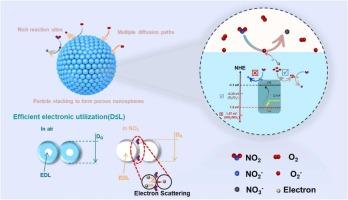
Conventional metal oxide semiconductor sensors frequently face challenges in detecting trace harmful gases at room temperature (RT) due to their limited sensing capabilities. Addressing this challenge, we construct a novel binary metal oxide sensors based on In6WO12 for the detection of NO2 at RT according to the synergistic effect of effective volume depletion and electron scattering. The sea urchin-like In6WO12 nanospheres with large surface area (124.5 cm2g−1) and multiple diffusion paths are assembled from 7.5 nm nanoparticles via an ethylenediamine-assisted coprecipitation method. Additionally, the decorating of Au atomic cluster with ∼4.5 nm further optimizes the surface reaction path of NO2. The 1 wt%Au-In6WO12 sensor demonstrates a remarkably high response value (203) to 2 ppm NO2 at RT, which was 54.8 times greater than that of the pristine In6WO12. Significantly, the sensor also shows exceptional selectivity, with a selectivity coefficient exceeding 98 %, and it can detect NO2 at concentrations as low as 1.73 ppb, outperforming state-of-the-art conventional MOS-based NO2 sensors. In-situ DRIFTS and energy band structures analyses confirm surface reaction processes of NO2 and elucidate the reasons for the optimization of surface reactions. Reaction kinetics calculations indicate that the reaction process is accelerated due to the anchoring of Au atomic clusters. The unprecedented NO2 sensing performances of the 1 wt%Au-In6WO12 sensor renders it an exceptional choice for precise real-time detection of ppb-level NO2 at RT, and offers a novel strategy to enhance NO2 sensing properties.
期刊介绍:
Sensors & Actuators, B: Chemical is an international journal focused on the research and development of chemical transducers. It covers chemical sensors and biosensors, chemical actuators, and analytical microsystems. The journal is interdisciplinary, aiming to publish original works showcasing substantial advancements beyond the current state of the art in these fields, with practical applicability to solving meaningful analytical problems. Review articles are accepted by invitation from an Editor of the journal.



 京公网安备 11010802042870号
京ICP备2023020795号-1
京公网安备 11010802042870号
京ICP备2023020795号-1

 分享
分享
 求助内容:
求助内容: 应助结果提醒方式:
 扫码关注我们
