Zhenhua Yang , Pan Du , Quanxi Zhang , Xiaopeng Fan , Xianyun Zheng , Yuexia Zhang , Chuan Dong
{"title":"Excitation wavelength-tuned dual-color carbon dots as a dual-channel sensing system for fluorescent and visual detection of Mn (VII) and Al (III)","authors":"Zhenhua Yang , Pan Du , Quanxi Zhang , Xiaopeng Fan , Xianyun Zheng , Yuexia Zhang , Chuan Dong","doi":"10.1016/j.apsusc.2025.163019","DOIUrl":null,"url":null,"abstract":"<div><div>Heavy metal pollution is posing a serious threat to the environment. However, the multichannel fluorescence sensor simultaneously detecting multiple metals is promising but challenging. In this work, excitation-dependent red and blue carbon dots (RBCDs) were synthesized through carbonization and amide reaction. RBCDs emitted red and blue fluorescence under different excitation wavelengths. Interestingly, the fluorescence of RBCDs embedded in PVA films and various paper matrics was highly stable. The fluorescence emission of RBCDs at 590 nm was effectively quenched by MnO<sub>4</sub><sup>-</sup> via the oxidation of RBCDs and the inner filter effect. Instead, the fluorescence at 485 nm could be effectively quenched by morin, whereas Al<sup>3+</sup> can reverse the quenching. Based on the interaction between RBCDs, MnO<sub>4</sub><sup>-</sup>, morin, and Al<sup>3+</sup>, dual-channel sensing systems for the analysis of MnO<sub>4</sub><sup>-</sup> and Al<sup>3+</sup> were successfully constructed. The established sensing systems exhibited excellent selectivity and practical applicability for detecting MnO<sub>4</sub><sup>-</sup> and Al<sup>3+</sup> in river water. These sensing systems offer several merits, such as low limits of detection (LOD), wide linear range, good anti-interference, and satisfactory detection reliability. These findings help to understand the behavior and distribution of these metal ions in the eco-environment, contributing to reinforcing resource management and strengthening environmental protection.</div></div>","PeriodicalId":247,"journal":{"name":"Applied Surface Science","volume":"697 ","pages":"Article 163019"},"PeriodicalIF":6.9000,"publicationDate":"2025-07-15","publicationTypes":"Journal Article","fieldsOfStudy":null,"isOpenAccess":false,"openAccessPdf":"","citationCount":"0","resultStr":null,"platform":"Semanticscholar","paperid":null,"PeriodicalName":"Applied Surface Science","FirstCategoryId":"88","ListUrlMain":"https://www.sciencedirect.com/science/article/pii/S0169433225007330","RegionNum":2,"RegionCategory":"材料科学","ArticlePicture":[],"TitleCN":null,"AbstractTextCN":null,"PMCID":null,"EPubDate":"2025/3/20 0:00:00","PubModel":"Epub","JCR":"Q2","JCRName":"CHEMISTRY, PHYSICAL","Score":null,"Total":0}
引用次数: 0
Abstract
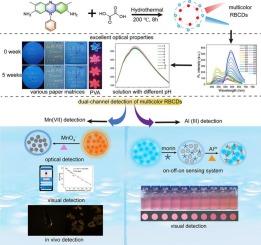
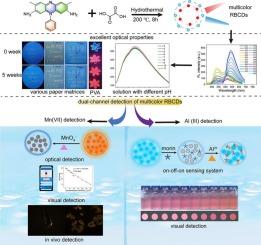
Heavy metal pollution is posing a serious threat to the environment. However, the multichannel fluorescence sensor simultaneously detecting multiple metals is promising but challenging. In this work, excitation-dependent red and blue carbon dots (RBCDs) were synthesized through carbonization and amide reaction. RBCDs emitted red and blue fluorescence under different excitation wavelengths. Interestingly, the fluorescence of RBCDs embedded in PVA films and various paper matrics was highly stable. The fluorescence emission of RBCDs at 590 nm was effectively quenched by MnO4- via the oxidation of RBCDs and the inner filter effect. Instead, the fluorescence at 485 nm could be effectively quenched by morin, whereas Al3+ can reverse the quenching. Based on the interaction between RBCDs, MnO4-, morin, and Al3+, dual-channel sensing systems for the analysis of MnO4- and Al3+ were successfully constructed. The established sensing systems exhibited excellent selectivity and practical applicability for detecting MnO4- and Al3+ in river water. These sensing systems offer several merits, such as low limits of detection (LOD), wide linear range, good anti-interference, and satisfactory detection reliability. These findings help to understand the behavior and distribution of these metal ions in the eco-environment, contributing to reinforcing resource management and strengthening environmental protection.
期刊介绍:
Applied Surface Science covers topics contributing to a better understanding of surfaces, interfaces, nanostructures and their applications. The journal is concerned with scientific research on the atomic and molecular level of material properties determined with specific surface analytical techniques and/or computational methods, as well as the processing of such structures.




 京公网安备 11010802042870号
京ICP备2023020795号-1
京公网安备 11010802042870号
京ICP备2023020795号-1

 分享
分享
 求助内容:
求助内容: 应助结果提醒方式:
 扫码关注我们
