Francisco Branco, Joana Cunha, Maria Mendes, João J. Sousa, Carla Vitorino
{"title":"3D Bioprinting Models for Glioblastoma: From Scaffold Design to Therapeutic Application","authors":"Francisco Branco, Joana Cunha, Maria Mendes, João J. Sousa, Carla Vitorino","doi":"10.1002/adma.202501994","DOIUrl":null,"url":null,"abstract":"<p>Conventional in vitro models fail to accurately mimic the tumor in vivo characteristics, being appointed as one of the causes of clinical attrition rate. Recent advances in 3D culture techniques, replicating essential physical and biochemical cues such as cell–cell and cell–extracellular matrix interactions, have led to the development of more realistic tumor models. Bioprinting has emerged to advance the creation of 3D in vitro models, providing enhanced flexibility, scalability, and reproducibility. This is crucial for the development of more effective drug treatments, and glioblastoma (GBM) is no exception. GBM, the most common and deadly brain cancer, remains a major challenge, with a median survival of only 15 months post-diagnosis. This review highlights the key components needed for 3D bioprinted GBM models. It encompasses an analysis of natural and synthetic biomaterials, along with crosslinking methods to improve structural integrity. Also, it critically evaluates current 3D bioprinted GBM models and their integration into GBM-on-a-chip platforms, which hold noteworthy potential for drug screening and personalized therapies. A versatile development framework grounded on Quality-by-Design principles is proposed to guide the design of bioprinting models. Future perspectives, including 4D bioprinting and machine learning approaches, are discussed, along with the current gaps to advance the field further.</p>","PeriodicalId":114,"journal":{"name":"Advanced Materials","volume":"37 18","pages":""},"PeriodicalIF":26.8000,"publicationDate":"2025-03-21","publicationTypes":"Journal Article","fieldsOfStudy":null,"isOpenAccess":false,"openAccessPdf":"","citationCount":"0","resultStr":null,"platform":"Semanticscholar","paperid":null,"PeriodicalName":"Advanced Materials","FirstCategoryId":"88","ListUrlMain":"https://advanced.onlinelibrary.wiley.com/doi/10.1002/adma.202501994","RegionNum":1,"RegionCategory":"材料科学","ArticlePicture":[],"TitleCN":null,"AbstractTextCN":null,"PMCID":null,"EPubDate":"","PubModel":"","JCR":"Q1","JCRName":"CHEMISTRY, MULTIDISCIPLINARY","Score":null,"Total":0}
引用次数: 0
Abstract
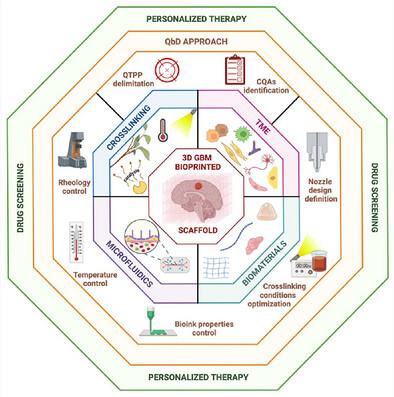
Conventional in vitro models fail to accurately mimic the tumor in vivo characteristics, being appointed as one of the causes of clinical attrition rate. Recent advances in 3D culture techniques, replicating essential physical and biochemical cues such as cell–cell and cell–extracellular matrix interactions, have led to the development of more realistic tumor models. Bioprinting has emerged to advance the creation of 3D in vitro models, providing enhanced flexibility, scalability, and reproducibility. This is crucial for the development of more effective drug treatments, and glioblastoma (GBM) is no exception. GBM, the most common and deadly brain cancer, remains a major challenge, with a median survival of only 15 months post-diagnosis. This review highlights the key components needed for 3D bioprinted GBM models. It encompasses an analysis of natural and synthetic biomaterials, along with crosslinking methods to improve structural integrity. Also, it critically evaluates current 3D bioprinted GBM models and their integration into GBM-on-a-chip platforms, which hold noteworthy potential for drug screening and personalized therapies. A versatile development framework grounded on Quality-by-Design principles is proposed to guide the design of bioprinting models. Future perspectives, including 4D bioprinting and machine learning approaches, are discussed, along with the current gaps to advance the field further.
期刊介绍:
Advanced Materials, one of the world's most prestigious journals and the foundation of the Advanced portfolio, is the home of choice for best-in-class materials science for more than 30 years. Following this fast-growing and interdisciplinary field, we are considering and publishing the most important discoveries on any and all materials from materials scientists, chemists, physicists, engineers as well as health and life scientists and bringing you the latest results and trends in modern materials-related research every week.






 京公网安备 11010802042870号
京ICP备2023020795号-1
京公网安备 11010802042870号
京ICP备2023020795号-1

 分享
分享
 求助内容:
求助内容: 应助结果提醒方式:
 扫码关注我们
