Oleksandr Cherniushok, Taras Parashchuk, G. Jeffrey Snyder, Krzysztof T. Wojciechowski
{"title":"Discovery of a New Cu-Based Chalcogenide with High zT Near Room Temperature: Low-Cost Alternative for the Bi2Te3-Based Thermoelectrics","authors":"Oleksandr Cherniushok, Taras Parashchuk, G. Jeffrey Snyder, Krzysztof T. Wojciechowski","doi":"10.1002/adma.202420556","DOIUrl":null,"url":null,"abstract":"<p>Copper-based chalcogenides are cost-effective and environmentally friendly thermoelectric (TE) materials for waste heat recovery. Despite demonstrating excellent thermoelectric performance, binary Cu<sub>2</sub><i>X</i> (<i>X</i> = S, Se, and Te) chalcogenides undergo superionic phase transitions above room temperature, leading to microstructural evolution and unstable properties. In this work, a new γ-phase of Cu<sub>6</sub>Te<sub>3-</sub><i><sub>x</sub></i>S<sub>1+</sub><i><sub>x</sub></i> (0 < <i>x</i> ≤ 1) is discovered, a narrow-bandgap semiconductor with outstanding thermoelectric performance and high stability. By substituting Te with S in metallic Cu<sub>6</sub>Te<sub>3</sub>S, the crystal symmetry is modified and structural phase transitions are eliminated. The γ-phase exhibits a significantly higher Seebeck coefficient of up to 200 µVK<sup>−1</sup> compared to 8.8 µVK<sup>−1</sup> for Cu<sub>6</sub>Te<sub>3</sub>S at room temperature due to optimized carrier concentration and increased effective mass. Cu<sub>6</sub>Te<sub>3-</sub><i><sub>x</sub></i>S<sub>1+</sub><i><sub>x</sub></i> materials also demonstrate ultralow thermal conductivity (≈0.25 Wm<sup>−1</sup>K<sup>−1</sup>), which, in concert with improved power factors, enables a high <i>zT</i> of ≈1.1 at a relatively low temperature of 500 K. Unlike most Cu-based chalcogenides, the γ-phase exhibits excellent transport property stability across multiple thermal cycles, making it a cost-effective and eco-friendly alternative to Bi<sub>2</sub>Te<sub>3</sub>-based materials. The developed Cu<sub>6</sub>Te<sub>3-</sub><i><sub>x</sub></i>S<sub>1+</sub><i><sub>x</sub></i> is a promising candidate for thermoelectric converters in waste heat recovery, and its potential can be further extended to cooling applications through carrier concentration tuning.</p>","PeriodicalId":114,"journal":{"name":"Advanced Materials","volume":"37 18","pages":""},"PeriodicalIF":26.8000,"publicationDate":"2025-03-21","publicationTypes":"Journal Article","fieldsOfStudy":null,"isOpenAccess":false,"openAccessPdf":"https://onlinelibrary.wiley.com/doi/epdf/10.1002/adma.202420556","citationCount":"0","resultStr":null,"platform":"Semanticscholar","paperid":null,"PeriodicalName":"Advanced Materials","FirstCategoryId":"88","ListUrlMain":"https://advanced.onlinelibrary.wiley.com/doi/10.1002/adma.202420556","RegionNum":1,"RegionCategory":"材料科学","ArticlePicture":[],"TitleCN":null,"AbstractTextCN":null,"PMCID":null,"EPubDate":"","PubModel":"","JCR":"Q1","JCRName":"CHEMISTRY, MULTIDISCIPLINARY","Score":null,"Total":0}
引用次数: 0
Abstract
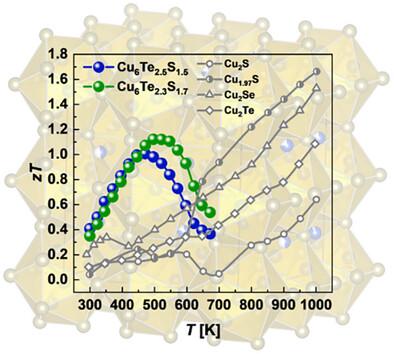
Copper-based chalcogenides are cost-effective and environmentally friendly thermoelectric (TE) materials for waste heat recovery. Despite demonstrating excellent thermoelectric performance, binary Cu2X (X = S, Se, and Te) chalcogenides undergo superionic phase transitions above room temperature, leading to microstructural evolution and unstable properties. In this work, a new γ-phase of Cu6Te3-xS1+x (0 < x ≤ 1) is discovered, a narrow-bandgap semiconductor with outstanding thermoelectric performance and high stability. By substituting Te with S in metallic Cu6Te3S, the crystal symmetry is modified and structural phase transitions are eliminated. The γ-phase exhibits a significantly higher Seebeck coefficient of up to 200 µVK−1 compared to 8.8 µVK−1 for Cu6Te3S at room temperature due to optimized carrier concentration and increased effective mass. Cu6Te3-xS1+x materials also demonstrate ultralow thermal conductivity (≈0.25 Wm−1K−1), which, in concert with improved power factors, enables a high zT of ≈1.1 at a relatively low temperature of 500 K. Unlike most Cu-based chalcogenides, the γ-phase exhibits excellent transport property stability across multiple thermal cycles, making it a cost-effective and eco-friendly alternative to Bi2Te3-based materials. The developed Cu6Te3-xS1+x is a promising candidate for thermoelectric converters in waste heat recovery, and its potential can be further extended to cooling applications through carrier concentration tuning.
期刊介绍:
Advanced Materials, one of the world's most prestigious journals and the foundation of the Advanced portfolio, is the home of choice for best-in-class materials science for more than 30 years. Following this fast-growing and interdisciplinary field, we are considering and publishing the most important discoveries on any and all materials from materials scientists, chemists, physicists, engineers as well as health and life scientists and bringing you the latest results and trends in modern materials-related research every week.






 京公网安备 11010802042870号
京ICP备2023020795号-1
京公网安备 11010802042870号
京ICP备2023020795号-1

 分享
分享
 求助内容:
求助内容: 应助结果提醒方式:
 扫码关注我们
