{"title":"Harnessing Bio-Inspired Axial Coordination to Boost Synergistic Effects for Enhanced Bifunctional Oxygen Electrocatalysis","authors":"Surajit Samui, Asif Iqbal, Ranjit Thapa, Ramendra Sundar Dey","doi":"10.1002/smll.202500911","DOIUrl":null,"url":null,"abstract":"<p>Strategic alteration of the chelating atoms around the metal center can modify the electronic band structure of the electrocatalyst, improving its performance in oxygen evolution and reduction reactions (OER/ORR). Advancements in the development of catalysts with heteroatoms and axial modifications in the coordination sphere are mostly limited to single-molecule electrocatalysts or elevated temperature-mediated pyrolysis approaches for oxygen electrocatalysis. Inspired by biological catalytic systems with axial coordination, a pyrolysis-free strategic methodology is adopted for the synthesis of an iron-metaled covalent organic polymer matrix axially laminated over cobalt-based metal-organic framework through an imidazole moiety. Precise engineering of coordination atoms in synthesized core-shell material, featuring dual metal sites with distinct neighboring atom exhibits mutual synergy due to the presence of bridging imidazole moiety between two metal sites. Modulated synergism navigates the electronic structure such that it favors specific reactant adsorption on specific metal sites during bifunctional O<sub>2</sub> electrocatalysis as confirmed through in situ Raman spectroscopy and in situ attenuated total reflection infrared (ATR-IR) spectroscopy. Through dynamic correlation between the in-situ studies and modified d-band center obtained theoretically, the pivotal role of axial coordination linkage mediated synergism favoring ORR/OER process via target-specific reactant adsorption is demonstrated.</p>","PeriodicalId":228,"journal":{"name":"Small","volume":"21 18","pages":""},"PeriodicalIF":12.1000,"publicationDate":"2025-03-21","publicationTypes":"Journal Article","fieldsOfStudy":null,"isOpenAccess":false,"openAccessPdf":"","citationCount":"0","resultStr":null,"platform":"Semanticscholar","paperid":null,"PeriodicalName":"Small","FirstCategoryId":"88","ListUrlMain":"https://onlinelibrary.wiley.com/doi/10.1002/smll.202500911","RegionNum":2,"RegionCategory":"材料科学","ArticlePicture":[],"TitleCN":null,"AbstractTextCN":null,"PMCID":null,"EPubDate":"","PubModel":"","JCR":"Q1","JCRName":"CHEMISTRY, MULTIDISCIPLINARY","Score":null,"Total":0}
引用次数: 0
Abstract
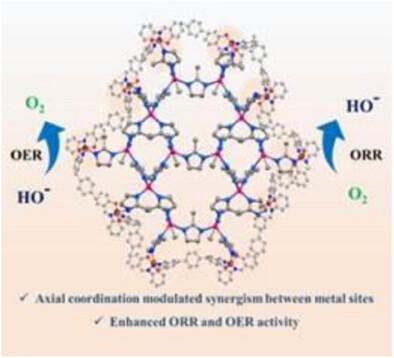
Strategic alteration of the chelating atoms around the metal center can modify the electronic band structure of the electrocatalyst, improving its performance in oxygen evolution and reduction reactions (OER/ORR). Advancements in the development of catalysts with heteroatoms and axial modifications in the coordination sphere are mostly limited to single-molecule electrocatalysts or elevated temperature-mediated pyrolysis approaches for oxygen electrocatalysis. Inspired by biological catalytic systems with axial coordination, a pyrolysis-free strategic methodology is adopted for the synthesis of an iron-metaled covalent organic polymer matrix axially laminated over cobalt-based metal-organic framework through an imidazole moiety. Precise engineering of coordination atoms in synthesized core-shell material, featuring dual metal sites with distinct neighboring atom exhibits mutual synergy due to the presence of bridging imidazole moiety between two metal sites. Modulated synergism navigates the electronic structure such that it favors specific reactant adsorption on specific metal sites during bifunctional O2 electrocatalysis as confirmed through in situ Raman spectroscopy and in situ attenuated total reflection infrared (ATR-IR) spectroscopy. Through dynamic correlation between the in-situ studies and modified d-band center obtained theoretically, the pivotal role of axial coordination linkage mediated synergism favoring ORR/OER process via target-specific reactant adsorption is demonstrated.
期刊介绍:
Small serves as an exceptional platform for both experimental and theoretical studies in fundamental and applied interdisciplinary research at the nano- and microscale. The journal offers a compelling mix of peer-reviewed Research Articles, Reviews, Perspectives, and Comments.
With a remarkable 2022 Journal Impact Factor of 13.3 (Journal Citation Reports from Clarivate Analytics, 2023), Small remains among the top multidisciplinary journals, covering a wide range of topics at the interface of materials science, chemistry, physics, engineering, medicine, and biology.
Small's readership includes biochemists, biologists, biomedical scientists, chemists, engineers, information technologists, materials scientists, physicists, and theoreticians alike.




 京公网安备 11010802042870号
京ICP备2023020795号-1
京公网安备 11010802042870号
京ICP备2023020795号-1

 分享
分享
 求助内容:
求助内容: 应助结果提醒方式:
 扫码关注我们
