Ag-ZnO Nanoflowers Enable Highly Selective Photocatalytic Conversion of CH4 to CH3OH at Atmospheric Pressure: Unraveling Reactive Interfaces and Intermediate Control
{"title":"Ag-ZnO Nanoflowers Enable Highly Selective Photocatalytic Conversion of CH4 to CH3OH at Atmospheric Pressure: Unraveling Reactive Interfaces and Intermediate Control","authors":"Boshi Zheng, Yi Wan, Qi Hua, Wenbin Wang, Shuai Wang, Zhengchao Wang, Yajun Zhang, Shuxu Zhu, Haonan Zhang, Minjun Zhou, Mingbo Wu, Wenting Wu","doi":"10.1002/smll.202501237","DOIUrl":null,"url":null,"abstract":"<p>At atmospheric pressure, the main challenge in the photocatalytic oxidation of CH<sub>4</sub> to CH<sub>3</sub>OH is to absorb and activate the inert C─H bond while preventing excessive oxidation of CH<sub>3</sub>OH. In this study, metal-supported ZnO nanoflowers (Ag-ZnO) are designed to produce abundant active interfacial oxygen sites for CH<sub>4</sub> oxidation at atmospheric pressure, with a CH<sub>3</sub>OH yield reaching 1300 µmol g<sub>cat</sub>\n <sup>−1</sup> h<sup>−1</sup> and the selectivity is 94%. DFT calculation and in situ analysis show that the addition of Ag regulates the electron state density and band center of O, which is beneficial to the adsorption of CH<sub>4</sub>, and decreases the dissociation energy barrier of C─H bond at O<sub>L</sub>(Lattice oxygen) site. The further selective conversion of ·CH<sub>3</sub> to CH<sub>3</sub>OH involves two different pathways: one pathway consists of the oxidation of ·CH<sub>3</sub> by O<sub>L</sub>, and the other pathway is the combination of ·CH<sub>3</sub> and ·OH generated from dissolved O<sub>2</sub> (0.28 m<span>m</span>) in water. Notably, in the photochemical flow device, the yield of CH<sub>3</sub>OH is increased to 5200 µmol g<sub>cat</sub>\n <sup>−1</sup> h<sup>−1</sup> and the selectivity is close to 100%. This work offers valuable insights into reactive interfaces, morphological engineering, and the control of intermediate evolution toward selective conversion of CH<sub>4</sub> to oxygenates at atmospheric pressure.</p>","PeriodicalId":228,"journal":{"name":"Small","volume":"21 18","pages":""},"PeriodicalIF":12.1000,"publicationDate":"2025-03-21","publicationTypes":"Journal Article","fieldsOfStudy":null,"isOpenAccess":false,"openAccessPdf":"","citationCount":"0","resultStr":null,"platform":"Semanticscholar","paperid":null,"PeriodicalName":"Small","FirstCategoryId":"88","ListUrlMain":"https://onlinelibrary.wiley.com/doi/10.1002/smll.202501237","RegionNum":2,"RegionCategory":"材料科学","ArticlePicture":[],"TitleCN":null,"AbstractTextCN":null,"PMCID":null,"EPubDate":"","PubModel":"","JCR":"Q1","JCRName":"CHEMISTRY, MULTIDISCIPLINARY","Score":null,"Total":0}
引用次数: 0
Abstract
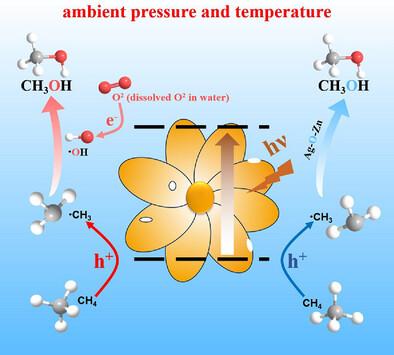
At atmospheric pressure, the main challenge in the photocatalytic oxidation of CH4 to CH3OH is to absorb and activate the inert C─H bond while preventing excessive oxidation of CH3OH. In this study, metal-supported ZnO nanoflowers (Ag-ZnO) are designed to produce abundant active interfacial oxygen sites for CH4 oxidation at atmospheric pressure, with a CH3OH yield reaching 1300 µmol gcat−1 h−1 and the selectivity is 94%. DFT calculation and in situ analysis show that the addition of Ag regulates the electron state density and band center of O, which is beneficial to the adsorption of CH4, and decreases the dissociation energy barrier of C─H bond at OL(Lattice oxygen) site. The further selective conversion of ·CH3 to CH3OH involves two different pathways: one pathway consists of the oxidation of ·CH3 by OL, and the other pathway is the combination of ·CH3 and ·OH generated from dissolved O2 (0.28 mm) in water. Notably, in the photochemical flow device, the yield of CH3OH is increased to 5200 µmol gcat−1 h−1 and the selectivity is close to 100%. This work offers valuable insights into reactive interfaces, morphological engineering, and the control of intermediate evolution toward selective conversion of CH4 to oxygenates at atmospheric pressure.
期刊介绍:
Small serves as an exceptional platform for both experimental and theoretical studies in fundamental and applied interdisciplinary research at the nano- and microscale. The journal offers a compelling mix of peer-reviewed Research Articles, Reviews, Perspectives, and Comments.
With a remarkable 2022 Journal Impact Factor of 13.3 (Journal Citation Reports from Clarivate Analytics, 2023), Small remains among the top multidisciplinary journals, covering a wide range of topics at the interface of materials science, chemistry, physics, engineering, medicine, and biology.
Small's readership includes biochemists, biologists, biomedical scientists, chemists, engineers, information technologists, materials scientists, physicists, and theoreticians alike.




 京公网安备 11010802042870号
京ICP备2023020795号-1
京公网安备 11010802042870号
京ICP备2023020795号-1

 分享
分享
 求助内容:
求助内容: 应助结果提醒方式:
 扫码关注我们
