{"title":"Non-targeted lipidomics reveals the distinct metabolic mechanisms of nZnO and Zn ions in fish liver†","authors":"Shuoli Ma and Wen-Xiong Wang","doi":"10.1039/D5EN00160A","DOIUrl":null,"url":null,"abstract":"<p >The toxicity of environmental pollutants often manifests as metabolic disruptions and damage to detoxification organs. However, current understanding cannot explain physiological response mechanisms of metabolically abnormal fish exposed to secondary pollutants in complex natural environments. This study established a fish model with a non-alcoholic fatty liver to evaluate the effects of Zn oxide nanoparticles (<em>n</em>ZnO) and Zn<small><sup>2+</sup></small> on physiological metabolism, using untargeted lipidomic and bioimaging techniques. Nile red and hematoxylin and eosin (H&E) staining indicated that increased Zn levels reduced the number of lipid droplets (LDs) and hepatocyte vacuolization in the livers of groupers. Non-targeted lipidomics, employing an unsupervised K-means clustering algorithm, identified key lipid profiles that differentiated the effects of <em>n</em>ZnO and Zn, including TG (16 : 0/16 : 1/18 : 1), PC (18 : 2/22 : 6), TG (18 : 2/18 : 2/22 : 6), SM (d18 : 1/24 : 1), and TG (16 : 1/18 : 1/18 : 2). The increased content of SM (d18 : 1/24 : 0) indicated that fish liver cells internalized <em>n</em>ZnO <em>via</em> lipid raft structures on the cell membrane, a process distinct from Zn ion uptake. Moreover, <em>n</em>ZnO/Zn treatments significantly activated lipolysis regulation in fish livers under oxidative stress. This study used non-targeted lipidomics to identify differential biomarkers of <em>n</em>ZnO and Zn, as well as their compensatory mechanisms in metabolically abnormal fish. These findings provide novel insights into the effects of nanometal exposure on aquatic animal health in complex environments.</p>","PeriodicalId":73,"journal":{"name":"Environmental Science: Nano","volume":" 5","pages":" 2775-2787"},"PeriodicalIF":5.1000,"publicationDate":"2025-03-21","publicationTypes":"Journal Article","fieldsOfStudy":null,"isOpenAccess":false,"openAccessPdf":"","citationCount":"0","resultStr":null,"platform":"Semanticscholar","paperid":null,"PeriodicalName":"Environmental Science: Nano","FirstCategoryId":"6","ListUrlMain":"https://pubs.rsc.org/en/content/articlelanding/2025/en/d5en00160a","RegionNum":2,"RegionCategory":"环境科学与生态学","ArticlePicture":[],"TitleCN":null,"AbstractTextCN":null,"PMCID":null,"EPubDate":"","PubModel":"","JCR":"Q1","JCRName":"CHEMISTRY, MULTIDISCIPLINARY","Score":null,"Total":0}
引用次数: 0
Abstract
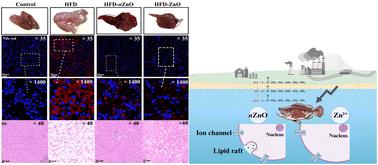
The toxicity of environmental pollutants often manifests as metabolic disruptions and damage to detoxification organs. However, current understanding cannot explain physiological response mechanisms of metabolically abnormal fish exposed to secondary pollutants in complex natural environments. This study established a fish model with a non-alcoholic fatty liver to evaluate the effects of Zn oxide nanoparticles (nZnO) and Zn2+ on physiological metabolism, using untargeted lipidomic and bioimaging techniques. Nile red and hematoxylin and eosin (H&E) staining indicated that increased Zn levels reduced the number of lipid droplets (LDs) and hepatocyte vacuolization in the livers of groupers. Non-targeted lipidomics, employing an unsupervised K-means clustering algorithm, identified key lipid profiles that differentiated the effects of nZnO and Zn, including TG (16 : 0/16 : 1/18 : 1), PC (18 : 2/22 : 6), TG (18 : 2/18 : 2/22 : 6), SM (d18 : 1/24 : 1), and TG (16 : 1/18 : 1/18 : 2). The increased content of SM (d18 : 1/24 : 0) indicated that fish liver cells internalized nZnO via lipid raft structures on the cell membrane, a process distinct from Zn ion uptake. Moreover, nZnO/Zn treatments significantly activated lipolysis regulation in fish livers under oxidative stress. This study used non-targeted lipidomics to identify differential biomarkers of nZnO and Zn, as well as their compensatory mechanisms in metabolically abnormal fish. These findings provide novel insights into the effects of nanometal exposure on aquatic animal health in complex environments.
期刊介绍:
Environmental Science: Nano serves as a comprehensive and high-impact peer-reviewed source of information on the design and demonstration of engineered nanomaterials for environment-based applications. It also covers the interactions between engineered, natural, and incidental nanomaterials with biological and environmental systems. This scope includes, but is not limited to, the following topic areas:
Novel nanomaterial-based applications for water, air, soil, food, and energy sustainability
Nanomaterial interactions with biological systems and nanotoxicology
Environmental fate, reactivity, and transformations of nanoscale materials
Nanoscale processes in the environment
Sustainable nanotechnology including rational nanomaterial design, life cycle assessment, risk/benefit analysis



 京公网安备 11010802042870号
京ICP备2023020795号-1
京公网安备 11010802042870号
京ICP备2023020795号-1

 分享
分享
 求助内容:
求助内容: 应助结果提醒方式:
 扫码关注我们
