{"title":"Nanomaterials ROS: a comprehensive review for environmental applications","authors":"Vishakha Takhar and Simranjit Singh","doi":"10.1039/D5EN00049A","DOIUrl":null,"url":null,"abstract":"<p >Reactive oxygen species (ROS) are crucial for environmental remediation, and nanomaterials have proven to be extremely effective catalysts for the utilization of ROS to degrade pollutants. This review presents a critical analysis of advanced ROS-generating nanomaterials such as metal oxides, two-dimensional (2D) materials, carbon-based materials, perovskites, and hybrid composites, along with various external triggers for ROS generation. There is a special emphasis on heterojunctions and upconversion systems, which boost charge transfer, band alignment, and interfacial interactions to maximize ROS generation. In contrast to other earlier research that emphasizes the use of particular material categories or biomedical purposes, this review gives special prominence to the environmental applications of nanomaterials, specifically in wastewater treatment. The novelty of this research is in the detailed discussion of hybrid materials, their mechanisms for ROS generation, and the convergence of defect engineering, plasmonic effects, heterostructures, and upconversion strategies toward improved photocatalytic performance. In addition, it critically assesses major challenges including material stability, scalability, environmental compatibility, and the demand for green synthesis methods. Research avenues for the future include devising standardized quantification protocols of ROS, computation-assisted design of materials, and large-scale fabrication methods for translating nanotechnology to real-world application. By addressing these research gaps, this review offers valuable insights into the advancement of next-generation ROS-based nanotechnologies, paving the way for their sustainable and effective implementation in environmental remediation.</p>","PeriodicalId":73,"journal":{"name":"Environmental Science: Nano","volume":" 5","pages":" 2516-2550"},"PeriodicalIF":5.1000,"publicationDate":"2025-03-21","publicationTypes":"Journal Article","fieldsOfStudy":null,"isOpenAccess":false,"openAccessPdf":"","citationCount":"0","resultStr":null,"platform":"Semanticscholar","paperid":null,"PeriodicalName":"Environmental Science: Nano","FirstCategoryId":"6","ListUrlMain":"https://pubs.rsc.org/en/content/articlelanding/2025/en/d5en00049a","RegionNum":2,"RegionCategory":"环境科学与生态学","ArticlePicture":[],"TitleCN":null,"AbstractTextCN":null,"PMCID":null,"EPubDate":"","PubModel":"","JCR":"Q1","JCRName":"CHEMISTRY, MULTIDISCIPLINARY","Score":null,"Total":0}
引用次数: 0
Abstract
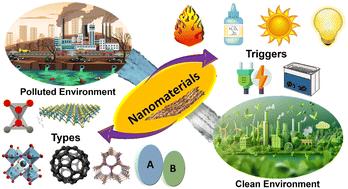
Reactive oxygen species (ROS) are crucial for environmental remediation, and nanomaterials have proven to be extremely effective catalysts for the utilization of ROS to degrade pollutants. This review presents a critical analysis of advanced ROS-generating nanomaterials such as metal oxides, two-dimensional (2D) materials, carbon-based materials, perovskites, and hybrid composites, along with various external triggers for ROS generation. There is a special emphasis on heterojunctions and upconversion systems, which boost charge transfer, band alignment, and interfacial interactions to maximize ROS generation. In contrast to other earlier research that emphasizes the use of particular material categories or biomedical purposes, this review gives special prominence to the environmental applications of nanomaterials, specifically in wastewater treatment. The novelty of this research is in the detailed discussion of hybrid materials, their mechanisms for ROS generation, and the convergence of defect engineering, plasmonic effects, heterostructures, and upconversion strategies toward improved photocatalytic performance. In addition, it critically assesses major challenges including material stability, scalability, environmental compatibility, and the demand for green synthesis methods. Research avenues for the future include devising standardized quantification protocols of ROS, computation-assisted design of materials, and large-scale fabrication methods for translating nanotechnology to real-world application. By addressing these research gaps, this review offers valuable insights into the advancement of next-generation ROS-based nanotechnologies, paving the way for their sustainable and effective implementation in environmental remediation.
期刊介绍:
Environmental Science: Nano serves as a comprehensive and high-impact peer-reviewed source of information on the design and demonstration of engineered nanomaterials for environment-based applications. It also covers the interactions between engineered, natural, and incidental nanomaterials with biological and environmental systems. This scope includes, but is not limited to, the following topic areas:
Novel nanomaterial-based applications for water, air, soil, food, and energy sustainability
Nanomaterial interactions with biological systems and nanotoxicology
Environmental fate, reactivity, and transformations of nanoscale materials
Nanoscale processes in the environment
Sustainable nanotechnology including rational nanomaterial design, life cycle assessment, risk/benefit analysis



 京公网安备 11010802042870号
京ICP备2023020795号-1
京公网安备 11010802042870号
京ICP备2023020795号-1

 分享
分享
 求助内容:
求助内容: 应助结果提醒方式:
 扫码关注我们
