Qingyang Shi, Dahang Shen, Rebecca Yates, Catherine Chou, Andrea Barajas, Jingjing Zhang, Daniel Schlenk, Jay Gan
{"title":"Safe Reuse of Treated Wastewater: Accumulation of Contaminants of Emerging Concern in Field-Grown Vegetables under Different Irrigation Schemes","authors":"Qingyang Shi, Dahang Shen, Rebecca Yates, Catherine Chou, Andrea Barajas, Jingjing Zhang, Daniel Schlenk, Jay Gan","doi":"10.1021/acs.est.4c13666","DOIUrl":null,"url":null,"abstract":"The reuse of treated wastewater (TWW) for irrigation alleviates freshwater (FW) scarcity while supporting a circular economy. However, the potential human exposure to contaminants of emerging concern (CECs) through plant accumulation is a significant barrier. Currently, knowledge on CEC contamination of edible produce and effective mitigation strategies for the safe reuse of TWW is limited, particularly under field conditions. This study examined the accumulation of a representative set of CECs, including perfluoroalkyl and polyfluoroalkyl substances (PFAS), pharmaceuticals and personal care products, and tire wear particle (TWP) chemicals, in radish, lettuce, and tomato under three irrigation practices: FULL (continuous TWW irrigation), HALF (midseason switch from TWW to FW), and FW-only. Despite low PFAS concentrations (8.1–25.7 ng/L) in TWW, the plant uptake was consistently observed, including in tomato fruits. Alternating TWW with FW significantly reduced CEC accumulation in edible tissues, particularly for compounds with short half-lives, with reductions up to 82.4% even for persistent PFAS. For most CECs and plant species, edible tissue concentrations were similar between the HALF and FW treatments. These findings demonstrate the on-farm applicability of simple irrigation modifications to reduce food contamination and contribute to the promotion of safe reuse of nonconventional waters.","PeriodicalId":36,"journal":{"name":"环境科学与技术","volume":"61 1","pages":""},"PeriodicalIF":11.3000,"publicationDate":"2025-03-20","publicationTypes":"Journal Article","fieldsOfStudy":null,"isOpenAccess":false,"openAccessPdf":"","citationCount":"0","resultStr":null,"platform":"Semanticscholar","paperid":null,"PeriodicalName":"环境科学与技术","FirstCategoryId":"1","ListUrlMain":"https://doi.org/10.1021/acs.est.4c13666","RegionNum":1,"RegionCategory":"环境科学与生态学","ArticlePicture":[],"TitleCN":null,"AbstractTextCN":null,"PMCID":null,"EPubDate":"","PubModel":"","JCR":"Q1","JCRName":"ENGINEERING, ENVIRONMENTAL","Score":null,"Total":0}
引用次数: 0
Abstract
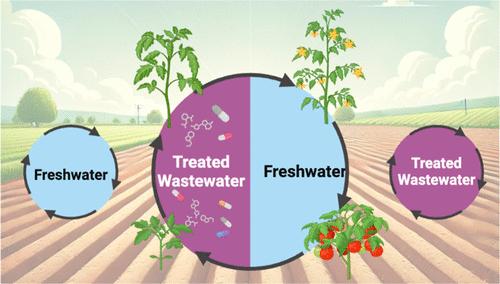
The reuse of treated wastewater (TWW) for irrigation alleviates freshwater (FW) scarcity while supporting a circular economy. However, the potential human exposure to contaminants of emerging concern (CECs) through plant accumulation is a significant barrier. Currently, knowledge on CEC contamination of edible produce and effective mitigation strategies for the safe reuse of TWW is limited, particularly under field conditions. This study examined the accumulation of a representative set of CECs, including perfluoroalkyl and polyfluoroalkyl substances (PFAS), pharmaceuticals and personal care products, and tire wear particle (TWP) chemicals, in radish, lettuce, and tomato under three irrigation practices: FULL (continuous TWW irrigation), HALF (midseason switch from TWW to FW), and FW-only. Despite low PFAS concentrations (8.1–25.7 ng/L) in TWW, the plant uptake was consistently observed, including in tomato fruits. Alternating TWW with FW significantly reduced CEC accumulation in edible tissues, particularly for compounds with short half-lives, with reductions up to 82.4% even for persistent PFAS. For most CECs and plant species, edible tissue concentrations were similar between the HALF and FW treatments. These findings demonstrate the on-farm applicability of simple irrigation modifications to reduce food contamination and contribute to the promotion of safe reuse of nonconventional waters.
期刊介绍:
Environmental Science & Technology (ES&T) is a co-sponsored academic and technical magazine by the Hubei Provincial Environmental Protection Bureau and the Hubei Provincial Academy of Environmental Sciences.
Environmental Science & Technology (ES&T) holds the status of Chinese core journals, scientific papers source journals of China, Chinese Science Citation Database source journals, and Chinese Academic Journal Comprehensive Evaluation Database source journals. This publication focuses on the academic field of environmental protection, featuring articles related to environmental protection and technical advancements.




 京公网安备 11010802042870号
京ICP备2023020795号-1
京公网安备 11010802042870号
京ICP备2023020795号-1

 分享
分享
 求助内容:
求助内容: 应助结果提醒方式:
 扫码关注我们
