Min Gong, Xiaobo Wang, Heng An, You Wu, Liang Zhang, Xiang Lin, Fengxian Gao, Zhen Wu, Dongrui Wang
{"title":"Supramolecular Zwitterionic Network Enabling Environment-Tolerant, Transparent, Adhesive, and Biocompatible Organogel for Epidermal Electronics","authors":"Min Gong, Xiaobo Wang, Heng An, You Wu, Liang Zhang, Xiang Lin, Fengxian Gao, Zhen Wu, Dongrui Wang","doi":"10.1021/acsmacrolett.5c00098","DOIUrl":null,"url":null,"abstract":"Ionic hydrogels are ideal for soft bioelectronics due to their softness, stretchability, and ion-mediated signal transduction. However, traditional hydrogels face dehydration and freezing issues. Inspired by natural skin, this study creates a supramolecular ionic organogel using silk fibroin, zwitterionic polymers, Ca<sup>2+</sup>, and ethylene glycol (EG). The organogel is conductive, highly stretchable, adhesive, environmentally stable, and biocompatible. Theoretical calculations reveal that interactions among Ca<sup>2+</sup>, zwitterionic groups, EG, and water are stronger than water–water interactions, converting “free” water into “locked” water. This mechanism allows the organogel to retain over 90% of its weight after 30 days at 25 °C and 60% relative humidity, while also resisting freezing by disrupting ice formation. Its conductivity, adhesion, and biocompatibility enable applications in on-skin strain sensors and electrodes for monitoring motion and recording electrophysiological signals. This work elucidates molecular interactions in organogel networks, provides a design framework for environmentally tolerant organogel, and advances ion-conductive bioelectronics.","PeriodicalId":18,"journal":{"name":"ACS Macro Letters","volume":"37 1","pages":""},"PeriodicalIF":5.2000,"publicationDate":"2025-03-20","publicationTypes":"Journal Article","fieldsOfStudy":null,"isOpenAccess":false,"openAccessPdf":"","citationCount":"0","resultStr":null,"platform":"Semanticscholar","paperid":null,"PeriodicalName":"ACS Macro Letters","FirstCategoryId":"92","ListUrlMain":"https://doi.org/10.1021/acsmacrolett.5c00098","RegionNum":0,"RegionCategory":null,"ArticlePicture":[],"TitleCN":null,"AbstractTextCN":null,"PMCID":null,"EPubDate":"","PubModel":"","JCR":"Q1","JCRName":"POLYMER SCIENCE","Score":null,"Total":0}
引用次数: 0
Abstract
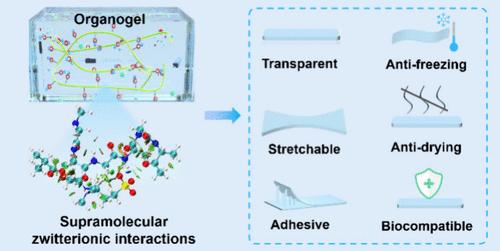
Ionic hydrogels are ideal for soft bioelectronics due to their softness, stretchability, and ion-mediated signal transduction. However, traditional hydrogels face dehydration and freezing issues. Inspired by natural skin, this study creates a supramolecular ionic organogel using silk fibroin, zwitterionic polymers, Ca2+, and ethylene glycol (EG). The organogel is conductive, highly stretchable, adhesive, environmentally stable, and biocompatible. Theoretical calculations reveal that interactions among Ca2+, zwitterionic groups, EG, and water are stronger than water–water interactions, converting “free” water into “locked” water. This mechanism allows the organogel to retain over 90% of its weight after 30 days at 25 °C and 60% relative humidity, while also resisting freezing by disrupting ice formation. Its conductivity, adhesion, and biocompatibility enable applications in on-skin strain sensors and electrodes for monitoring motion and recording electrophysiological signals. This work elucidates molecular interactions in organogel networks, provides a design framework for environmentally tolerant organogel, and advances ion-conductive bioelectronics.
期刊介绍:
ACS Macro Letters publishes research in all areas of contemporary soft matter science in which macromolecules play a key role, including nanotechnology, self-assembly, supramolecular chemistry, biomaterials, energy generation and storage, and renewable/sustainable materials. Submissions to ACS Macro Letters should justify clearly the rapid disclosure of the key elements of the study. The scope of the journal includes high-impact research of broad interest in all areas of polymer science and engineering, including cross-disciplinary research that interfaces with polymer science.
With the launch of ACS Macro Letters, all Communications that were formerly published in Macromolecules and Biomacromolecules will be published as Letters in ACS Macro Letters.



 京公网安备 11010802042870号
京ICP备2023020795号-1
京公网安备 11010802042870号
京ICP备2023020795号-1

 分享
分享
 求助内容:
求助内容: 应助结果提醒方式:
 扫码关注我们
