Yu Liu, Gongli Wei, Yutian Jiao, Baocai Xu and Li Zhao
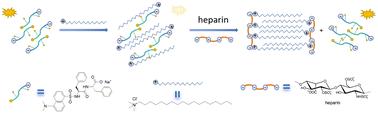
{"title":"Sensitive fluorescence detection of heparin based on the assembly of a cationic surfactant and an anionic dye†","authors":"Yu Liu, Gongli Wei, Yutian Jiao, Baocai Xu and Li Zhao","doi":"10.1039/D5AN00154D","DOIUrl":null,"url":null,"abstract":"<p >A highly sensitive sensing system for heparin has been developed using a synthetic fluorescent dye, <small>L</small>-phenylalanyl-<small>L</small>-phenylalanine-modified dansyl (FF-Dns), in combination with the cationic surfactant octadecyltrimethylammonium chloride (OTAC). At low concentrations, FF-Dns and OTAC self-assemble, leading to a reduction in the fluorescence intensity of the dansyl group. However, upon the introduction of heparin, the electrostatic binding between OTAC and heparin disrupts the self-assembly, effectively releasing FF-Dns and restoring its fluorescence. This system shows exceptional selectivity for heparin over a range of potential interfering substances. The detection limit for heparin was determined to be 31.7 ng mL<small><sup>−1</sup></small>, with a linear response range of 0–4 μg mL<small><sup>−1</sup></small>. In addition, a “turn-on” fluorescence-based assay platform using FF-Dns/OTAC was successfully established in 0.2% serum with a detection limit of 30.57 ng mL<small><sup>−1</sup></small> and a linear span of 0–5 μg mL<small><sup>−1</sup></small>. In addition, the FF-Dns/OTAC/heparin mixture was identified as a potential sensing platform for protamine, exploiting the strong binding affinity between protamine and heparin.</p>","PeriodicalId":63,"journal":{"name":"Analyst","volume":" 9","pages":" 1920-1928"},"PeriodicalIF":3.3000,"publicationDate":"2025-03-21","publicationTypes":"Journal Article","fieldsOfStudy":null,"isOpenAccess":false,"openAccessPdf":"","citationCount":"0","resultStr":null,"platform":"Semanticscholar","paperid":null,"PeriodicalName":"Analyst","FirstCategoryId":"92","ListUrlMain":"https://pubs.rsc.org/en/content/articlelanding/2025/an/d5an00154d","RegionNum":3,"RegionCategory":"化学","ArticlePicture":[],"TitleCN":null,"AbstractTextCN":null,"PMCID":null,"EPubDate":"","PubModel":"","JCR":"Q2","JCRName":"CHEMISTRY, ANALYTICAL","Score":null,"Total":0}
引用次数: 0
Abstract
A highly sensitive sensing system for heparin has been developed using a synthetic fluorescent dye, L-phenylalanyl-L-phenylalanine-modified dansyl (FF-Dns), in combination with the cationic surfactant octadecyltrimethylammonium chloride (OTAC). At low concentrations, FF-Dns and OTAC self-assemble, leading to a reduction in the fluorescence intensity of the dansyl group. However, upon the introduction of heparin, the electrostatic binding between OTAC and heparin disrupts the self-assembly, effectively releasing FF-Dns and restoring its fluorescence. This system shows exceptional selectivity for heparin over a range of potential interfering substances. The detection limit for heparin was determined to be 31.7 ng mL−1, with a linear response range of 0–4 μg mL−1. In addition, a “turn-on” fluorescence-based assay platform using FF-Dns/OTAC was successfully established in 0.2% serum with a detection limit of 30.57 ng mL−1 and a linear span of 0–5 μg mL−1. In addition, the FF-Dns/OTAC/heparin mixture was identified as a potential sensing platform for protamine, exploiting the strong binding affinity between protamine and heparin.




 京公网安备 11010802042870号
京ICP备2023020795号-1
京公网安备 11010802042870号
京ICP备2023020795号-1

 分享
分享
 求助内容:
求助内容: 应助结果提醒方式:
 扫码关注我们
