{"title":"A Novel Approach to Determine and Maintain Area-Wise Minimum Inertia in Renewable Energy Dominated Power Systems","authors":"Pijush Kanti Dhara;Zakir Hussain Rather","doi":"10.1109/TSTE.2024.3502193","DOIUrl":null,"url":null,"abstract":"The rapid displacement of synchronous generators by increased penetration of inverter-based resources (IBR) in power system areas that are potentially rich in renewable energy can lead to spatial non-uniform distribution of synchronous inertia. Consequently, even if the overall minimum inertia (MI) of the system is maintained, certain areas may experience stability issues, which would breach grid-code limits for the rate of change of frequency (RoCoF) following a contingency. Given this context, a method to determine the MI that is specific to individual areas is introduced. Additionally, a method for redistributing surplus inertia from high-inertia areas to low inertia areas is introduced by reducing electrical distance between the nodes. This approach utilizes green corridors, which are additional transmission lines that are established to evacuate surplus renewable power to the areas with higher demand and fossil-fueled-based generation, as pathways to transfer inertia. Furthermore, a machine-learning-assisted technique to compensate for shortfall in area-wise MI by placing new synchronous inertia compensators is proposed. Using this method, system operators can identify the location and size of synchronous or virtual inertia that may be required. The amount of additionally required inertia is quantified by the size of synchronous inertia compensators, to uphold area-specific RoCoF in renewable energy-integrated power systems. The proposed methodology is tested and validated in the modified IEEE-39 bus system.","PeriodicalId":452,"journal":{"name":"IEEE Transactions on Sustainable Energy","volume":"16 2","pages":"1084-1097"},"PeriodicalIF":10.0000,"publicationDate":"2024-11-19","publicationTypes":"Journal Article","fieldsOfStudy":null,"isOpenAccess":false,"openAccessPdf":"","citationCount":"0","resultStr":null,"platform":"Semanticscholar","paperid":null,"PeriodicalName":"IEEE Transactions on Sustainable Energy","FirstCategoryId":"5","ListUrlMain":"https://ieeexplore.ieee.org/document/10758198/","RegionNum":1,"RegionCategory":"工程技术","ArticlePicture":[],"TitleCN":null,"AbstractTextCN":null,"PMCID":null,"EPubDate":"","PubModel":"","JCR":"Q1","JCRName":"ENERGY & FUELS","Score":null,"Total":0}
引用次数: 0
Abstract
The rapid displacement of synchronous generators by increased penetration of inverter-based resources (IBR) in power system areas that are potentially rich in renewable energy can lead to spatial non-uniform distribution of synchronous inertia. Consequently, even if the overall minimum inertia (MI) of the system is maintained, certain areas may experience stability issues, which would breach grid-code limits for the rate of change of frequency (RoCoF) following a contingency. Given this context, a method to determine the MI that is specific to individual areas is introduced. Additionally, a method for redistributing surplus inertia from high-inertia areas to low inertia areas is introduced by reducing electrical distance between the nodes. This approach utilizes green corridors, which are additional transmission lines that are established to evacuate surplus renewable power to the areas with higher demand and fossil-fueled-based generation, as pathways to transfer inertia. Furthermore, a machine-learning-assisted technique to compensate for shortfall in area-wise MI by placing new synchronous inertia compensators is proposed. Using this method, system operators can identify the location and size of synchronous or virtual inertia that may be required. The amount of additionally required inertia is quantified by the size of synchronous inertia compensators, to uphold area-specific RoCoF in renewable energy-integrated power systems. The proposed methodology is tested and validated in the modified IEEE-39 bus system.
期刊介绍:
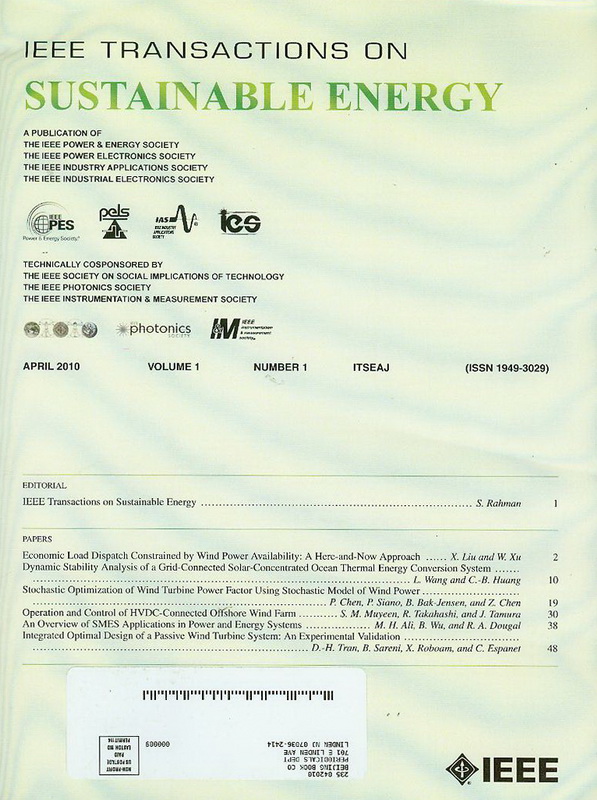
The IEEE Transactions on Sustainable Energy serves as a pivotal platform for sharing groundbreaking research findings on sustainable energy systems, with a focus on their seamless integration into power transmission and/or distribution grids. The journal showcases original research spanning the design, implementation, grid-integration, and control of sustainable energy technologies and systems. Additionally, the Transactions warmly welcomes manuscripts addressing the design, implementation, and evaluation of power systems influenced by sustainable energy systems and devices.



 京公网安备 11010802042870号
京ICP备2023020795号-1
京公网安备 11010802042870号
京ICP备2023020795号-1

 分享
分享
 求助内容:
求助内容: 应助结果提醒方式:
 扫码关注我们
