{"title":"Cooperative Strategies for Frequency Control of Wind Turbines to Mitigate Secondary Frequency Dip: Coefficient Allocation and Exit Techniques","authors":"Zishuo Huang;Wenchuan Wu;Chenhui Lin;Zizhen Guo","doi":"10.1109/TSTE.2024.3498006","DOIUrl":null,"url":null,"abstract":"With the increasing integration of wind power into the power system, the incorporation of wind turbines into the grid's primary frequency regulation through inertia and droop control has been proven effective. However, a phenomenon known as secondary frequency dip (SFD) occurs when wind generators exit frequency regulation to restore the turbines’ speeds. This paper introduces a cooperative approach to mitigate SFD. Initially, a system frequency response model is established, incorporating the combined effects of synchronous generators and wind turbines. Subsequently, a model to forecast the rotational speed of each wind turbine in response to load changes is developed. Based on these models, the droop and inertia coefficients of different turbines in a wind farm are optimized to minimize overall wind energy loss during frequency regulation, thereby alleviating SFD, while ensuring the rotational speed remains within a safe range. Additionally, a smooth transition strategy based on a low-pass filter is proposed to prevent an abrupt decrease in active power as turbines exit frequency regulation. Finally, to prevent a simultaneous drop in active power among a large number of wind turbines, a sequential exit strategy from frequency regulation is proposed. Simulation results validate the effectiveness of the proposed methods in mitigating SFD.","PeriodicalId":452,"journal":{"name":"IEEE Transactions on Sustainable Energy","volume":"16 2","pages":"1056-1067"},"PeriodicalIF":10.0000,"publicationDate":"2024-11-13","publicationTypes":"Journal Article","fieldsOfStudy":null,"isOpenAccess":false,"openAccessPdf":"","citationCount":"0","resultStr":null,"platform":"Semanticscholar","paperid":null,"PeriodicalName":"IEEE Transactions on Sustainable Energy","FirstCategoryId":"5","ListUrlMain":"https://ieeexplore.ieee.org/document/10752840/","RegionNum":1,"RegionCategory":"工程技术","ArticlePicture":[],"TitleCN":null,"AbstractTextCN":null,"PMCID":null,"EPubDate":"","PubModel":"","JCR":"Q1","JCRName":"ENERGY & FUELS","Score":null,"Total":0}
引用次数: 0
Abstract
With the increasing integration of wind power into the power system, the incorporation of wind turbines into the grid's primary frequency regulation through inertia and droop control has been proven effective. However, a phenomenon known as secondary frequency dip (SFD) occurs when wind generators exit frequency regulation to restore the turbines’ speeds. This paper introduces a cooperative approach to mitigate SFD. Initially, a system frequency response model is established, incorporating the combined effects of synchronous generators and wind turbines. Subsequently, a model to forecast the rotational speed of each wind turbine in response to load changes is developed. Based on these models, the droop and inertia coefficients of different turbines in a wind farm are optimized to minimize overall wind energy loss during frequency regulation, thereby alleviating SFD, while ensuring the rotational speed remains within a safe range. Additionally, a smooth transition strategy based on a low-pass filter is proposed to prevent an abrupt decrease in active power as turbines exit frequency regulation. Finally, to prevent a simultaneous drop in active power among a large number of wind turbines, a sequential exit strategy from frequency regulation is proposed. Simulation results validate the effectiveness of the proposed methods in mitigating SFD.
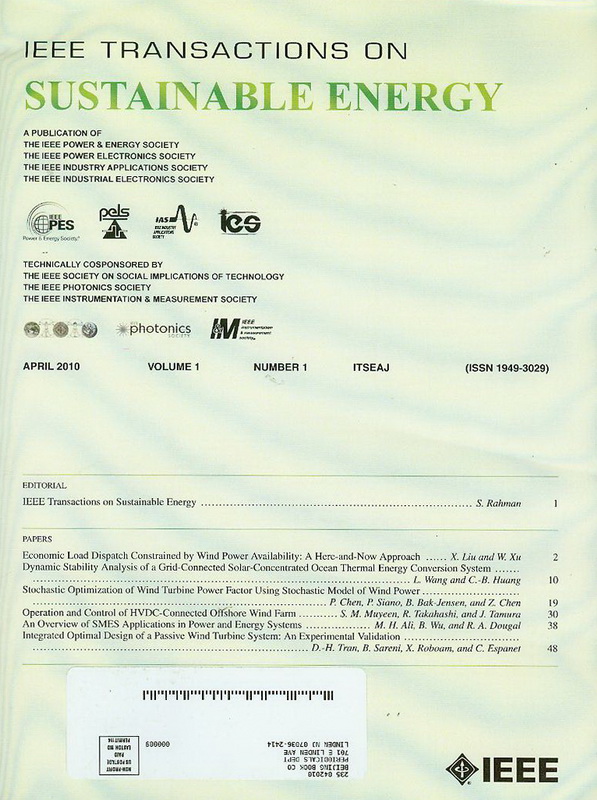
期刊介绍:
The IEEE Transactions on Sustainable Energy serves as a pivotal platform for sharing groundbreaking research findings on sustainable energy systems, with a focus on their seamless integration into power transmission and/or distribution grids. The journal showcases original research spanning the design, implementation, grid-integration, and control of sustainable energy technologies and systems. Additionally, the Transactions warmly welcomes manuscripts addressing the design, implementation, and evaluation of power systems influenced by sustainable energy systems and devices.



 京公网安备 11010802042870号
京ICP备2023020795号-1
京公网安备 11010802042870号
京ICP备2023020795号-1

 分享
分享
 求助内容:
求助内容: 应助结果提醒方式:
 扫码关注我们
