{"title":"The discriminative ability on anomaly detection using quantum kernels for shipping inspection","authors":"Takao Tomono, Kazuya Tsujimura","doi":"10.1140/epjqt/s40507-025-00335-4","DOIUrl":null,"url":null,"abstract":"<div><p>We aim to use quantum machine learning to detect various anomalies in image inspection by using small size data. Assuming the possibility that the expressive power of the quantum kernel space is superior to that of the classical kernel space, we are studying a quantum machine learning model. Through trials of image inspection processes not only for factory products but also for products including agricultural products, the importance of trials on real data is recognized. In this study, training was carried out on SVMs embedded with various quantum kernels on a small number of agricultural product image data sets collected in the markets. The quantum kernels prepared in this study consisted of a smaller number of rotating gates and control gates. The F1 scores for each quantum kernel showed a significant effect of using CNOT gates. After confirming the results with a quantum simulator, the usefulness of the quantum kernels was confirmed on a quantum computer. Learning with SVMs embedded with specific quantum kernels showed significantly higher values of the AUC compared to classical kernels. The reason for the lack of learning in quantum kernels is considered to be due to kernel concentration or exponential concentration similar to the Baren plateau. The reason why the F1 score does not increase as the number of features increases is suggested to be due to exponential concentration, while at the same time it is possible that only certain features have discriminative ability. Furthermore, it is suggested that controlled Toffoli gate may be a promising quantum kernel component.</p></div>","PeriodicalId":547,"journal":{"name":"EPJ Quantum Technology","volume":"12 1","pages":""},"PeriodicalIF":5.6000,"publicationDate":"2025-03-21","publicationTypes":"Journal Article","fieldsOfStudy":null,"isOpenAccess":false,"openAccessPdf":"https://epjquantumtechnology.springeropen.com/counter/pdf/10.1140/epjqt/s40507-025-00335-4","citationCount":"0","resultStr":null,"platform":"Semanticscholar","paperid":null,"PeriodicalName":"EPJ Quantum Technology","FirstCategoryId":"101","ListUrlMain":"https://link.springer.com/article/10.1140/epjqt/s40507-025-00335-4","RegionNum":2,"RegionCategory":"物理与天体物理","ArticlePicture":[],"TitleCN":null,"AbstractTextCN":null,"PMCID":null,"EPubDate":"","PubModel":"","JCR":"Q1","JCRName":"OPTICS","Score":null,"Total":0}
引用次数: 0
Abstract
We aim to use quantum machine learning to detect various anomalies in image inspection by using small size data. Assuming the possibility that the expressive power of the quantum kernel space is superior to that of the classical kernel space, we are studying a quantum machine learning model. Through trials of image inspection processes not only for factory products but also for products including agricultural products, the importance of trials on real data is recognized. In this study, training was carried out on SVMs embedded with various quantum kernels on a small number of agricultural product image data sets collected in the markets. The quantum kernels prepared in this study consisted of a smaller number of rotating gates and control gates. The F1 scores for each quantum kernel showed a significant effect of using CNOT gates. After confirming the results with a quantum simulator, the usefulness of the quantum kernels was confirmed on a quantum computer. Learning with SVMs embedded with specific quantum kernels showed significantly higher values of the AUC compared to classical kernels. The reason for the lack of learning in quantum kernels is considered to be due to kernel concentration or exponential concentration similar to the Baren plateau. The reason why the F1 score does not increase as the number of features increases is suggested to be due to exponential concentration, while at the same time it is possible that only certain features have discriminative ability. Furthermore, it is suggested that controlled Toffoli gate may be a promising quantum kernel component.
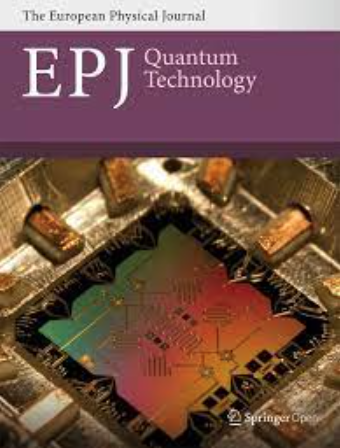
期刊介绍:
Driven by advances in technology and experimental capability, the last decade has seen the emergence of quantum technology: a new praxis for controlling the quantum world. It is now possible to engineer complex, multi-component systems that merge the once distinct fields of quantum optics and condensed matter physics.
EPJ Quantum Technology covers theoretical and experimental advances in subjects including but not limited to the following:
Quantum measurement, metrology and lithography
Quantum complex systems, networks and cellular automata
Quantum electromechanical systems
Quantum optomechanical systems
Quantum machines, engineering and nanorobotics
Quantum control theory
Quantum information, communication and computation
Quantum thermodynamics
Quantum metamaterials
The effect of Casimir forces on micro- and nano-electromechanical systems
Quantum biology
Quantum sensing
Hybrid quantum systems
Quantum simulations.



 京公网安备 11010802042870号
京ICP备2023020795号-1
京公网安备 11010802042870号
京ICP备2023020795号-1

 分享
分享
 求助内容:
求助内容: 应助结果提醒方式:
 扫码关注我们
