{"title":"Assessment and estimation of runoff and soil loss using novel machine learning techniques for conservation bench terraces","authors":"Ambrish Kumar , Manish Kumar , Narinder Kumar Sharma , Bihari Lal Dhyani , Uday Mandal","doi":"10.1016/j.scitotenv.2025.179093","DOIUrl":null,"url":null,"abstract":"<div><div>Conservation of land and water resources, especially in terms of runoff and soil loss, has the utmost priority in enhancing agricultural production, especially in the foothills of the Himalayas. Many engineering measures have been applied to reduce runoff velocity and soil loss. The present study deals with the effectiveness of Conservation Bench Terraces (CBT) as engineering measures constructed in the outer foothills of the Himalayas (ICAR-IISWC, Dehradun, India) to reduce runoff and soil losses in the context of strom size. Further, the development of runoff and soil loss models using available climatic parameters and machine learning techniques. The parameters used were maximum temperature (T<sub>max</sub>, °C), minimum temperature (T<sub>min</sub>, °C), soil temperature (T<sub>soil</sub>, °C), rainfall (mm), pan evaporation (mm), runoff (mm), and soil loss (Mg/ha) during the year 2007–2015. The machine learning techniques, artificial neural network (ANN), linear function support vector machine (SVM-L), radial function support vector machine (SVM-R), multiple linear regression (MLR) along with hybridization of ANN and both function of SVM with wavelet transform as WANN, WSVM-L and WSVM-R, respectively were employed for the estimation of runoff and soil loss. Their performance evaluation was also assessed with the well accepted quantitative and qualitative indicators. The results revealed that the CBT has reduced runoff and soil losses from the experimental plots. The estimation of runoff and sediment were best predicted by SVM-L model with PCC, RMSE, NSE, MAE, and WI values as 0.82 and 0.56, 18.21 and 0.11, 0.41 and 0.16, 13.45 and 0.069, 0.799 and 0.716, respectively for runoff and sediment modelling. The wavelet hybridized models were inaccurate in prediction in this case. Furthermore, sensitivity analysis were carried out and found rainfall was the most sensitive parameter. The SVM-L model could be applied for the estimation of runoff and soil loss from given parameters, which is helpful in planning and designing of CBTs in larger areas. The results indicate CBT's effectiveness in reducing plot-level runoff and soil losses is comparitively high, specially for storm size lesser than 75 mm. The SVM-L model can act as a powerful tool for policymakers and implementing agencies in planning and designing of CBTs.</div></div>","PeriodicalId":422,"journal":{"name":"Science of the Total Environment","volume":"973 ","pages":"Article 179093"},"PeriodicalIF":8.0000,"publicationDate":"2025-04-10","publicationTypes":"Journal Article","fieldsOfStudy":null,"isOpenAccess":false,"openAccessPdf":"","citationCount":"0","resultStr":null,"platform":"Semanticscholar","paperid":null,"PeriodicalName":"Science of the Total Environment","FirstCategoryId":"93","ListUrlMain":"https://www.sciencedirect.com/science/article/pii/S0048969725007284","RegionNum":1,"RegionCategory":"环境科学与生态学","ArticlePicture":[],"TitleCN":null,"AbstractTextCN":null,"PMCID":null,"EPubDate":"2025/3/19 0:00:00","PubModel":"Epub","JCR":"Q1","JCRName":"ENVIRONMENTAL SCIENCES","Score":null,"Total":0}
引用次数: 0
Abstract
Conservation of land and water resources, especially in terms of runoff and soil loss, has the utmost priority in enhancing agricultural production, especially in the foothills of the Himalayas. Many engineering measures have been applied to reduce runoff velocity and soil loss. The present study deals with the effectiveness of Conservation Bench Terraces (CBT) as engineering measures constructed in the outer foothills of the Himalayas (ICAR-IISWC, Dehradun, India) to reduce runoff and soil losses in the context of strom size. Further, the development of runoff and soil loss models using available climatic parameters and machine learning techniques. The parameters used were maximum temperature (Tmax, °C), minimum temperature (Tmin, °C), soil temperature (Tsoil, °C), rainfall (mm), pan evaporation (mm), runoff (mm), and soil loss (Mg/ha) during the year 2007–2015. The machine learning techniques, artificial neural network (ANN), linear function support vector machine (SVM-L), radial function support vector machine (SVM-R), multiple linear regression (MLR) along with hybridization of ANN and both function of SVM with wavelet transform as WANN, WSVM-L and WSVM-R, respectively were employed for the estimation of runoff and soil loss. Their performance evaluation was also assessed with the well accepted quantitative and qualitative indicators. The results revealed that the CBT has reduced runoff and soil losses from the experimental plots. The estimation of runoff and sediment were best predicted by SVM-L model with PCC, RMSE, NSE, MAE, and WI values as 0.82 and 0.56, 18.21 and 0.11, 0.41 and 0.16, 13.45 and 0.069, 0.799 and 0.716, respectively for runoff and sediment modelling. The wavelet hybridized models were inaccurate in prediction in this case. Furthermore, sensitivity analysis were carried out and found rainfall was the most sensitive parameter. The SVM-L model could be applied for the estimation of runoff and soil loss from given parameters, which is helpful in planning and designing of CBTs in larger areas. The results indicate CBT's effectiveness in reducing plot-level runoff and soil losses is comparitively high, specially for storm size lesser than 75 mm. The SVM-L model can act as a powerful tool for policymakers and implementing agencies in planning and designing of CBTs.
期刊介绍:
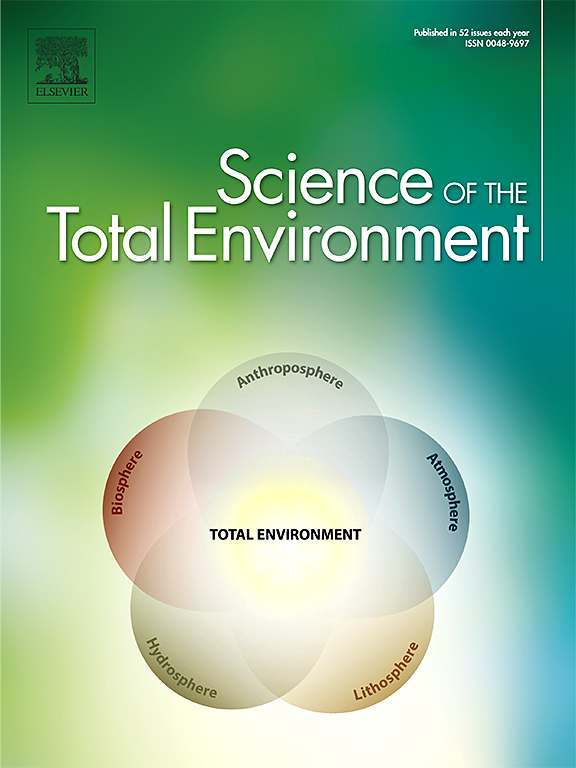
The Science of the Total Environment is an international journal dedicated to scientific research on the environment and its interaction with humanity. It covers a wide range of disciplines and seeks to publish innovative, hypothesis-driven, and impactful research that explores the entire environment, including the atmosphere, lithosphere, hydrosphere, biosphere, and anthroposphere.
The journal's updated Aims & Scope emphasizes the importance of interdisciplinary environmental research with broad impact. Priority is given to studies that advance fundamental understanding and explore the interconnectedness of multiple environmental spheres. Field studies are preferred, while laboratory experiments must demonstrate significant methodological advancements or mechanistic insights with direct relevance to the environment.




 京公网安备 11010802042870号
京ICP备2023020795号-1
京公网安备 11010802042870号
京ICP备2023020795号-1

 分享
分享
 求助内容:
求助内容: 应助结果提醒方式:
 扫码关注我们
