Pierre Bardoult, Elodie Cadic, Olivier Brichory, Véronique Marie, Caroline Rouxel, Christophe Millet, Magalie Daudin, Elodie Peguet, Nicolas Massart
{"title":"Which carbon footprint for my ICU? Benchmark, hot spots and perspectives.","authors":"Pierre Bardoult, Elodie Cadic, Olivier Brichory, Véronique Marie, Caroline Rouxel, Christophe Millet, Magalie Daudin, Elodie Peguet, Nicolas Massart","doi":"10.1186/s13613-025-01445-z","DOIUrl":null,"url":null,"abstract":"<p><strong>Background: </strong>The purpose of this study was to identify the main greenhouse gas (GHG) emitting activities or products among the medical devices (MD) and medicines used in a polyvalent Intensive Care Unit (ICU).</p><p><strong>Methods: </strong>A pragmatic eco-audit was conducted in a 21-beds polyvalent ICU, in Saint-Brieuc, Bretagne, France. It consisted of estimating GHG emissions of products or activities, considering process-based life cycle analysis (LCA), economic input-output analysis (EIO) and hybrid-LCA. Results were expressed as Carbon Dioxide Equivalent (CO<sub>2</sub>e) emissions per patient-day considering each medication and MD (including personal protective equipment).</p><p><strong>Results: </strong>With remaining uncertainty, GHG emissions were estimated at 61.1 kgCO<sub>2</sub>e per patient-day. Two hundred and two individual MD were used per patient-day, equivalent to 5.1 kgCO<sub>2</sub>e per patient-day (process-based LCA). Gloves accounted for the main part of kgCO<sub>2</sub>e emissions (representing 1.8 kgCO<sub>2</sub>e per patient-day). Then, syringes (1.1 kgCO<sub>2</sub>e per patient-day), perfusion tubings (1.0 per patient-day) and gauze pads (0.4 kgCO<sub>2</sub>e per patient-day) were the most important sources of MD related GHG emissions. Forty-seven individual medicines were used per patient-day. Most consumed medications were sterile water for injection, propofol, and sodium chlorure. The GHG emissions of medications were estimated with EIO-LCA at 21.5 kgCO<sub>2</sub>e per patient-day, mostly due to injectable medicines (15.3 kgCO<sub>2</sub>e per patient-day).</p><p><strong>Conclusion: </strong>Upcoming studies focusing on actions on these particular hot spots would be of interest in order to significantly decrease GHG emissions but also to increase resilience of critical care.</p>","PeriodicalId":7966,"journal":{"name":"Annals of Intensive Care","volume":"15 1","pages":"35"},"PeriodicalIF":5.5000,"publicationDate":"2025-03-20","publicationTypes":"Journal Article","fieldsOfStudy":null,"isOpenAccess":false,"openAccessPdf":"https://www.ncbi.nlm.nih.gov/pmc/articles/PMC11925816/pdf/","citationCount":"0","resultStr":null,"platform":"Semanticscholar","paperid":null,"PeriodicalName":"Annals of Intensive Care","FirstCategoryId":"3","ListUrlMain":"https://doi.org/10.1186/s13613-025-01445-z","RegionNum":1,"RegionCategory":"医学","ArticlePicture":[],"TitleCN":null,"AbstractTextCN":null,"PMCID":null,"EPubDate":"","PubModel":"","JCR":"Q1","JCRName":"CRITICAL CARE MEDICINE","Score":null,"Total":0}
引用次数: 0
Abstract
Background: The purpose of this study was to identify the main greenhouse gas (GHG) emitting activities or products among the medical devices (MD) and medicines used in a polyvalent Intensive Care Unit (ICU).
Methods: A pragmatic eco-audit was conducted in a 21-beds polyvalent ICU, in Saint-Brieuc, Bretagne, France. It consisted of estimating GHG emissions of products or activities, considering process-based life cycle analysis (LCA), economic input-output analysis (EIO) and hybrid-LCA. Results were expressed as Carbon Dioxide Equivalent (CO2e) emissions per patient-day considering each medication and MD (including personal protective equipment).
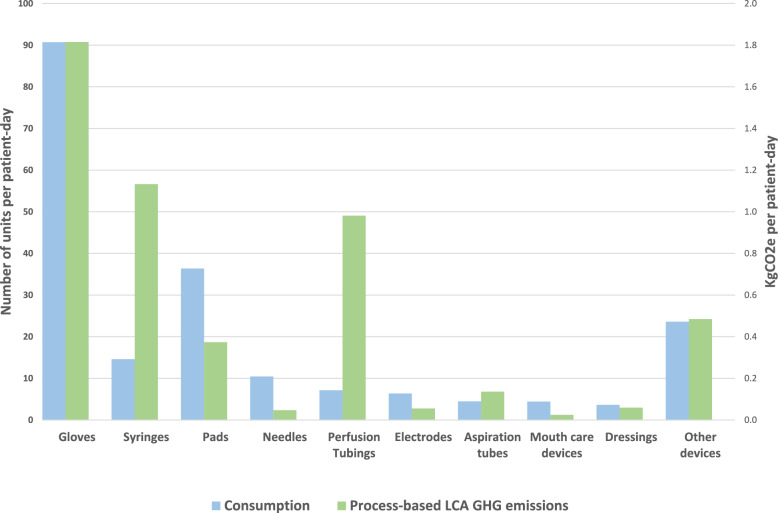
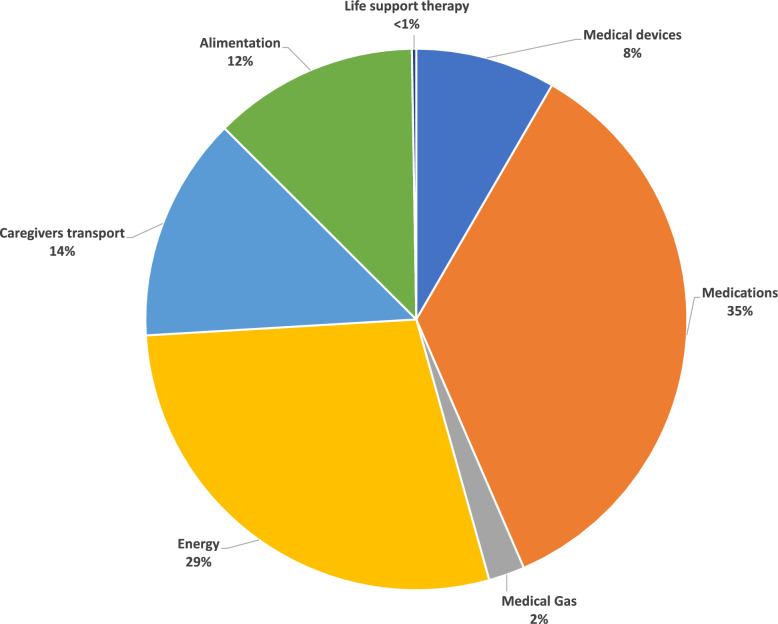
Results: With remaining uncertainty, GHG emissions were estimated at 61.1 kgCO2e per patient-day. Two hundred and two individual MD were used per patient-day, equivalent to 5.1 kgCO2e per patient-day (process-based LCA). Gloves accounted for the main part of kgCO2e emissions (representing 1.8 kgCO2e per patient-day). Then, syringes (1.1 kgCO2e per patient-day), perfusion tubings (1.0 per patient-day) and gauze pads (0.4 kgCO2e per patient-day) were the most important sources of MD related GHG emissions. Forty-seven individual medicines were used per patient-day. Most consumed medications were sterile water for injection, propofol, and sodium chlorure. The GHG emissions of medications were estimated with EIO-LCA at 21.5 kgCO2e per patient-day, mostly due to injectable medicines (15.3 kgCO2e per patient-day).
Conclusion: Upcoming studies focusing on actions on these particular hot spots would be of interest in order to significantly decrease GHG emissions but also to increase resilience of critical care.
期刊介绍:
Annals of Intensive Care is an online peer-reviewed journal that publishes high-quality review articles and original research papers in the field of intensive care medicine. It targets critical care providers including attending physicians, fellows, residents, nurses, and physiotherapists, who aim to enhance their knowledge and provide optimal care for their patients. The journal's articles are included in various prestigious databases such as CAS, Current contents, DOAJ, Embase, Journal Citation Reports/Science Edition, OCLC, PubMed, PubMed Central, Science Citation Index Expanded, SCOPUS, and Summon by Serial Solutions.




 京公网安备 11010802042870号
京ICP备2023020795号-1
京公网安备 11010802042870号
京ICP备2023020795号-1

 分享
分享
 求助内容:
求助内容: 应助结果提醒方式:
 扫码关注我们
