Marco Amato, Lisa Seekircher, Lena Tschiderer, Peter Willeit, Harald Schennach, Anita Siller
{"title":"Optimized Protocol for Producing Pathogen-inactivated Double-dose Platelet Concentrates From Six Pooled Buffy Coats.","authors":"Marco Amato, Lisa Seekircher, Lena Tschiderer, Peter Willeit, Harald Schennach, Anita Siller","doi":"10.3343/alm.2024.0555","DOIUrl":null,"url":null,"abstract":"<p><strong>Background: </strong>Pooled platelet (PLT) production methods differ worldwide. In Europe, the buffy coat (BC) method is predominantly used, with four to eight BCs being pooled to produce single- or double-dose PLT products. The European Directorate for the Quality of Medicines & HealthCare (EDQM) blood guide and Austrian legislation define a therapeutic PLT unit as ≥ 2 × 10<sup>11</sup> PLTs/unit. We optimized the manufacturing steps to produce double-dose PLT products from six BCs, aiming to enhance production efficiency while maintaining product quality.</p><p><strong>Methods: </strong>We stepwise optimized our protocol starting from five BCs (BC5) (N=107). First, we included an additional BC (BC6) (N=110). Second, we used a hematology analyzer (Sysmex XN-1000) equipped with blood bank mode, which is a novel software application for measuring PLT counts in PLT units (BC6+XN-1000) (N=106). Third, we optimized the blood cell separator (BCS) settings to produce higher-volume BCs (BC6+XN-1000+BCS) (N=107). Fourth, we adapted the centrifugation (BC6+XN-1000+BCS+CF) (N=197). All units were pathogen-inactivated using the INTERCEPT blood system (amotosalen/ultraviolet A).</p><p><strong>Results: </strong>Each optimization step significantly increased the yield ( × 10<sup>11</sup>/PLT concentrate) (<i>P</i> <0.001). The mean yield increased from 2.83 (SD 0.39) for BC5 to 4.81 (SD 0.58) for BC6+XN-1000+BCS+CF. The mean BC volume increased from 47.78 mL (SD 5.09) to 55.59 mL (SD 5.11) following BCS adaptions (<i>P</i> <0.001).</p><p><strong>Conclusions: </strong>After stepwise protocol optimization, we could produce pathogen-inactivated double-dose PLT concentrates by pooling six BCs, complying with national regulations and EDQM quality requirements while reducing costs and minimizing blood wastage.</p>","PeriodicalId":8421,"journal":{"name":"Annals of Laboratory Medicine","volume":" ","pages":"601-608"},"PeriodicalIF":3.9000,"publicationDate":"2025-11-01","publicationTypes":"Journal Article","fieldsOfStudy":null,"isOpenAccess":false,"openAccessPdf":"https://www.ncbi.nlm.nih.gov/pmc/articles/PMC12535830/pdf/","citationCount":"0","resultStr":null,"platform":"Semanticscholar","paperid":null,"PeriodicalName":"Annals of Laboratory Medicine","FirstCategoryId":"3","ListUrlMain":"https://doi.org/10.3343/alm.2024.0555","RegionNum":2,"RegionCategory":"医学","ArticlePicture":[],"TitleCN":null,"AbstractTextCN":null,"PMCID":null,"EPubDate":"2025/3/21 0:00:00","PubModel":"Epub","JCR":"Q1","JCRName":"MEDICAL LABORATORY TECHNOLOGY","Score":null,"Total":0}
引用次数: 0
Abstract
Background: Pooled platelet (PLT) production methods differ worldwide. In Europe, the buffy coat (BC) method is predominantly used, with four to eight BCs being pooled to produce single- or double-dose PLT products. The European Directorate for the Quality of Medicines & HealthCare (EDQM) blood guide and Austrian legislation define a therapeutic PLT unit as ≥ 2 × 10¹¹ PLTs/unit. We optimized the manufacturing steps to produce double-dose PLT products from six BCs, aiming to enhance production efficiency while maintaining product quality.
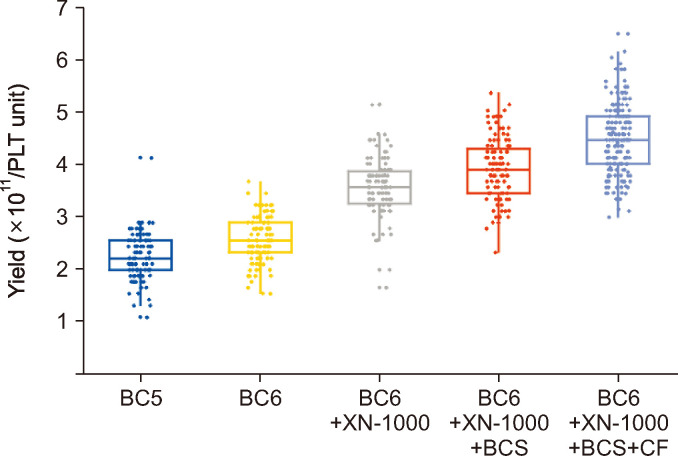
Methods: We stepwise optimized our protocol starting from five BCs (BC5) (N=107). First, we included an additional BC (BC6) (N=110). Second, we used a hematology analyzer (Sysmex XN-1000) equipped with blood bank mode, which is a novel software application for measuring PLT counts in PLT units (BC6+XN-1000) (N=106). Third, we optimized the blood cell separator (BCS) settings to produce higher-volume BCs (BC6+XN-1000+BCS) (N=107). Fourth, we adapted the centrifugation (BC6+XN-1000+BCS+CF) (N=197). All units were pathogen-inactivated using the INTERCEPT blood system (amotosalen/ultraviolet A).
Results: Each optimization step significantly increased the yield ( × 1011/PLT concentrate) (P <0.001). The mean yield increased from 2.83 (SD 0.39) for BC5 to 4.81 (SD 0.58) for BC6+XN-1000+BCS+CF. The mean BC volume increased from 47.78 mL (SD 5.09) to 55.59 mL (SD 5.11) following BCS adaptions (P <0.001).
Conclusions: After stepwise protocol optimization, we could produce pathogen-inactivated double-dose PLT concentrates by pooling six BCs, complying with national regulations and EDQM quality requirements while reducing costs and minimizing blood wastage.
期刊介绍:
Annals of Laboratory Medicine is the official journal of Korean Society for Laboratory Medicine. The journal title has been recently changed from the Korean Journal of Laboratory Medicine (ISSN, 1598-6535) from the January issue of 2012. The JCR 2017 Impact factor of Ann Lab Med was 1.916.





 京公网安备 11010802042870号
京ICP备2023020795号-1
京公网安备 11010802042870号
京ICP备2023020795号-1

 分享
分享
 求助内容:
求助内容: 应助结果提醒方式:
 扫码关注我们
