Marek Svitok, Igor Zelnik, Kateřina Bubíková, Mateja Germ, Alenka Gaberščik, Judita Kochjarová, Helena Oťaheľová, Peter Paľove-Balang, Richard Hrivnák
{"title":"Comparative diversity of aquatic plants in three Central European regions.","authors":"Marek Svitok, Igor Zelnik, Kateřina Bubíková, Mateja Germ, Alenka Gaberščik, Judita Kochjarová, Helena Oťaheľová, Peter Paľove-Balang, Richard Hrivnák","doi":"10.3389/fpls.2025.1536731","DOIUrl":null,"url":null,"abstract":"<p><p>Freshwaters are among the most threatened ecosystems globally, with biodiversity declining at far greater rates than the biodiversity of the most affected terrestrial ecosystems. There is an urgent need for accurate information on spatial patterns of freshwater biodiversity, a first step in effective conservation planning and management of these ecosystems. We explored patterns of aquatic macrophyte diversity in four waterbody types, rivers, streams, ponds and ditches, across three Central European regions. By analyzing local (α), among-site (β) and regional (γ) diversity, we assessed the roles of these ecosystems as biodiversity hotspots, particularly for red-listed species. Sampling 220 sites across Slovakia and Slovenia, we recorded 113 macrophyte taxa (31% of which were red-listed), with ponds and ditches consistently supporting higher α and γ diversity than running waters. β diversity was primarily driven by species turnover, with ponds displaying high heterogeneity linked to environmental variability. Our findings highlight the conservation value of artificial habitats like ditches and ponds, harbouring significant macrophyte diversity, including unique and threatened species. These results underscore the need to prioritize small waterbodies in biodiversity conservation strategies within agricultural landscapes.</p>","PeriodicalId":12632,"journal":{"name":"Frontiers in Plant Science","volume":"16 ","pages":"1536731"},"PeriodicalIF":4.1000,"publicationDate":"2025-03-06","publicationTypes":"Journal Article","fieldsOfStudy":null,"isOpenAccess":false,"openAccessPdf":"https://www.ncbi.nlm.nih.gov/pmc/articles/PMC11922903/pdf/","citationCount":"0","resultStr":null,"platform":"Semanticscholar","paperid":null,"PeriodicalName":"Frontiers in Plant Science","FirstCategoryId":"99","ListUrlMain":"https://doi.org/10.3389/fpls.2025.1536731","RegionNum":2,"RegionCategory":"生物学","ArticlePicture":[],"TitleCN":null,"AbstractTextCN":null,"PMCID":null,"EPubDate":"2025/1/1 0:00:00","PubModel":"eCollection","JCR":"Q1","JCRName":"PLANT SCIENCES","Score":null,"Total":0}
引用次数: 0
Abstract
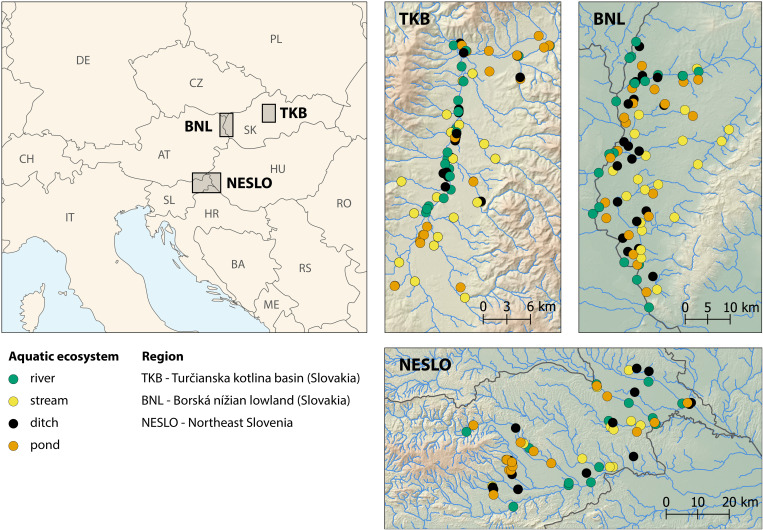
Freshwaters are among the most threatened ecosystems globally, with biodiversity declining at far greater rates than the biodiversity of the most affected terrestrial ecosystems. There is an urgent need for accurate information on spatial patterns of freshwater biodiversity, a first step in effective conservation planning and management of these ecosystems. We explored patterns of aquatic macrophyte diversity in four waterbody types, rivers, streams, ponds and ditches, across three Central European regions. By analyzing local (α), among-site (β) and regional (γ) diversity, we assessed the roles of these ecosystems as biodiversity hotspots, particularly for red-listed species. Sampling 220 sites across Slovakia and Slovenia, we recorded 113 macrophyte taxa (31% of which were red-listed), with ponds and ditches consistently supporting higher α and γ diversity than running waters. β diversity was primarily driven by species turnover, with ponds displaying high heterogeneity linked to environmental variability. Our findings highlight the conservation value of artificial habitats like ditches and ponds, harbouring significant macrophyte diversity, including unique and threatened species. These results underscore the need to prioritize small waterbodies in biodiversity conservation strategies within agricultural landscapes.
期刊介绍:
In an ever changing world, plant science is of the utmost importance for securing the future well-being of humankind. Plants provide oxygen, food, feed, fibers, and building materials. In addition, they are a diverse source of industrial and pharmaceutical chemicals. Plants are centrally important to the health of ecosystems, and their understanding is critical for learning how to manage and maintain a sustainable biosphere. Plant science is extremely interdisciplinary, reaching from agricultural science to paleobotany, and molecular physiology to ecology. It uses the latest developments in computer science, optics, molecular biology and genomics to address challenges in model systems, agricultural crops, and ecosystems. Plant science research inquires into the form, function, development, diversity, reproduction, evolution and uses of both higher and lower plants and their interactions with other organisms throughout the biosphere. Frontiers in Plant Science welcomes outstanding contributions in any field of plant science from basic to applied research, from organismal to molecular studies, from single plant analysis to studies of populations and whole ecosystems, and from molecular to biophysical to computational approaches.
Frontiers in Plant Science publishes articles on the most outstanding discoveries across a wide research spectrum of Plant Science. The mission of Frontiers in Plant Science is to bring all relevant Plant Science areas together on a single platform.





 京公网安备 11010802042870号
京ICP备2023020795号-1
京公网安备 11010802042870号
京ICP备2023020795号-1

 分享
分享
 求助内容:
求助内容: 应助结果提醒方式:
 扫码关注我们
