Daniel Fu, Aman M Patel, Lucy Revercomb, Andrey Filimonov, Ghayoour S Mir
{"title":"Machine Learning Predicts 30-Day Readmission and Mortality After Surgical Resection of Head and Neck Cancer.","authors":"Daniel Fu, Aman M Patel, Lucy Revercomb, Andrey Filimonov, Ghayoour S Mir","doi":"10.1002/oto2.70100","DOIUrl":null,"url":null,"abstract":"<p><strong>Objective: </strong>To develop and validate a machine learning model to identify patients at high risk of 30-day mortality and hospital readmission using routinely collected health care data.</p><p><strong>Study design: </strong>Prognostic predictive modeling and retrospective cohort study. The study was conducted in 2024 using data from 2006 to 2018, with at least a 30-day follow-up.</p><p><strong>Setting: </strong>The 2006 to 2018 National Cancer Database (NCDB).</p><p><strong>Methods: </strong>The study used deidentified NCDB data on 103,891 head and neck squamous cell carcinoma (HNSCC) patients who underwent surgical resection. Machine learning models were trained on 80% of the data, tested on the remaining 20%, and evaluated using the area under the curve (AUC) and SHapley Additive exPlanations (SHAP) analysis to identify key predictors for 30-day mortality and readmission.</p><p><strong>Results: </strong>Among 103,891 patients, 5838 (5.6%) were readmitted, and 829 (0.8%) died within 30 days. The median age was 62, 69% male, and 89% white. Predictors included demographic and clinical data from the NCDB. Five machine learning models were combined and achieved an AUC of 0.80 (95% CI: 0.77-0.83) for mortality prediction and 0.67 (95% CI: 0.65-0.68) for readmission prediction. SHAP analysis identified sex and urban-rural index as key predictors of mortality and readmission, respectively.</p><p><strong>Conclusion: </strong>Machine learning models can accurately predict mortality and readmission risks, offering insights into the most influential factors. With further validation, these models may enhance clinical decision-making in postsurgical care for HNSCC patients.</p>","PeriodicalId":19697,"journal":{"name":"OTO Open","volume":"9 1","pages":"e70100"},"PeriodicalIF":1.8000,"publicationDate":"2025-03-20","publicationTypes":"Journal Article","fieldsOfStudy":null,"isOpenAccess":false,"openAccessPdf":"https://www.ncbi.nlm.nih.gov/pmc/articles/PMC11924807/pdf/","citationCount":"0","resultStr":null,"platform":"Semanticscholar","paperid":null,"PeriodicalName":"OTO Open","FirstCategoryId":"1085","ListUrlMain":"https://doi.org/10.1002/oto2.70100","RegionNum":0,"RegionCategory":null,"ArticlePicture":[],"TitleCN":null,"AbstractTextCN":null,"PMCID":null,"EPubDate":"2025/1/1 0:00:00","PubModel":"eCollection","JCR":"Q2","JCRName":"OTORHINOLARYNGOLOGY","Score":null,"Total":0}
引用次数: 0
Abstract
Objective: To develop and validate a machine learning model to identify patients at high risk of 30-day mortality and hospital readmission using routinely collected health care data.
Study design: Prognostic predictive modeling and retrospective cohort study. The study was conducted in 2024 using data from 2006 to 2018, with at least a 30-day follow-up.
Setting: The 2006 to 2018 National Cancer Database (NCDB).
Methods: The study used deidentified NCDB data on 103,891 head and neck squamous cell carcinoma (HNSCC) patients who underwent surgical resection. Machine learning models were trained on 80% of the data, tested on the remaining 20%, and evaluated using the area under the curve (AUC) and SHapley Additive exPlanations (SHAP) analysis to identify key predictors for 30-day mortality and readmission.
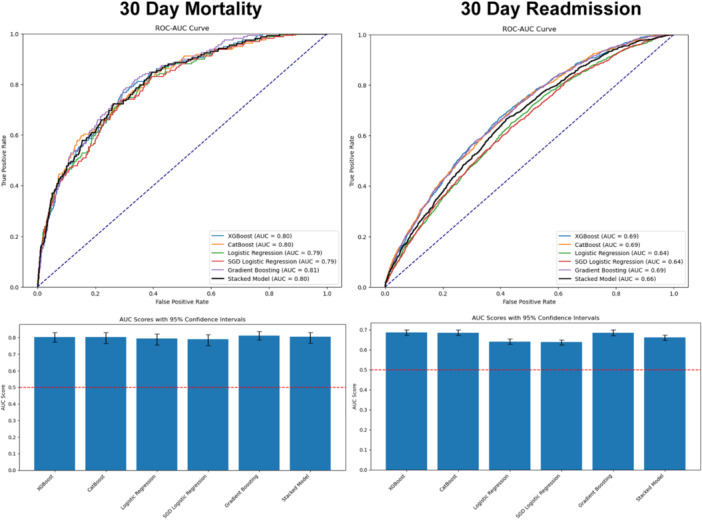
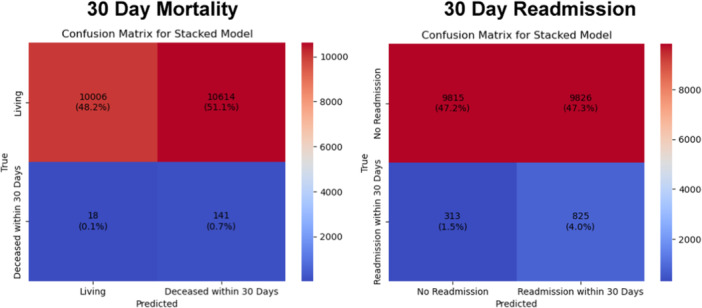
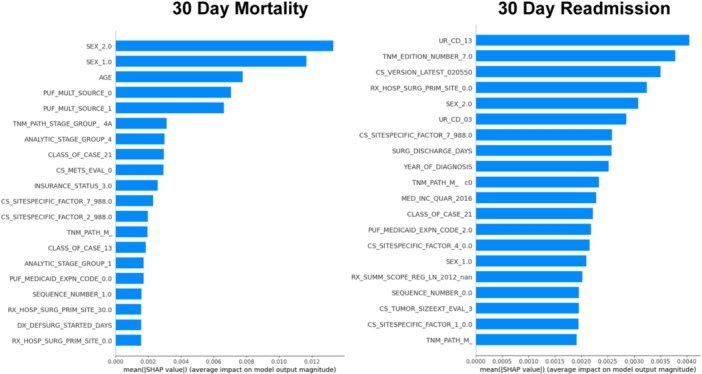
Results: Among 103,891 patients, 5838 (5.6%) were readmitted, and 829 (0.8%) died within 30 days. The median age was 62, 69% male, and 89% white. Predictors included demographic and clinical data from the NCDB. Five machine learning models were combined and achieved an AUC of 0.80 (95% CI: 0.77-0.83) for mortality prediction and 0.67 (95% CI: 0.65-0.68) for readmission prediction. SHAP analysis identified sex and urban-rural index as key predictors of mortality and readmission, respectively.
Conclusion: Machine learning models can accurately predict mortality and readmission risks, offering insights into the most influential factors. With further validation, these models may enhance clinical decision-making in postsurgical care for HNSCC patients.





 京公网安备 11010802042870号
京ICP备2023020795号-1
京公网安备 11010802042870号
京ICP备2023020795号-1

 分享
分享
 求助内容:
求助内容: 应助结果提醒方式:
 扫码关注我们
