Y T Shi, J H Yang, H H Li, S S Wang, H W Li, S M Chen, R R Li, Y H Bao, W C Wang, S Y Du, J H Wang, X H Fang, H B Yang, D Ma, S S Yang, M Liu, Y He
{"title":"[Association between physical activity and all-cause mortality in the elderly with different obesity status in Beijing: a prospective cohort study].","authors":"Y T Shi, J H Yang, H H Li, S S Wang, H W Li, S M Chen, R R Li, Y H Bao, W C Wang, S Y Du, J H Wang, X H Fang, H B Yang, D Ma, S S Yang, M Liu, Y He","doi":"10.3760/cma.j.cn112338-20240711-00416","DOIUrl":null,"url":null,"abstract":"<p><p><b>Objective:</b> To explore the association between physical activity (PA) level and all-cause mortality in the elderly with different obesity status in Beijing. <b>Methods:</b> The study subjects were from the Cardiovascular and Cognitive Healthy Study in Middle-Aged and Elderly Residents of Beijing, a total of 3 746 individuals aged ≥60 years in the baseline survey between 2013 and 2015 were included in the study. Questionnaire survey and physical examination were conducted to collect the basic information of the individuals. The metabolic equivalent of the elderly was used to calculate the PA level, and an international PA questionnaire was used to determine the PA intensity. BMI, waist-to-height ratio (WHtR) and a body shape index (ABSI) were used to evaluate individuals' obesity status. The distribution of different PA levels under different obesity states was described by using bar chart and cumulative percentage bar chart. Cox proportional hazard regression model was used to analyze the correlation between the level of PA and all-cause mortality risk in different types of obesity status. <b>Results:</b> By December 31, 2019, the median follow-up time was 5.46 years, and the mortality density was 244.55/10 000 person-years. Compared with the individuals in high-PA intensity group, the all-cause mortality risk increased by 41% (<i>HR</i>=1.41, 95%<i>CI</i>: 1.14-1.76) and 122% (<i>HR</i>=2.22, 95%<i>CI</i>: 1.76-2.81), respectively, in moderate and low PA intensity groups. Compared with the individuals in high-PA intensity-high-obesity group, based on the BMI, the all-cause mortality risk increased by 85% (<i>HR</i>=1.85, 95%<i>CI</i>: 1.08-3.16) and 250% (<i>HR</i>=3.50, 95%<i>CI</i>: 2.01-6.10) in those in moderate-PA intensity-high-obesity group and in low-intensity-high-obesity group. Based on the WHtR, the all-cause mortality risk increased by 53% (<i>HR</i>=1.53, 95%<i>CI</i>: 1.02-2.29) and 218% (<i>HR</i>=3.18, 95%<i>CI</i>: 2.09-4.86), respectively, in those with moderate-PA intensity-high-obesity and those with low-PA intensity-high-obesity. According to the ABSI, the all-cause mortality risk increased by 120% in those in low-PA intensity-high-obesity group (<i>HR</i>=2.20, 95%<i>CI</i>: 1.53-3.18). Based on any one of the indicators BMI, WHtR, or ABSI, there was no significant difference in all-cause mortality risk between high-intensity-moderate-obesity group and high-intensity-low-obesity group (all <i>P</i>>0.05). <b>Conclusions:</b> PA level is closely associated with the all-cause mortality risk in the elderly in communities of Beijing. Increasing PA level can not only reduce the all-cause mortality risk but also reduce even eliminate the excess all-cause mortality risk associated with obesity.</p>","PeriodicalId":23968,"journal":{"name":"中华流行病学杂志","volume":"46 3","pages":"402-409"},"PeriodicalIF":0.0000,"publicationDate":"2025-03-10","publicationTypes":"Journal Article","fieldsOfStudy":null,"isOpenAccess":false,"openAccessPdf":"","citationCount":"0","resultStr":null,"platform":"Semanticscholar","paperid":null,"PeriodicalName":"中华流行病学杂志","FirstCategoryId":"3","ListUrlMain":"https://doi.org/10.3760/cma.j.cn112338-20240711-00416","RegionNum":0,"RegionCategory":null,"ArticlePicture":[],"TitleCN":null,"AbstractTextCN":null,"PMCID":null,"EPubDate":"","PubModel":"","JCR":"Q1","JCRName":"Medicine","Score":null,"Total":0}
引用次数: 0
Abstract
Objective: To explore the association between physical activity (PA) level and all-cause mortality in the elderly with different obesity status in Beijing. Methods: The study subjects were from the Cardiovascular and Cognitive Healthy Study in Middle-Aged and Elderly Residents of Beijing, a total of 3 746 individuals aged ≥60 years in the baseline survey between 2013 and 2015 were included in the study. Questionnaire survey and physical examination were conducted to collect the basic information of the individuals. The metabolic equivalent of the elderly was used to calculate the PA level, and an international PA questionnaire was used to determine the PA intensity. BMI, waist-to-height ratio (WHtR) and a body shape index (ABSI) were used to evaluate individuals' obesity status. The distribution of different PA levels under different obesity states was described by using bar chart and cumulative percentage bar chart. Cox proportional hazard regression model was used to analyze the correlation between the level of PA and all-cause mortality risk in different types of obesity status. Results: By December 31, 2019, the median follow-up time was 5.46 years, and the mortality density was 244.55/10 000 person-years. Compared with the individuals in high-PA intensity group, the all-cause mortality risk increased by 41% (HR=1.41, 95%CI: 1.14-1.76) and 122% (HR=2.22, 95%CI: 1.76-2.81), respectively, in moderate and low PA intensity groups. Compared with the individuals in high-PA intensity-high-obesity group, based on the BMI, the all-cause mortality risk increased by 85% (HR=1.85, 95%CI: 1.08-3.16) and 250% (HR=3.50, 95%CI: 2.01-6.10) in those in moderate-PA intensity-high-obesity group and in low-intensity-high-obesity group. Based on the WHtR, the all-cause mortality risk increased by 53% (HR=1.53, 95%CI: 1.02-2.29) and 218% (HR=3.18, 95%CI: 2.09-4.86), respectively, in those with moderate-PA intensity-high-obesity and those with low-PA intensity-high-obesity. According to the ABSI, the all-cause mortality risk increased by 120% in those in low-PA intensity-high-obesity group (HR=2.20, 95%CI: 1.53-3.18). Based on any one of the indicators BMI, WHtR, or ABSI, there was no significant difference in all-cause mortality risk between high-intensity-moderate-obesity group and high-intensity-low-obesity group (all P>0.05). Conclusions: PA level is closely associated with the all-cause mortality risk in the elderly in communities of Beijing. Increasing PA level can not only reduce the all-cause mortality risk but also reduce even eliminate the excess all-cause mortality risk associated with obesity.
期刊介绍:
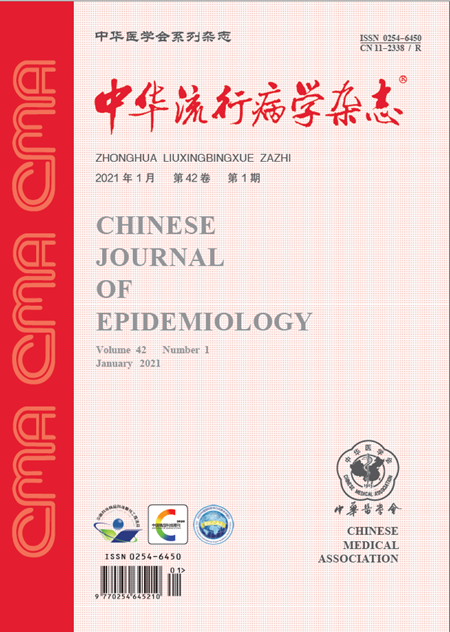
Chinese Journal of Epidemiology, established in 1981, is an advanced academic periodical in epidemiology and related disciplines in China, which, according to the principle of integrating theory with practice, mainly reports the major progress in epidemiological research. The columns of the journal include commentary, expert forum, original article, field investigation, disease surveillance, laboratory research, clinical epidemiology, basic theory or method and review, etc.
The journal is included by more than ten major biomedical databases and index systems worldwide, such as been indexed in Scopus, PubMed/MEDLINE, PubMed Central (PMC), Europe PubMed Central, Embase, Chemical Abstract, Chinese Science and Technology Paper and Citation Database (CSTPCD), Chinese core journal essentials overview, Chinese Science Citation Database (CSCD) core database, Chinese Biological Medical Disc (CBMdisc), and Chinese Medical Citation Index (CMCI), etc. It is one of the core academic journals and carefully selected core journals in preventive and basic medicine in China.



 京公网安备 11010802042870号
京ICP备2023020795号-1
京公网安备 11010802042870号
京ICP备2023020795号-1

 分享
分享
 求助内容:
求助内容: 应助结果提醒方式:
 扫码关注我们
