Ting Sun, Yangyang Zhang, Chunzhi Xie, Anyi Teng, Shi Lin, Hui Zhang, Yan Li
{"title":"Establishment of a predictive model for spontaneous preterm birth in primiparas with grade A1 gestational diabetes mellitus.","authors":"Ting Sun, Yangyang Zhang, Chunzhi Xie, Anyi Teng, Shi Lin, Hui Zhang, Yan Li","doi":"10.3389/fgwh.2025.1496085","DOIUrl":null,"url":null,"abstract":"<p><strong>Objective: </strong>To establish a predictive model for spontaneous preterm birth (SPB) in primiparas with grade A1 gestational diabetes mellitus (GDM).</p><p><strong>Methods: </strong>The clinical data of 1,229 primiparas with grade A1 GDM who delivered in our hospital from July 2020 to August 2023 were retrospectively analyzed, including 142 primiparas in the SPB group and 1,087 primiparas in the full-term group. Their basic information, family history, weight, cervical length (CL) measured by transvaginal ultrasound in the second trimester, and pregnancy complications were analyzed. The factors influencing SPB were explored, and a prediction model based on a random forest algorithm was constructed.</p><p><strong>Results: </strong>Short CL in the second trimester, a family history of preterm birth, a high pre-pregnancy and prenatal body mass index, the use of assisted reproductive technology, and a high fasting blood glucose level in the first trimester were important risk factors for SPB in primiparas with grade A1 GDM. The prediction model constructed in this study has a high overall prediction angle.</p><p><strong>Conclusions: </strong>Evaluation of the above risk factors before or during pregnancy and preventive measures and interventions targeting these risk factors will reduce the risk of SPB in primiparas with grade A1 GDM.</p>","PeriodicalId":73087,"journal":{"name":"Frontiers in global women's health","volume":"6 ","pages":"1496085"},"PeriodicalIF":2.4000,"publicationDate":"2025-03-06","publicationTypes":"Journal Article","fieldsOfStudy":null,"isOpenAccess":false,"openAccessPdf":"https://www.ncbi.nlm.nih.gov/pmc/articles/PMC11922705/pdf/","citationCount":"0","resultStr":null,"platform":"Semanticscholar","paperid":null,"PeriodicalName":"Frontiers in global women's health","FirstCategoryId":"1085","ListUrlMain":"https://doi.org/10.3389/fgwh.2025.1496085","RegionNum":0,"RegionCategory":null,"ArticlePicture":[],"TitleCN":null,"AbstractTextCN":null,"PMCID":null,"EPubDate":"2025/1/1 0:00:00","PubModel":"eCollection","JCR":"Q2","JCRName":"OBSTETRICS & GYNECOLOGY","Score":null,"Total":0}
引用次数: 0
Abstract
Objective: To establish a predictive model for spontaneous preterm birth (SPB) in primiparas with grade A1 gestational diabetes mellitus (GDM).
Methods: The clinical data of 1,229 primiparas with grade A1 GDM who delivered in our hospital from July 2020 to August 2023 were retrospectively analyzed, including 142 primiparas in the SPB group and 1,087 primiparas in the full-term group. Their basic information, family history, weight, cervical length (CL) measured by transvaginal ultrasound in the second trimester, and pregnancy complications were analyzed. The factors influencing SPB were explored, and a prediction model based on a random forest algorithm was constructed.
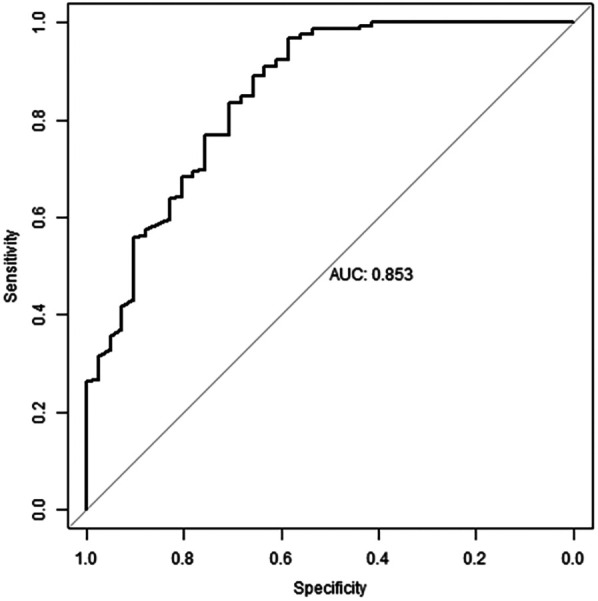
Results: Short CL in the second trimester, a family history of preterm birth, a high pre-pregnancy and prenatal body mass index, the use of assisted reproductive technology, and a high fasting blood glucose level in the first trimester were important risk factors for SPB in primiparas with grade A1 GDM. The prediction model constructed in this study has a high overall prediction angle.
Conclusions: Evaluation of the above risk factors before or during pregnancy and preventive measures and interventions targeting these risk factors will reduce the risk of SPB in primiparas with grade A1 GDM.




 京公网安备 11010802042870号
京ICP备2023020795号-1
京公网安备 11010802042870号
京ICP备2023020795号-1

 分享
分享

 求助内容:
求助内容: 应助结果提醒方式:
 扫码关注我们
