Gabriel Bluteau, Dominic E. Ponton, Maikel Rosabal, Marc Amyot
{"title":"Biodynamics and Environmental Concentrations of the Platinum Group Elements in Freshwater Systems","authors":"Gabriel Bluteau, Dominic E. Ponton, Maikel Rosabal, Marc Amyot","doi":"10.1021/acs.est.4c08750","DOIUrl":null,"url":null,"abstract":"Growing reliance on platinum group elements (PGEs) as critical minerals for emerging technologies raises concerns regarding their ecotoxicological behavior. We studied their environmental fate in various inorganic and biological matrices from Canada using ICP-MS/MS analysis. Our findings confirmed previously published rhodium, palladium, and platinum concentration gradients from road dust to sediments, soils, and water, but differed from the literature reporting high biological contamination, which was not observed in our study. We also conducted experiments using a predator–prey model by exposing <i>Chaoborus americanus</i> to PGE mixtures for 24 h and to contaminated prey (<i>Daphnia magna</i>) for 8 days, followed by a 3-day excretion period. We estimated water uptake rate constants (<i>k</i><sub><i>uw</i></sub> = 1.6–3.5 mL g<sup>–1</sup> d<sup>–1</sup>), assimilation efficiencies (AEs = 0.024–32.2%), and efflux rate constants (<i>k</i><sub><i>e</i></sub> = 0.51–0.69 d<sup>–1</sup>) for four PGEs. Overall, <i>Chaoborus</i> showed poor bioaccumulation and low trophic transfer of the PGEs, which were rapidly excreted. Experimental results supported low detection of PGEs in wild organisms, underscoring the need for caution when interpreting studies reporting high PGE levels in biological matrices. Nonetheless, this study improves our understanding of the PGEs’ environmental fate, revealing correlations with several quantitative ion character–activity relationships (QICARs) and highlighting chemical bond softness (σ<sub>Parr</sub>) as a predictor of biological assimilation and excretion.","PeriodicalId":36,"journal":{"name":"环境科学与技术","volume":"33 1","pages":""},"PeriodicalIF":11.3000,"publicationDate":"2025-03-21","publicationTypes":"Journal Article","fieldsOfStudy":null,"isOpenAccess":false,"openAccessPdf":"","citationCount":"0","resultStr":null,"platform":"Semanticscholar","paperid":null,"PeriodicalName":"环境科学与技术","FirstCategoryId":"1","ListUrlMain":"https://doi.org/10.1021/acs.est.4c08750","RegionNum":1,"RegionCategory":"环境科学与生态学","ArticlePicture":[],"TitleCN":null,"AbstractTextCN":null,"PMCID":null,"EPubDate":"","PubModel":"","JCR":"Q1","JCRName":"ENGINEERING, ENVIRONMENTAL","Score":null,"Total":0}
引用次数: 0
Abstract
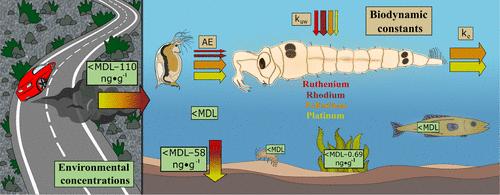
Growing reliance on platinum group elements (PGEs) as critical minerals for emerging technologies raises concerns regarding their ecotoxicological behavior. We studied their environmental fate in various inorganic and biological matrices from Canada using ICP-MS/MS analysis. Our findings confirmed previously published rhodium, palladium, and platinum concentration gradients from road dust to sediments, soils, and water, but differed from the literature reporting high biological contamination, which was not observed in our study. We also conducted experiments using a predator–prey model by exposing Chaoborus americanus to PGE mixtures for 24 h and to contaminated prey (Daphnia magna) for 8 days, followed by a 3-day excretion period. We estimated water uptake rate constants (kuw = 1.6–3.5 mL g–1 d–1), assimilation efficiencies (AEs = 0.024–32.2%), and efflux rate constants (ke = 0.51–0.69 d–1) for four PGEs. Overall, Chaoborus showed poor bioaccumulation and low trophic transfer of the PGEs, which were rapidly excreted. Experimental results supported low detection of PGEs in wild organisms, underscoring the need for caution when interpreting studies reporting high PGE levels in biological matrices. Nonetheless, this study improves our understanding of the PGEs’ environmental fate, revealing correlations with several quantitative ion character–activity relationships (QICARs) and highlighting chemical bond softness (σParr) as a predictor of biological assimilation and excretion.
期刊介绍:
Environmental Science & Technology (ES&T) is a co-sponsored academic and technical magazine by the Hubei Provincial Environmental Protection Bureau and the Hubei Provincial Academy of Environmental Sciences.
Environmental Science & Technology (ES&T) holds the status of Chinese core journals, scientific papers source journals of China, Chinese Science Citation Database source journals, and Chinese Academic Journal Comprehensive Evaluation Database source journals. This publication focuses on the academic field of environmental protection, featuring articles related to environmental protection and technical advancements.



 京公网安备 11010802042870号
京ICP备2023020795号-1
京公网安备 11010802042870号
京ICP备2023020795号-1

 分享
分享
 求助内容:
求助内容: 应助结果提醒方式:
 扫码关注我们
