Xiaokang Chen, Yi Tan, Jian Yuan, Shengliang Zhai, Le Su, Yujin Mou, Wei-Qiao Deng, Hao Wu
{"title":"Enhancing Urea Electrosynthesis From CO2 and Nitrate Through High-Entropy Alloying","authors":"Xiaokang Chen, Yi Tan, Jian Yuan, Shengliang Zhai, Le Su, Yujin Mou, Wei-Qiao Deng, Hao Wu","doi":"10.1002/aenm.202500872","DOIUrl":null,"url":null,"abstract":"<p>Ordered intermetallic compounds, one of the most effective alloying ways of enhancing electrocatalytic activity may provide more active sites for intermediates adsorption in single catalytic reactions. However, for catalysis involving several starting materials (such as the co-catalytic synthesis of urea from CO<sub>2</sub> and NO<sub>3</sub>⁻), it typically cannot favor multiple intermediates adsorption, leading to preferred individual catalysis and preventing effective C─N coupling. As a proof of concept, AuCuIrCo medium-entropy intermetallic (MEI) compounds are synthesized and use Pd to disrupt the ordered arrangement, achieving PdAuCuIrCo high-entropy alloy (HEA) counterpart for co-catalytic urea synthesis. In situ spectroscopic analyses indicate that the MEI produces greater NH₃–resultant of sole NO<sub>3</sub>⁻ reduction, while HEA yields more C─N coupling products. Theoretical calculations indicate that the HEA shows a reduced <sup>*</sup>NO<sub>2</sub> adsorption energy compared to MEI and lowers energy barriers for both C─N coupling and hydrogenation processes, allowing for effective co-adsorption with <sup>*</sup>CO<sub>2</sub>, whereas the MEI excessively stabilizes <sup>*</sup>NO<sub>2</sub>, favoring a single-pathway reduction to NH<sub>3</sub>. Consequently, the HEA achieves a high urea yield rate of 52.43 mmol h⁻¹ g⁻¹ and a Faradaic efficiency of 22.57% at −0.9 V, greatly surpassing the MEI. This study provides a framework for the development of multi-pathway electrocatalytic reactions.</p>","PeriodicalId":111,"journal":{"name":"Advanced Energy Materials","volume":"15 26","pages":""},"PeriodicalIF":26.0000,"publicationDate":"2025-03-22","publicationTypes":"Journal Article","fieldsOfStudy":null,"isOpenAccess":false,"openAccessPdf":"","citationCount":"0","resultStr":null,"platform":"Semanticscholar","paperid":null,"PeriodicalName":"Advanced Energy Materials","FirstCategoryId":"88","ListUrlMain":"https://advanced.onlinelibrary.wiley.com/doi/10.1002/aenm.202500872","RegionNum":1,"RegionCategory":"材料科学","ArticlePicture":[],"TitleCN":null,"AbstractTextCN":null,"PMCID":null,"EPubDate":"","PubModel":"","JCR":"Q1","JCRName":"CHEMISTRY, PHYSICAL","Score":null,"Total":0}
引用次数: 0
Abstract
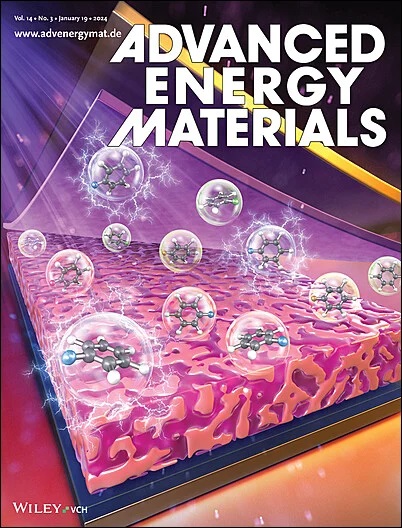
Ordered intermetallic compounds, one of the most effective alloying ways of enhancing electrocatalytic activity may provide more active sites for intermediates adsorption in single catalytic reactions. However, for catalysis involving several starting materials (such as the co-catalytic synthesis of urea from CO2 and NO3⁻), it typically cannot favor multiple intermediates adsorption, leading to preferred individual catalysis and preventing effective C─N coupling. As a proof of concept, AuCuIrCo medium-entropy intermetallic (MEI) compounds are synthesized and use Pd to disrupt the ordered arrangement, achieving PdAuCuIrCo high-entropy alloy (HEA) counterpart for co-catalytic urea synthesis. In situ spectroscopic analyses indicate that the MEI produces greater NH₃–resultant of sole NO3⁻ reduction, while HEA yields more C─N coupling products. Theoretical calculations indicate that the HEA shows a reduced *NO2 adsorption energy compared to MEI and lowers energy barriers for both C─N coupling and hydrogenation processes, allowing for effective co-adsorption with *CO2, whereas the MEI excessively stabilizes *NO2, favoring a single-pathway reduction to NH3. Consequently, the HEA achieves a high urea yield rate of 52.43 mmol h⁻¹ g⁻¹ and a Faradaic efficiency of 22.57% at −0.9 V, greatly surpassing the MEI. This study provides a framework for the development of multi-pathway electrocatalytic reactions.
期刊介绍:
Established in 2011, Advanced Energy Materials is an international, interdisciplinary, English-language journal that focuses on materials used in energy harvesting, conversion, and storage. It is regarded as a top-quality journal alongside Advanced Materials, Advanced Functional Materials, and Small.
With a 2022 Impact Factor of 27.8, Advanced Energy Materials is considered a prime source for the best energy-related research. The journal covers a wide range of topics in energy-related research, including organic and inorganic photovoltaics, batteries and supercapacitors, fuel cells, hydrogen generation and storage, thermoelectrics, water splitting and photocatalysis, solar fuels and thermosolar power, magnetocalorics, and piezoelectronics.
The readership of Advanced Energy Materials includes materials scientists, chemists, physicists, and engineers in both academia and industry. The journal is indexed in various databases and collections, such as Advanced Technologies & Aerospace Database, FIZ Karlsruhe, INSPEC (IET), Science Citation Index Expanded, Technology Collection, and Web of Science, among others.




 京公网安备 11010802042870号
京ICP备2023020795号-1
京公网安备 11010802042870号
京ICP备2023020795号-1

 分享
分享
 求助内容:
求助内容: 应助结果提醒方式:
 扫码关注我们
