Sewon Lim, Donghwan Kim, Hee Jung Kim, Hwandong Jang, Sienoh Park and Eunkyoung Kim
{"title":"Synergistic enhancement of luminescence and ferroelectricity driven by (Z)-clipping of a tetraphenylethene†","authors":"Sewon Lim, Donghwan Kim, Hee Jung Kim, Hwandong Jang, Sienoh Park and Eunkyoung Kim","doi":"10.1039/D4MH01620C","DOIUrl":null,"url":null,"abstract":"<p >Synergistic enhancement of luminescence and ferroelectricity (SELF) was explored in a (<em>Z</em>)-isomer of tetraphenylethene derivatives containing two clipping units in (<em>Z</em>)-configuration (<strong>TPC2-(<em>Z</em>)</strong>). <strong>TPC2-(<em>Z</em>)</strong> was synthesized utilizing a ‘body core’ precursor, which exclusively afforded (<em>Z</em>)-configuration. High-resolution transmission electron microscopy measurements indicated that <strong>TPC2-(<em>Z</em>)</strong> formed a layered morphology in film, with well-ordered crystalline structures, which was ascribed to the (<em>Z</em>)-clipped self-assembled structures. The film exhibited good photoluminescence performances with 45.6% quantum yield. Simultaneously, the film exhibited high ferroelectricity as inferred from high remnant polarization (<em>P</em><small><sub>r</sub></small> = 2.54 μC cm<small><sup>−2</sup></small>) and saturated polarization (3.56 μC cm<small><sup>−2</sup></small>) along with a longitudinal piezoelectric coefficient (<em>d</em><small><sub>33</sub></small> = −23.8 pm V<small><sup>−1</sup></small>), indicating that <strong>TPC2-(<em>Z</em>)</strong> exhibits excellent SELF. Owing to its fluorescence and thermal stability, we fabricated light-emitting electrochemical cells (LEC) that exhibited maximum 890 cd m<small><sup>−2</sup></small> at <em>V</em><small><sub>on</sub></small> of 3.9 V. This was more than 40% enhanced performance compared to that of the (<em>E</em>)/(<em>Z</em>) mixture. A new self-powered, stimuli-sensitive electroluminescent device was demonstrated with <strong>TPC2-(<em>Z</em>)</strong>, where the piezoelectrically tunable LECs effectively ‘switched on’ luminescence, showing 120-fold increased brightness after 254 bending at 1 Hz, compared to the ‘off’ state without bending. These results underscore that <em>Z</em>-clipping is an effective method for enhancing SELF and could create new self-powered, stimuli-sensitive electroluminescent devices.</p>","PeriodicalId":87,"journal":{"name":"Materials Horizons","volume":" 11","pages":" 3965-3978"},"PeriodicalIF":10.7000,"publicationDate":"2025-03-11","publicationTypes":"Journal Article","fieldsOfStudy":null,"isOpenAccess":false,"openAccessPdf":"https://pubs.rsc.org/en/content/articlepdf/2025/mh/d4mh01620c?page=search","citationCount":"0","resultStr":null,"platform":"Semanticscholar","paperid":null,"PeriodicalName":"Materials Horizons","FirstCategoryId":"88","ListUrlMain":"https://pubs.rsc.org/en/content/articlelanding/2025/mh/d4mh01620c","RegionNum":2,"RegionCategory":"材料科学","ArticlePicture":[],"TitleCN":null,"AbstractTextCN":null,"PMCID":null,"EPubDate":"","PubModel":"","JCR":"Q1","JCRName":"CHEMISTRY, MULTIDISCIPLINARY","Score":null,"Total":0}
引用次数: 0
Abstract
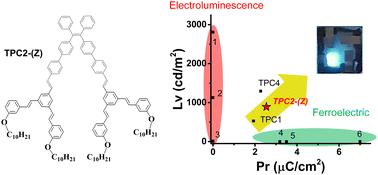
Synergistic enhancement of luminescence and ferroelectricity (SELF) was explored in a (Z)-isomer of tetraphenylethene derivatives containing two clipping units in (Z)-configuration (TPC2-(Z)). TPC2-(Z) was synthesized utilizing a ‘body core’ precursor, which exclusively afforded (Z)-configuration. High-resolution transmission electron microscopy measurements indicated that TPC2-(Z) formed a layered morphology in film, with well-ordered crystalline structures, which was ascribed to the (Z)-clipped self-assembled structures. The film exhibited good photoluminescence performances with 45.6% quantum yield. Simultaneously, the film exhibited high ferroelectricity as inferred from high remnant polarization (Pr = 2.54 μC cm−2) and saturated polarization (3.56 μC cm−2) along with a longitudinal piezoelectric coefficient (d33 = −23.8 pm V−1), indicating that TPC2-(Z) exhibits excellent SELF. Owing to its fluorescence and thermal stability, we fabricated light-emitting electrochemical cells (LEC) that exhibited maximum 890 cd m−2 at Von of 3.9 V. This was more than 40% enhanced performance compared to that of the (E)/(Z) mixture. A new self-powered, stimuli-sensitive electroluminescent device was demonstrated with TPC2-(Z), where the piezoelectrically tunable LECs effectively ‘switched on’ luminescence, showing 120-fold increased brightness after 254 bending at 1 Hz, compared to the ‘off’ state without bending. These results underscore that Z-clipping is an effective method for enhancing SELF and could create new self-powered, stimuli-sensitive electroluminescent devices.



 京公网安备 11010802042870号
京ICP备2023020795号-1
京公网安备 11010802042870号
京ICP备2023020795号-1

 分享
分享
 求助内容:
求助内容: 应助结果提醒方式:
 扫码关注我们
