Evaluation of 28-day inhalation toxicity mechanism of environmentally friendly insulating gas C5F10O based on pharmacology and molecular docking technology
Shuangshuang Tian , Qianqian Wan , Yimeng Chen , Benli Liu , Weihao Liu , Fanchao Ye , Zhou Huang
{"title":"Evaluation of 28-day inhalation toxicity mechanism of environmentally friendly insulating gas C5F10O based on pharmacology and molecular docking technology","authors":"Shuangshuang Tian , Qianqian Wan , Yimeng Chen , Benli Liu , Weihao Liu , Fanchao Ye , Zhou Huang","doi":"10.1016/j.fct.2025.115356","DOIUrl":null,"url":null,"abstract":"<div><div>C<sub>5</sub>F<sub>10</sub>O is a new eco-friendly insulating gas with excellent insulating properties and environmental characteristics. However, the toxicity of C<sub>5</sub>F<sub>10</sub>O needs to be studied before application. In this paper, 28-day inhalation toxicity experiments are conducted on rats exposed to C<sub>5</sub>F<sub>10</sub>O/air at 0 ppm, 500 ppm, 2000 ppm and 8000 ppm, with satellite groups at 0 ppm and 8000 ppm. The 28-day inhalation toxicity of C<sub>5</sub>F<sub>10</sub>O is invested in the term of the change of weight and food intake, the analysis of hematology, biochemistry, urine and histopathology. Molecular docking technology is used for virtual screening to analyze potential toxicological mechanisms. The results show that C<sub>5</sub>F<sub>10</sub>O has no effect on the food intake of rats. Combined with clinic and histopathology results, 8000 ppm C<sub>5</sub>F<sub>10</sub>O is toxic to the lungs of both male and female rats, and the lungs have not improved in the 8000 ppm satellite group which indicates the lungs as the target organ, and high dose C<sub>5</sub>F<sub>10</sub>O induces aggregation of rat lung foam cells. In addition, a NOAEC of 2000 ppm and a LOAEC of 6000 ppm are observed for C<sub>5</sub>F<sub>10</sub>O. Molecular docking results show that C<sub>5</sub>F<sub>10</sub>O binds to multiple proteins, impacting the HIF-1 pathway and immune response regulation, which may explain the foam cell aggregation in the lungs.</div></div>","PeriodicalId":317,"journal":{"name":"Food and Chemical Toxicology","volume":"200 ","pages":"Article 115356"},"PeriodicalIF":3.5000,"publicationDate":"2025-03-19","publicationTypes":"Journal Article","fieldsOfStudy":null,"isOpenAccess":false,"openAccessPdf":"","citationCount":"0","resultStr":null,"platform":"Semanticscholar","paperid":null,"PeriodicalName":"Food and Chemical Toxicology","FirstCategoryId":"97","ListUrlMain":"https://www.sciencedirect.com/science/article/pii/S0278691525001231","RegionNum":3,"RegionCategory":"医学","ArticlePicture":[],"TitleCN":null,"AbstractTextCN":null,"PMCID":null,"EPubDate":"","PubModel":"","JCR":"Q2","JCRName":"FOOD SCIENCE & TECHNOLOGY","Score":null,"Total":0}
引用次数: 0
Abstract
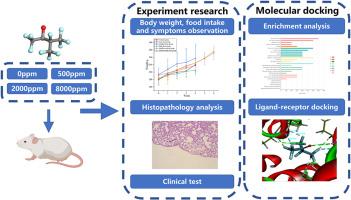
C5F10O is a new eco-friendly insulating gas with excellent insulating properties and environmental characteristics. However, the toxicity of C5F10O needs to be studied before application. In this paper, 28-day inhalation toxicity experiments are conducted on rats exposed to C5F10O/air at 0 ppm, 500 ppm, 2000 ppm and 8000 ppm, with satellite groups at 0 ppm and 8000 ppm. The 28-day inhalation toxicity of C5F10O is invested in the term of the change of weight and food intake, the analysis of hematology, biochemistry, urine and histopathology. Molecular docking technology is used for virtual screening to analyze potential toxicological mechanisms. The results show that C5F10O has no effect on the food intake of rats. Combined with clinic and histopathology results, 8000 ppm C5F10O is toxic to the lungs of both male and female rats, and the lungs have not improved in the 8000 ppm satellite group which indicates the lungs as the target organ, and high dose C5F10O induces aggregation of rat lung foam cells. In addition, a NOAEC of 2000 ppm and a LOAEC of 6000 ppm are observed for C5F10O. Molecular docking results show that C5F10O binds to multiple proteins, impacting the HIF-1 pathway and immune response regulation, which may explain the foam cell aggregation in the lungs.
期刊介绍:
Food and Chemical Toxicology (FCT), an internationally renowned journal, that publishes original research articles and reviews on toxic effects, in animals and humans, of natural or synthetic chemicals occurring in the human environment with particular emphasis on food, drugs, and chemicals, including agricultural and industrial safety, and consumer product safety. Areas such as safety evaluation of novel foods and ingredients, biotechnologically-derived products, and nanomaterials are included in the scope of the journal. FCT also encourages submission of papers on inter-relationships between nutrition and toxicology and on in vitro techniques, particularly those fostering the 3 Rs.
The principal aim of the journal is to publish high impact, scholarly work and to serve as a multidisciplinary forum for research in toxicology. Papers submitted will be judged on the basis of scientific originality and contribution to the field, quality and subject matter. Studies should address at least one of the following:
-Adverse physiological/biochemical, or pathological changes induced by specific defined substances
-New techniques for assessing potential toxicity, including molecular biology
-Mechanisms underlying toxic phenomena
-Toxicological examinations of specific chemicals or consumer products, both those showing adverse effects and those demonstrating safety, that meet current standards of scientific acceptability.
Authors must clearly and briefly identify what novel toxic effect (s) or toxic mechanism (s) of the chemical are being reported and what their significance is in the abstract. Furthermore, sufficient doses should be included in order to provide information on NOAEL/LOAEL values.



 京公网安备 11010802042870号
京ICP备2023020795号-1
京公网安备 11010802042870号
京ICP备2023020795号-1

 分享
分享
 求助内容:
求助内容: 应助结果提醒方式:
 扫码关注我们
