Saskia Janssen, Caryn Upton, Veronique R de Jager, Christo van Niekerk, Rodney Dawson, Jane Hutchings, Jeongjun Kim, Jinho Choi, Kiyean Nam, Eugene Sun, Andreas H Diacon
{"title":"Telacebec, a Potent Agent in the Fight against Tuberculosis: Findings from a Randomized, Phase 2 Clinical Trial and Beyond.","authors":"Saskia Janssen, Caryn Upton, Veronique R de Jager, Christo van Niekerk, Rodney Dawson, Jane Hutchings, Jeongjun Kim, Jinho Choi, Kiyean Nam, Eugene Sun, Andreas H Diacon","doi":"10.1164/rccm.202408-1632OC","DOIUrl":null,"url":null,"abstract":"<p><p><b>Rationale:</b> Antibiotic-resistant mycobacterial infections are a major threat to health care. Telacebec is a novel, first-in-class agent targeting mycobacterial cellular energy production in a range of pathogenic mycobacteria, including <i>Mycobacterium tuberculosis</i>, <i>M. leprae</i>, and <i>M. ulcerans</i>. <b>Objectives:</b> To explore telacebec's early bactericidal activity, tolerability, safety, and pharmacokinetics in patients with pulmonary tuberculosis and to summarize its current state of development for other diseases. <b>Methods:</b> We randomly assigned 64 patients with smear-positive, drug-sensitive tuberculosis to daily telacebec 100, 200, or 300 mg, or standard four-drug treatment as control, for 14 days. <b>Measurements and Main Results:</b> Sputum collected overnight was cultured in liquid and on solid media to determine the change of viable mycobacteria over time. Safety and tolerability were assessed daily. A full pharmacokinetic profile was obtained on Day 14. We found a dose-dependent reduction of the sputum mycobacterial load with a mean ± SD daily change for telacebec 300 mg and control, respectively, of 0.097 ± 0.050 and 0.200 ± 0.073 log colony-forming units, and 3.738 ± 2.747 and 6.853 ± 1.194 hours to culture positivity over the first 14 days of treatment. Pharmacokinetics were dose proportional. Telacebec was well tolerated and safe, with low adverse event rates across all doses. <b>Conclusions:</b> These results confirm telacebec's clinical activity against <i>M. tuberculosis</i>. Longer trials, in combination with other agents, are required to validate these results and to investigate telacebec's full potential. These results encourage the exploration of telacebec for more effective, shorter treatment regimens for leprosy and Buruli ulcer. A clinical trial for Buruli ulcer is under way. Clinical trial registered with URL (NCT03563599).</p>","PeriodicalId":7664,"journal":{"name":"American journal of respiratory and critical care medicine","volume":" ","pages":"1504-1512"},"PeriodicalIF":19.4000,"publicationDate":"2025-08-01","publicationTypes":"Journal Article","fieldsOfStudy":null,"isOpenAccess":false,"openAccessPdf":"","citationCount":"0","resultStr":null,"platform":"Semanticscholar","paperid":null,"PeriodicalName":"American journal of respiratory and critical care medicine","FirstCategoryId":"3","ListUrlMain":"https://doi.org/10.1164/rccm.202408-1632OC","RegionNum":1,"RegionCategory":"医学","ArticlePicture":[],"TitleCN":null,"AbstractTextCN":null,"PMCID":null,"EPubDate":"","PubModel":"","JCR":"Q1","JCRName":"CRITICAL CARE MEDICINE","Score":null,"Total":0}
引用次数: 0
Abstract
Rationale: Antibiotic-resistant mycobacterial infections are a major threat to health care. Telacebec is a novel, first-in-class agent targeting mycobacterial cellular energy production in a range of pathogenic mycobacteria, including Mycobacterium tuberculosis, M. leprae, and M. ulcerans. Objectives: To explore telacebec's early bactericidal activity, tolerability, safety, and pharmacokinetics in patients with pulmonary tuberculosis and to summarize its current state of development for other diseases. Methods: We randomly assigned 64 patients with smear-positive, drug-sensitive tuberculosis to daily telacebec 100, 200, or 300 mg, or standard four-drug treatment as control, for 14 days. Measurements and Main Results: Sputum collected overnight was cultured in liquid and on solid media to determine the change of viable mycobacteria over time. Safety and tolerability were assessed daily. A full pharmacokinetic profile was obtained on Day 14. We found a dose-dependent reduction of the sputum mycobacterial load with a mean ± SD daily change for telacebec 300 mg and control, respectively, of 0.097 ± 0.050 and 0.200 ± 0.073 log colony-forming units, and 3.738 ± 2.747 and 6.853 ± 1.194 hours to culture positivity over the first 14 days of treatment. Pharmacokinetics were dose proportional. Telacebec was well tolerated and safe, with low adverse event rates across all doses. Conclusions: These results confirm telacebec's clinical activity against M. tuberculosis. Longer trials, in combination with other agents, are required to validate these results and to investigate telacebec's full potential. These results encourage the exploration of telacebec for more effective, shorter treatment regimens for leprosy and Buruli ulcer. A clinical trial for Buruli ulcer is under way. Clinical trial registered with URL (NCT03563599).
期刊介绍:
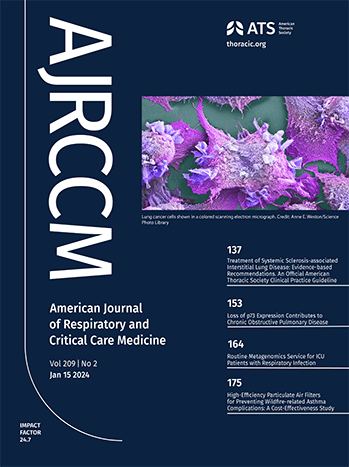
The American Journal of Respiratory and Critical Care Medicine focuses on human biology and disease, as well as animal studies that contribute to the understanding of pathophysiology and treatment of diseases that affect the respiratory system and critically ill patients. Papers that are solely or predominantly based in cell and molecular biology are published in the companion journal, the American Journal of Respiratory Cell and Molecular Biology. The Journal also seeks to publish clinical trials and outstanding review articles on areas of interest in several forms. The State-of-the-Art review is a treatise usually covering a broad field that brings bench research to the bedside. Shorter reviews are published as Critical Care Perspectives or Pulmonary Perspectives. These are generally focused on a more limited area and advance a concerted opinion about care for a specific process. Concise Clinical Reviews provide an evidence-based synthesis of the literature pertaining to topics of fundamental importance to the practice of pulmonary, critical care, and sleep medicine. Images providing advances or unusual contributions to the field are published as Images in Pulmonary, Critical Care, Sleep Medicine and the Sciences.
A recent trend and future direction of the Journal has been to include debates of a topical nature on issues of importance in pulmonary and critical care medicine and to the membership of the American Thoracic Society. Other recent changes have included encompassing works from the field of critical care medicine and the extension of the editorial governing of journal policy to colleagues outside of the United States of America. The focus and direction of the Journal is to establish an international forum for state-of-the-art respiratory and critical care medicine.



 京公网安备 11010802042870号
京ICP备2023020795号-1
京公网安备 11010802042870号
京ICP备2023020795号-1

 分享
分享
 求助内容:
求助内容: 应助结果提醒方式:
 扫码关注我们
