{"title":"Measuring the influence of contrast, ambiguity, and side of spatial context on perceptual dominance during binocular rivalry.","authors":"Lisa Beckmann, Thomas Schenk, Karin Ludwig","doi":"10.1167/jov.25.3.6","DOIUrl":null,"url":null,"abstract":"<p><p>The perception of ambiguous stimuli, notably binocular rivalry (BR), has been demonstrated to be influenced by spatial context. Previous results are, however, inconsistent with regard to whether the context biases perception toward the BR target that matches the context or toward the one that differs from the context. Furthermore, it is unclear what roles the perceptual ambiguity of the context and its lateral location play. We varied ambiguity, contrast, size, and location (left/right) of the context surrounding a rivalry target in a high-powered within-subject design to investigate (1) the effects of contrast and ambiguity of the surrounding context and (2) whether we could find laterality effects that correlated with an established pseudoneglect measure. The results showed an increase in perceptual predominance of the rivalry targets differing from the surround across all high-contrast conditions (irrespective of the ambiguity of the context), whereas the effect in the low-contrast condition was less pronounced. We found no laterality effects, but the strength of the context effects scaled with the context size (half/full). In an exploratory analysis, we further found a nasal advantage in the half-field condition. We interpret the results in the theoretical frameworks of surround inhibition and facilitation, figure-ground segregation, pseudoneglect, and nasal visual field advantage.</p>","PeriodicalId":49955,"journal":{"name":"Journal of Vision","volume":"25 3","pages":"6"},"PeriodicalIF":2.3000,"publicationDate":"2025-03-03","publicationTypes":"Journal Article","fieldsOfStudy":null,"isOpenAccess":false,"openAccessPdf":"https://www.ncbi.nlm.nih.gov/pmc/articles/PMC11935559/pdf/","citationCount":"0","resultStr":null,"platform":"Semanticscholar","paperid":null,"PeriodicalName":"Journal of Vision","FirstCategoryId":"3","ListUrlMain":"https://doi.org/10.1167/jov.25.3.6","RegionNum":4,"RegionCategory":"心理学","ArticlePicture":[],"TitleCN":null,"AbstractTextCN":null,"PMCID":null,"EPubDate":"","PubModel":"","JCR":"Q2","JCRName":"OPHTHALMOLOGY","Score":null,"Total":0}
引用次数: 0
Abstract
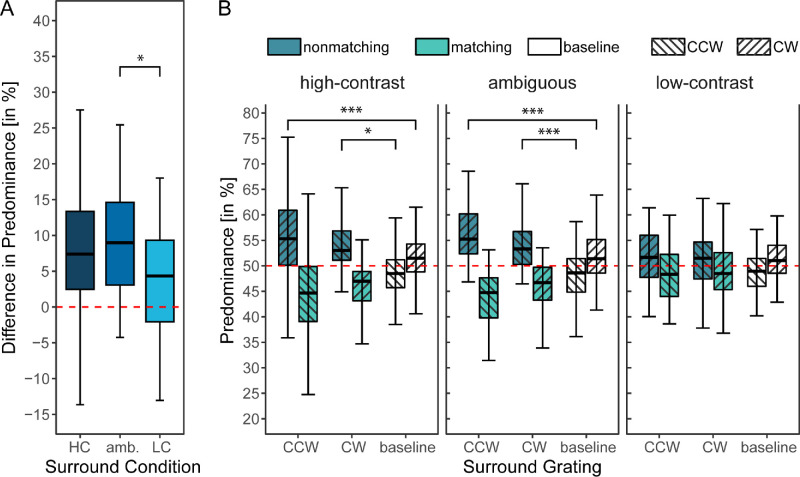
The perception of ambiguous stimuli, notably binocular rivalry (BR), has been demonstrated to be influenced by spatial context. Previous results are, however, inconsistent with regard to whether the context biases perception toward the BR target that matches the context or toward the one that differs from the context. Furthermore, it is unclear what roles the perceptual ambiguity of the context and its lateral location play. We varied ambiguity, contrast, size, and location (left/right) of the context surrounding a rivalry target in a high-powered within-subject design to investigate (1) the effects of contrast and ambiguity of the surrounding context and (2) whether we could find laterality effects that correlated with an established pseudoneglect measure. The results showed an increase in perceptual predominance of the rivalry targets differing from the surround across all high-contrast conditions (irrespective of the ambiguity of the context), whereas the effect in the low-contrast condition was less pronounced. We found no laterality effects, but the strength of the context effects scaled with the context size (half/full). In an exploratory analysis, we further found a nasal advantage in the half-field condition. We interpret the results in the theoretical frameworks of surround inhibition and facilitation, figure-ground segregation, pseudoneglect, and nasal visual field advantage.
期刊介绍:
Exploring all aspects of biological visual function, including spatial vision, perception,
low vision, color vision and more, spanning the fields of neuroscience, psychology and psychophysics.





 京公网安备 11010802042870号
京ICP备2023020795号-1
京公网安备 11010802042870号
京ICP备2023020795号-1

 分享
分享
 求助内容:
求助内容: 应助结果提醒方式:
 扫码关注我们
