Andrea M. Rich , Leopold Berger , Robin Deller , Niccoló De Berardinis , Gry Hulsart Billström , Benedikt Helgason , Stephen J. Ferguson , Cecilia Persson , Jörg F. Löffler
{"title":"Bioresorbable, amorphous magnesium-fiber reinforced bone cement with enhanced mechanical and biological properties","authors":"Andrea M. Rich , Leopold Berger , Robin Deller , Niccoló De Berardinis , Gry Hulsart Billström , Benedikt Helgason , Stephen J. Ferguson , Cecilia Persson , Jörg F. Löffler","doi":"10.1016/j.bioadv.2025.214285","DOIUrl":null,"url":null,"abstract":"<div><div>In this study, we developed and characterized a fully biodegradable composite bone cement reinforced with short, randomly oriented amorphous magnesium fibers. Fibers of composition Mg<sub>60</sub>Zn<sub>35</sub>Ca<sub>5</sub> (in at.%) with 50 μm diameter and 2 mm length were produced by wire spinning and then mixed with a magnesium calcium phosphate cement using fiber volume fractions between 10 and 20 %. The interface strength between the fibers and cement was improved by treating the fibers with diammonium hydrogen phosphate. Compared to the reference cement without fibers, flexural strength was increased by 18 % for the composites with 13 and 18 vol% fibers, and the work of fracture was increased by over 1000× in all cases (<em>p</em> < 0.05, <em>n</em> = 6). Immersion in simulated body fluid for two and four weeks showed that the cement's struvite phase degrades first, and overall, the composite degrades slower. The degradation rate can be tailored to the application by changing the fiber percentage or the cement/fiber composition. Murine pre-osteoblastic cells (MC3T3) cultured in extracts of reference and composite cements had significantly higher cell viability, and composites with 13 vol% fibers also had a significantly higher number of cells compared to the control, indicating that the fibers can enhance and promote pre-osteoblastic cell growth. The results demonstrate that amorphous magnesium fibers enhance both the mechanical and biological properties of ceramic bone cement, expanding their prospects for clinical application.</div></div>","PeriodicalId":51111,"journal":{"name":"Materials Science & Engineering C-Materials for Biological Applications","volume":"173 ","pages":"Article 214285"},"PeriodicalIF":6.0000,"publicationDate":"2025-03-11","publicationTypes":"Journal Article","fieldsOfStudy":null,"isOpenAccess":false,"openAccessPdf":"","citationCount":"0","resultStr":null,"platform":"Semanticscholar","paperid":null,"PeriodicalName":"Materials Science & Engineering C-Materials for Biological Applications","FirstCategoryId":"1085","ListUrlMain":"https://www.sciencedirect.com/science/article/pii/S2772950825001128","RegionNum":2,"RegionCategory":"医学","ArticlePicture":[],"TitleCN":null,"AbstractTextCN":null,"PMCID":null,"EPubDate":"","PubModel":"","JCR":"Q2","JCRName":"MATERIALS SCIENCE, BIOMATERIALS","Score":null,"Total":0}
引用次数: 0
Abstract
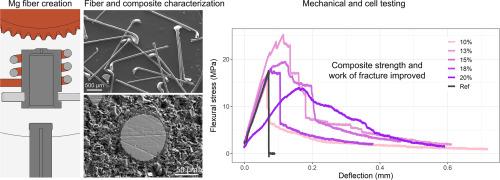
In this study, we developed and characterized a fully biodegradable composite bone cement reinforced with short, randomly oriented amorphous magnesium fibers. Fibers of composition Mg60Zn35Ca5 (in at.%) with 50 μm diameter and 2 mm length were produced by wire spinning and then mixed with a magnesium calcium phosphate cement using fiber volume fractions between 10 and 20 %. The interface strength between the fibers and cement was improved by treating the fibers with diammonium hydrogen phosphate. Compared to the reference cement without fibers, flexural strength was increased by 18 % for the composites with 13 and 18 vol% fibers, and the work of fracture was increased by over 1000× in all cases (p < 0.05, n = 6). Immersion in simulated body fluid for two and four weeks showed that the cement's struvite phase degrades first, and overall, the composite degrades slower. The degradation rate can be tailored to the application by changing the fiber percentage or the cement/fiber composition. Murine pre-osteoblastic cells (MC3T3) cultured in extracts of reference and composite cements had significantly higher cell viability, and composites with 13 vol% fibers also had a significantly higher number of cells compared to the control, indicating that the fibers can enhance and promote pre-osteoblastic cell growth. The results demonstrate that amorphous magnesium fibers enhance both the mechanical and biological properties of ceramic bone cement, expanding their prospects for clinical application.
期刊介绍:
Biomaterials Advances, previously known as Materials Science and Engineering: C-Materials for Biological Applications (P-ISSN: 0928-4931, E-ISSN: 1873-0191). Includes topics at the interface of the biomedical sciences and materials engineering. These topics include:
• Bioinspired and biomimetic materials for medical applications
• Materials of biological origin for medical applications
• Materials for "active" medical applications
• Self-assembling and self-healing materials for medical applications
• "Smart" (i.e., stimulus-response) materials for medical applications
• Ceramic, metallic, polymeric, and composite materials for medical applications
• Materials for in vivo sensing
• Materials for in vivo imaging
• Materials for delivery of pharmacologic agents and vaccines
• Novel approaches for characterizing and modeling materials for medical applications
Manuscripts on biological topics without a materials science component, or manuscripts on materials science without biological applications, will not be considered for publication in Materials Science and Engineering C. New submissions are first assessed for language, scope and originality (plagiarism check) and can be desk rejected before review if they need English language improvements, are out of scope or present excessive duplication with published sources.
Biomaterials Advances sits within Elsevier''s biomaterials science portfolio alongside Biomaterials, Materials Today Bio and Biomaterials and Biosystems. As part of the broader Materials Today family, Biomaterials Advances offers authors rigorous peer review, rapid decisions, and high visibility. We look forward to receiving your submissions!



 京公网安备 11010802042870号
京ICP备2023020795号-1
京公网安备 11010802042870号
京ICP备2023020795号-1

 分享
分享
 求助内容:
求助内容: 应助结果提醒方式:
 扫码关注我们
