{"title":"Thermal runaway and gas venting behaviors of large-format prismatic sodium-ion battery","authors":"Zhiyuan Li, Yin Yu, Junjie Wang, Chengdong Wang, Xiaofang He, Zhixiang Cheng, Huang Li, Wenxin Mei, Qingsong Wang","doi":"10.1016/j.ensm.2025.104197","DOIUrl":null,"url":null,"abstract":"<div><div>Sodium-ion batteries (SIBs) have emerged as promising alternatives to lithium-ion batteries due to the advantages of low cost, abundant resources, and superior low-temperature performance. However, research on the thermal runaway (TR) behavior of large-format prismatic SIBs remains limited. To address this research gap, this work investigates the TR behavior of 185 Ah SIBs at different states of charges (SOCs). In contrast to prior research, the primary contribution of this work is the investigation of heat generation, gas production, and mechanical changes in SIBs during TR. Two significant conclusions are obtained: 1) The proportion of H<sub>2</sub> increases significantly with SOC, reaching as high as 42% at 100% SOC, with an explosion range of 6.5%∼69.0%, suggesting substantial combustion and explosion hazards associated with SIBs; 2) SIBs release a large amount of heat during TR, resulting in the ejection of internal hot particles as sparks. However, the intense gas production behavior during TR process effectively dissipates heat from SIBs while isolating the combustible gases from the sparks and oxygen, leading to a self-extinguishing phenomenon. This study highlights the influence of SOC on TR and gas production behavior in SIBs, providing critical insights for the advancement of electrochemical energy storage systems.</div></div>","PeriodicalId":306,"journal":{"name":"Energy Storage Materials","volume":"77 ","pages":"Article 104197"},"PeriodicalIF":20.2000,"publicationDate":"2025-04-01","publicationTypes":"Journal Article","fieldsOfStudy":null,"isOpenAccess":false,"openAccessPdf":"","citationCount":"0","resultStr":null,"platform":"Semanticscholar","paperid":null,"PeriodicalName":"Energy Storage Materials","FirstCategoryId":"88","ListUrlMain":"https://www.sciencedirect.com/science/article/pii/S2405829725001977","RegionNum":1,"RegionCategory":"材料科学","ArticlePicture":[],"TitleCN":null,"AbstractTextCN":null,"PMCID":null,"EPubDate":"2025/3/22 0:00:00","PubModel":"Epub","JCR":"Q1","JCRName":"CHEMISTRY, PHYSICAL","Score":null,"Total":0}
引用次数: 0
Abstract
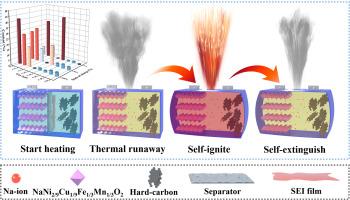
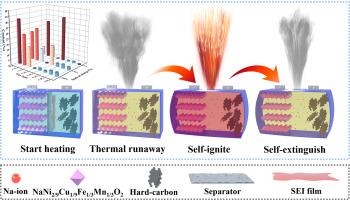
Sodium-ion batteries (SIBs) have emerged as promising alternatives to lithium-ion batteries due to the advantages of low cost, abundant resources, and superior low-temperature performance. However, research on the thermal runaway (TR) behavior of large-format prismatic SIBs remains limited. To address this research gap, this work investigates the TR behavior of 185 Ah SIBs at different states of charges (SOCs). In contrast to prior research, the primary contribution of this work is the investigation of heat generation, gas production, and mechanical changes in SIBs during TR. Two significant conclusions are obtained: 1) The proportion of H2 increases significantly with SOC, reaching as high as 42% at 100% SOC, with an explosion range of 6.5%∼69.0%, suggesting substantial combustion and explosion hazards associated with SIBs; 2) SIBs release a large amount of heat during TR, resulting in the ejection of internal hot particles as sparks. However, the intense gas production behavior during TR process effectively dissipates heat from SIBs while isolating the combustible gases from the sparks and oxygen, leading to a self-extinguishing phenomenon. This study highlights the influence of SOC on TR and gas production behavior in SIBs, providing critical insights for the advancement of electrochemical energy storage systems.
期刊介绍:
Energy Storage Materials is a global interdisciplinary journal dedicated to sharing scientific and technological advancements in materials and devices for advanced energy storage and related energy conversion, such as in metal-O2 batteries. The journal features comprehensive research articles, including full papers and short communications, as well as authoritative feature articles and reviews by leading experts in the field.
Energy Storage Materials covers a wide range of topics, including the synthesis, fabrication, structure, properties, performance, and technological applications of energy storage materials. Additionally, the journal explores strategies, policies, and developments in the field of energy storage materials and devices for sustainable energy.
Published papers are selected based on their scientific and technological significance, their ability to provide valuable new knowledge, and their relevance to the international research community.



 京公网安备 11010802042870号
京ICP备2023020795号-1
京公网安备 11010802042870号
京ICP备2023020795号-1

 分享
分享
 求助内容:
求助内容: 应助结果提醒方式:
 扫码关注我们
