Yanxiang Li , Jianlin Li , Yang Cao , Yajie Zhong , Jiarui Zeng , Wenqiang Xie , Chengcheng Li , Wei Huang
{"title":"Lattice distortion and synergistic crystal field: A path to broad-spectrum absorption in high-entropy sulfides for solar water evaporation","authors":"Yanxiang Li , Jianlin Li , Yang Cao , Yajie Zhong , Jiarui Zeng , Wenqiang Xie , Chengcheng Li , Wei Huang","doi":"10.1016/j.nanoen.2025.110902","DOIUrl":null,"url":null,"abstract":"<div><div>Solar interfacial evaporation is a promising and sustainable approach to address global water shortages, yet the limited light absorption of existing photothermal materials constrains their efficiency. Here, we present an innovative lattice distortion and synergistic crystal field strategy for designing advanced photothermal materials with broad-spectrum absorption. For the first time, we report ZnCdFeCoNiS, a high-entropy sulfide (HES-NPs) material exhibiting exceptional photothermal conversion efficiency for solar seawater desalination. This HES-NPs achieves an average absorbance of over 92 % across the full solar spectrum (250–2500 nm). It delivers an impressive photothermal conversion efficiency exceeding 93 % under one sun irradiation, alongside a high evaporation rate of 1.92 kg m<sup>−2</sup> h<sup>−1</sup>. XRD analysis reveals significant lattice distortion in HES-NPs, showing a 4.32 % increase in layer distance for the (111) orientation. DFT calculations and diffuse reflectance spectra indicate this distortion effectively narrows the band gap. Additionally, the introduction of multiple transition metals creates overlapping crystal fields, creating synergistic <em>e</em><sub><em>g</em></sub> and <em>t</em><sub><em>2 g</em></sub> states. This approach not only reduces the layer gap but also enhances interband transitions, thereby broadening the light absorption range and boosting absorption efficiency. This lattice distortion and synergistic crystal field approach not only optimizes the photothermal properties of HES-NPs but also establishes a new design paradigm for high-performance materials in solar-driven water evaporation and desalination applications.</div></div>","PeriodicalId":394,"journal":{"name":"Nano Energy","volume":"138 ","pages":"Article 110902"},"PeriodicalIF":17.1000,"publicationDate":"2025-03-22","publicationTypes":"Journal Article","fieldsOfStudy":null,"isOpenAccess":false,"openAccessPdf":"","citationCount":"0","resultStr":null,"platform":"Semanticscholar","paperid":null,"PeriodicalName":"Nano Energy","FirstCategoryId":"88","ListUrlMain":"https://www.sciencedirect.com/science/article/pii/S2211285525002617","RegionNum":1,"RegionCategory":"材料科学","ArticlePicture":[],"TitleCN":null,"AbstractTextCN":null,"PMCID":null,"EPubDate":"","PubModel":"","JCR":"Q1","JCRName":"CHEMISTRY, PHYSICAL","Score":null,"Total":0}
引用次数: 0
Abstract
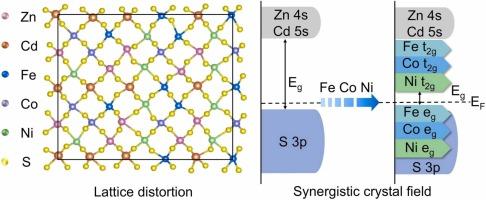
Solar interfacial evaporation is a promising and sustainable approach to address global water shortages, yet the limited light absorption of existing photothermal materials constrains their efficiency. Here, we present an innovative lattice distortion and synergistic crystal field strategy for designing advanced photothermal materials with broad-spectrum absorption. For the first time, we report ZnCdFeCoNiS, a high-entropy sulfide (HES-NPs) material exhibiting exceptional photothermal conversion efficiency for solar seawater desalination. This HES-NPs achieves an average absorbance of over 92 % across the full solar spectrum (250–2500 nm). It delivers an impressive photothermal conversion efficiency exceeding 93 % under one sun irradiation, alongside a high evaporation rate of 1.92 kg m−2 h−1. XRD analysis reveals significant lattice distortion in HES-NPs, showing a 4.32 % increase in layer distance for the (111) orientation. DFT calculations and diffuse reflectance spectra indicate this distortion effectively narrows the band gap. Additionally, the introduction of multiple transition metals creates overlapping crystal fields, creating synergistic eg and t2 g states. This approach not only reduces the layer gap but also enhances interband transitions, thereby broadening the light absorption range and boosting absorption efficiency. This lattice distortion and synergistic crystal field approach not only optimizes the photothermal properties of HES-NPs but also establishes a new design paradigm for high-performance materials in solar-driven water evaporation and desalination applications.
期刊介绍:
Nano Energy is a multidisciplinary, rapid-publication forum of original peer-reviewed contributions on the science and engineering of nanomaterials and nanodevices used in all forms of energy harvesting, conversion, storage, utilization and policy. Through its mixture of articles, reviews, communications, research news, and information on key developments, Nano Energy provides a comprehensive coverage of this exciting and dynamic field which joins nanoscience and nanotechnology with energy science. The journal is relevant to all those who are interested in nanomaterials solutions to the energy problem.
Nano Energy publishes original experimental and theoretical research on all aspects of energy-related research which utilizes nanomaterials and nanotechnology. Manuscripts of four types are considered: review articles which inform readers of the latest research and advances in energy science; rapid communications which feature exciting research breakthroughs in the field; full-length articles which report comprehensive research developments; and news and opinions which comment on topical issues or express views on the developments in related fields.



 京公网安备 11010802042870号
京ICP备2023020795号-1
京公网安备 11010802042870号
京ICP备2023020795号-1

 分享
分享
 求助内容:
求助内容: 应助结果提醒方式:
 扫码关注我们
