Ruiqian Chen , Lei Gu , Jiacheng Su , Yang Feng, Haoran Deng, Jie Zhang, Yaqi Bao, Dourong Wang, Xinyue Song, Lei Zhao, Lin Song
{"title":"Stabilizing 2D perovskite passivation layer with mixed spacer cations for efficient and stable perovskite solar cells","authors":"Ruiqian Chen , Lei Gu , Jiacheng Su , Yang Feng, Haoran Deng, Jie Zhang, Yaqi Bao, Dourong Wang, Xinyue Song, Lei Zhao, Lin Song","doi":"10.1016/j.nanoen.2025.110904","DOIUrl":null,"url":null,"abstract":"<div><div>Post-treating perovskite films with phenylethylammonium iodide (PEAI) is a commonly used method to passivate surface defects for high performance perovskite solar cells (PSCs). However, this post-treatment usually leads to a rapid performance decay in the initial stage during the stability measurements, which are frequently observed in literature. In this work, we first disclose the degradation mechanism of the PEAI induced 2D perovskites, in which (PEA)<sub>2</sub>PbI<sub>4</sub> (n = 1 phase) degrades gradually over time instead of (PEA)<sub>2</sub>FAPb<sub>2</sub>I<sub>7</sub> (n = 2 phase). To address this problem, we substitute parts of PEA<sup>+</sup> with NMA<sup>+</sup> in the n = 1 phase, which consequently stabilizes in air over time with respect to the structures and optoelectronic properties. Moreover, the obtained 2D perovskites can harvest hot charge carriers generated in the 3D counterparts. As a result, the related PSCs deliver a champion power conversion efficiency (PCE) of 25.7 % with a <em>V</em><sub>OC</sub> of 1.187 V. Moreover, the alleviated performance degradation is observed in the initial stage of the stability test, which is manifest in only 6 % power conversion efficiency (PCE) loss after being aged in air (relative humidity of 30 %-40 %) for 100 h, compared to 20 % decay for the PEAI-treated device.</div></div>","PeriodicalId":394,"journal":{"name":"Nano Energy","volume":"139 ","pages":"Article 110904"},"PeriodicalIF":17.1000,"publicationDate":"2025-03-22","publicationTypes":"Journal Article","fieldsOfStudy":null,"isOpenAccess":false,"openAccessPdf":"","citationCount":"0","resultStr":null,"platform":"Semanticscholar","paperid":null,"PeriodicalName":"Nano Energy","FirstCategoryId":"88","ListUrlMain":"https://www.sciencedirect.com/science/article/pii/S2211285525002630","RegionNum":1,"RegionCategory":"材料科学","ArticlePicture":[],"TitleCN":null,"AbstractTextCN":null,"PMCID":null,"EPubDate":"","PubModel":"","JCR":"Q1","JCRName":"CHEMISTRY, PHYSICAL","Score":null,"Total":0}
引用次数: 0
Abstract
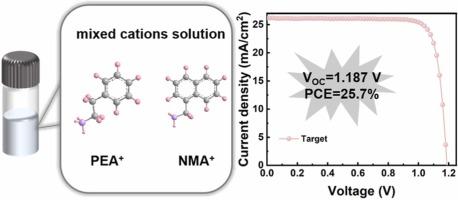
Post-treating perovskite films with phenylethylammonium iodide (PEAI) is a commonly used method to passivate surface defects for high performance perovskite solar cells (PSCs). However, this post-treatment usually leads to a rapid performance decay in the initial stage during the stability measurements, which are frequently observed in literature. In this work, we first disclose the degradation mechanism of the PEAI induced 2D perovskites, in which (PEA)2PbI4 (n = 1 phase) degrades gradually over time instead of (PEA)2FAPb2I7 (n = 2 phase). To address this problem, we substitute parts of PEA+ with NMA+ in the n = 1 phase, which consequently stabilizes in air over time with respect to the structures and optoelectronic properties. Moreover, the obtained 2D perovskites can harvest hot charge carriers generated in the 3D counterparts. As a result, the related PSCs deliver a champion power conversion efficiency (PCE) of 25.7 % with a VOC of 1.187 V. Moreover, the alleviated performance degradation is observed in the initial stage of the stability test, which is manifest in only 6 % power conversion efficiency (PCE) loss after being aged in air (relative humidity of 30 %-40 %) for 100 h, compared to 20 % decay for the PEAI-treated device.
期刊介绍:
Nano Energy is a multidisciplinary, rapid-publication forum of original peer-reviewed contributions on the science and engineering of nanomaterials and nanodevices used in all forms of energy harvesting, conversion, storage, utilization and policy. Through its mixture of articles, reviews, communications, research news, and information on key developments, Nano Energy provides a comprehensive coverage of this exciting and dynamic field which joins nanoscience and nanotechnology with energy science. The journal is relevant to all those who are interested in nanomaterials solutions to the energy problem.
Nano Energy publishes original experimental and theoretical research on all aspects of energy-related research which utilizes nanomaterials and nanotechnology. Manuscripts of four types are considered: review articles which inform readers of the latest research and advances in energy science; rapid communications which feature exciting research breakthroughs in the field; full-length articles which report comprehensive research developments; and news and opinions which comment on topical issues or express views on the developments in related fields.



 京公网安备 11010802042870号
京ICP备2023020795号-1
京公网安备 11010802042870号
京ICP备2023020795号-1

 分享
分享
 求助内容:
求助内容: 应助结果提醒方式:
 扫码关注我们
