Xuri Wang , Bo Zhao , Xiangcun Li , Xinhong Qi , Yan Dai , Tiantian Li , Gaohong He , Fangyi Chu , Xiaobin Jiang
{"title":"Inducing spherical lithium deposition via simultaneously optimized electric field and ionic flux for fast-charging lithium metal batteries","authors":"Xuri Wang , Bo Zhao , Xiangcun Li , Xinhong Qi , Yan Dai , Tiantian Li , Gaohong He , Fangyi Chu , Xiaobin Jiang","doi":"10.1016/j.ensm.2025.104200","DOIUrl":null,"url":null,"abstract":"<div><div>Nonuniform Li-ion gradient and electric fields in conventional host lead to uncontrollable Li top-growth behavior and Li dendrite, impeding the practical application of lithium metal anodes (LMAs). Herein, we design a 3D hierarchical flexible membrane host with gradient lithiophilic properties (GFC@PVDF) to regulate bottom-up growth of the spherical Li within host, by optimizing the electric field and Li-ion flux. The membrane networks with CNT as cores and β-PVDF as linking shells enabling fast electron transfer and low Li-ion migration energy barriers. Gradient Fe<sub>2</sub>O<sub>3</sub> particles in the membrane by layer-by-layer bottom-up attenuating could induce Li-ion dredging and pumps towards the bottom for bottom-up deposition regime, reducing ion concentration gradient via lithiophilic gradient properties. Meanwhile, the Fe<sub>2</sub>O<sub>3</sub> is converted into hybrid electron/ion conductor Fe/Li<sub>2</sub>O during cycling, which acts as charge decoupling and fast transport path that enhances the bottom transport of Li-ions. Consequently, stable symmetric cells over 500 cycles with Li spherical uniform deposition are obtained under an ultrahigh current density of 50 mA cm<sup>-2</sup>. The full cell paired with LiFePO<sub>4</sub> cathode exhibits remarkable cycling stability at a low N/P ratio of 1.7. This study provides new insights into dendrite-free Li metal anodes, paving the way for high-energy, fast-charging LMAs.</div></div>","PeriodicalId":306,"journal":{"name":"Energy Storage Materials","volume":"77 ","pages":"Article 104200"},"PeriodicalIF":20.2000,"publicationDate":"2025-04-01","publicationTypes":"Journal Article","fieldsOfStudy":null,"isOpenAccess":false,"openAccessPdf":"","citationCount":"0","resultStr":null,"platform":"Semanticscholar","paperid":null,"PeriodicalName":"Energy Storage Materials","FirstCategoryId":"88","ListUrlMain":"https://www.sciencedirect.com/science/article/pii/S2405829725002004","RegionNum":1,"RegionCategory":"材料科学","ArticlePicture":[],"TitleCN":null,"AbstractTextCN":null,"PMCID":null,"EPubDate":"2025/3/22 0:00:00","PubModel":"Epub","JCR":"Q1","JCRName":"CHEMISTRY, PHYSICAL","Score":null,"Total":0}
引用次数: 0
Abstract
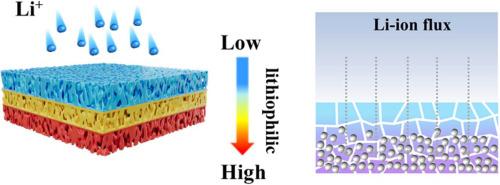
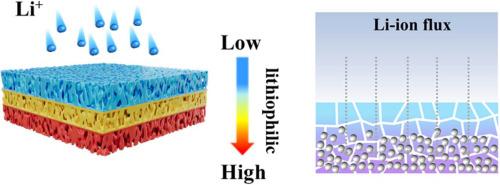
Nonuniform Li-ion gradient and electric fields in conventional host lead to uncontrollable Li top-growth behavior and Li dendrite, impeding the practical application of lithium metal anodes (LMAs). Herein, we design a 3D hierarchical flexible membrane host with gradient lithiophilic properties (GFC@PVDF) to regulate bottom-up growth of the spherical Li within host, by optimizing the electric field and Li-ion flux. The membrane networks with CNT as cores and β-PVDF as linking shells enabling fast electron transfer and low Li-ion migration energy barriers. Gradient Fe2O3 particles in the membrane by layer-by-layer bottom-up attenuating could induce Li-ion dredging and pumps towards the bottom for bottom-up deposition regime, reducing ion concentration gradient via lithiophilic gradient properties. Meanwhile, the Fe2O3 is converted into hybrid electron/ion conductor Fe/Li2O during cycling, which acts as charge decoupling and fast transport path that enhances the bottom transport of Li-ions. Consequently, stable symmetric cells over 500 cycles with Li spherical uniform deposition are obtained under an ultrahigh current density of 50 mA cm-2. The full cell paired with LiFePO4 cathode exhibits remarkable cycling stability at a low N/P ratio of 1.7. This study provides new insights into dendrite-free Li metal anodes, paving the way for high-energy, fast-charging LMAs.
常规基质中锂离子梯度和电场的不均匀性导致锂的顶生长行为和枝晶不可控,阻碍了锂金属阳极的实际应用。本文设计了一种具有梯度亲锂特性的三维分层柔性膜宿主(GFC@PVDF),通过优化电场和锂离子通量来调节宿主体内球形锂的自下而上生长。以碳纳米管为核心,β-PVDF为连接壳层的膜网络能够实现快速电子转移和低锂离子迁移能垒。膜中的梯度Fe2O3颗粒通过逐层自底向上衰减,诱导li离子疏通并向底部泵入,形成自底向上沉积机制,通过亲锂梯度特性降低离子浓度梯度。同时,Fe2O3在循环过程中转变为杂化电子/离子导体Fe/Li2O,起到电荷去耦和快速输运的作用,增强了锂离子的底输运。因此,在50 mA cm-2的超高电流密度下,在500次循环中获得了稳定的对称电池,并获得了Li球形均匀沉积。在低N/P比为1.7的情况下,与LiFePO4阴极配对的电池具有显著的循环稳定性。这项研究为无枝晶锂金属阳极提供了新的见解,为高能、快速充电的lma铺平了道路。
期刊介绍:
Energy Storage Materials is a global interdisciplinary journal dedicated to sharing scientific and technological advancements in materials and devices for advanced energy storage and related energy conversion, such as in metal-O2 batteries. The journal features comprehensive research articles, including full papers and short communications, as well as authoritative feature articles and reviews by leading experts in the field.
Energy Storage Materials covers a wide range of topics, including the synthesis, fabrication, structure, properties, performance, and technological applications of energy storage materials. Additionally, the journal explores strategies, policies, and developments in the field of energy storage materials and devices for sustainable energy.
Published papers are selected based on their scientific and technological significance, their ability to provide valuable new knowledge, and their relevance to the international research community.



 京公网安备 11010802042870号
京ICP备2023020795号-1
京公网安备 11010802042870号
京ICP备2023020795号-1

 分享
分享
 求助内容:
求助内容: 应助结果提醒方式:
 扫码关注我们
