Qiyue Jia , Hongyu Gao , Wenling Du, Jiaxin Bai, Mei Li, Jiansheng Liu, Zhanli Chai
{"title":"Plasmonic Ti3C2Tx MXene tuned by Tx moieties in 2D/2D heterojunction for boosting the photocatalytic degradation performances","authors":"Qiyue Jia , Hongyu Gao , Wenling Du, Jiaxin Bai, Mei Li, Jiansheng Liu, Zhanli Chai","doi":"10.1016/j.apsusc.2025.163062","DOIUrl":null,"url":null,"abstract":"<div><div>Expediting the separation and transfer of photogenerated carriers is crucial for plasmonic materials to improve the performance of photocatalysts. However, it remains a significant challenge to strengthen the local surface plasma resonance (LSPR) through the modulation of surface functional groups. Herein, Ti<sub>3</sub>C<sub>2</sub>T<sub>x</sub> MXene is combined with two typical semiconductor materials to form Ti<sub>3</sub>C<sub>2</sub>T<sub>x</sub>/CdS (TCS) with dominated surface O<sub>x</sub> groups and Ti<sub>3</sub>C<sub>2</sub>T<sub>x</sub>/C<sub>3</sub>N<sub>4</sub> (TCN) with surface-terminated F<sub>x</sub> species. The obtained TCS composite shows a higher photocatalytic performance (96.7 %) than TCN (86.7 %) and the corresponding bare catalysts in the degradation of tetracycline within 60 min under visible-light irradiation. Moreover, the degradation rate of Ti<sub>3</sub>C<sub>2</sub>T<sub>x</sub>/CdS composite decreases by only 2.3 % after 4 cycles photocatalytic process, which is more stable than Ti<sub>3</sub>C<sub>2</sub>T<sub>x</sub>/C<sub>3</sub>N<sub>4</sub> (3.3 %) and CdS (39.3 %). The improved photocatalytic activity and stability mainly result from the enhanced LSPR effect of Ti<sub>3</sub>C<sub>2</sub>T<sub>x</sub> MXene. In particular, the better performance of TCS compared to TCN indicates that the LSPR effect is highly related to the surface-terminated [O]/[F] ratio. These results directly provide a strategy to enhance the electric field dynamics of MXene materials for improving photocatalytic performance.</div></div>","PeriodicalId":247,"journal":{"name":"Applied Surface Science","volume":"698 ","pages":"Article 163062"},"PeriodicalIF":6.9000,"publicationDate":"2025-07-30","publicationTypes":"Journal Article","fieldsOfStudy":null,"isOpenAccess":false,"openAccessPdf":"","citationCount":"0","resultStr":null,"platform":"Semanticscholar","paperid":null,"PeriodicalName":"Applied Surface Science","FirstCategoryId":"88","ListUrlMain":"https://www.sciencedirect.com/science/article/pii/S0169433225007767","RegionNum":2,"RegionCategory":"材料科学","ArticlePicture":[],"TitleCN":null,"AbstractTextCN":null,"PMCID":null,"EPubDate":"2025/3/22 0:00:00","PubModel":"Epub","JCR":"Q2","JCRName":"CHEMISTRY, PHYSICAL","Score":null,"Total":0}
引用次数: 0
Abstract
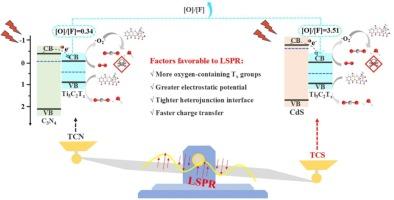
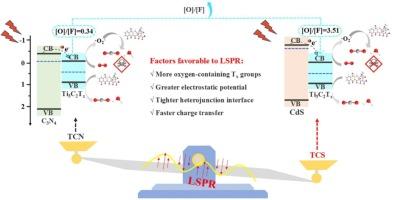
Expediting the separation and transfer of photogenerated carriers is crucial for plasmonic materials to improve the performance of photocatalysts. However, it remains a significant challenge to strengthen the local surface plasma resonance (LSPR) through the modulation of surface functional groups. Herein, Ti3C2Tx MXene is combined with two typical semiconductor materials to form Ti3C2Tx/CdS (TCS) with dominated surface Ox groups and Ti3C2Tx/C3N4 (TCN) with surface-terminated Fx species. The obtained TCS composite shows a higher photocatalytic performance (96.7 %) than TCN (86.7 %) and the corresponding bare catalysts in the degradation of tetracycline within 60 min under visible-light irradiation. Moreover, the degradation rate of Ti3C2Tx/CdS composite decreases by only 2.3 % after 4 cycles photocatalytic process, which is more stable than Ti3C2Tx/C3N4 (3.3 %) and CdS (39.3 %). The improved photocatalytic activity and stability mainly result from the enhanced LSPR effect of Ti3C2Tx MXene. In particular, the better performance of TCS compared to TCN indicates that the LSPR effect is highly related to the surface-terminated [O]/[F] ratio. These results directly provide a strategy to enhance the electric field dynamics of MXene materials for improving photocatalytic performance.
期刊介绍:
Applied Surface Science covers topics contributing to a better understanding of surfaces, interfaces, nanostructures and their applications. The journal is concerned with scientific research on the atomic and molecular level of material properties determined with specific surface analytical techniques and/or computational methods, as well as the processing of such structures.



 京公网安备 11010802042870号
京ICP备2023020795号-1
京公网安备 11010802042870号
京ICP备2023020795号-1

 分享
分享
 求助内容:
求助内容: 应助结果提醒方式:
 扫码关注我们
